

When you hear about AI, you often hear either loud predictions or long-term strategies that require large investments. It appears that this technology is primarily intended for corporations with multi-million-dollar budgets, and small companies can only observe from the sidelines. In practice, everything is simpler: even a ready-to-use tool can give real results and show an impact on ROI.
AI is no longer an experiment, but a tool that helps save time, reduce costs, and achieve goals faster. Statistics show: 72% of companies worldwide are already actively using AI for at least one business function.
Moreover, you can start today, with minimal costs and without complex integrations. This is exactly what I’m writing about in my new article.
Method #1: AI operating in the sales department
The success of modern sales depends on how accurately the team understands the needs of each customer and how quickly it responds to changes in the funnel. AI turns every interaction into data to improve the sales process. The best part is that you can start today, without investing millions.
1. Recording and decoding calls
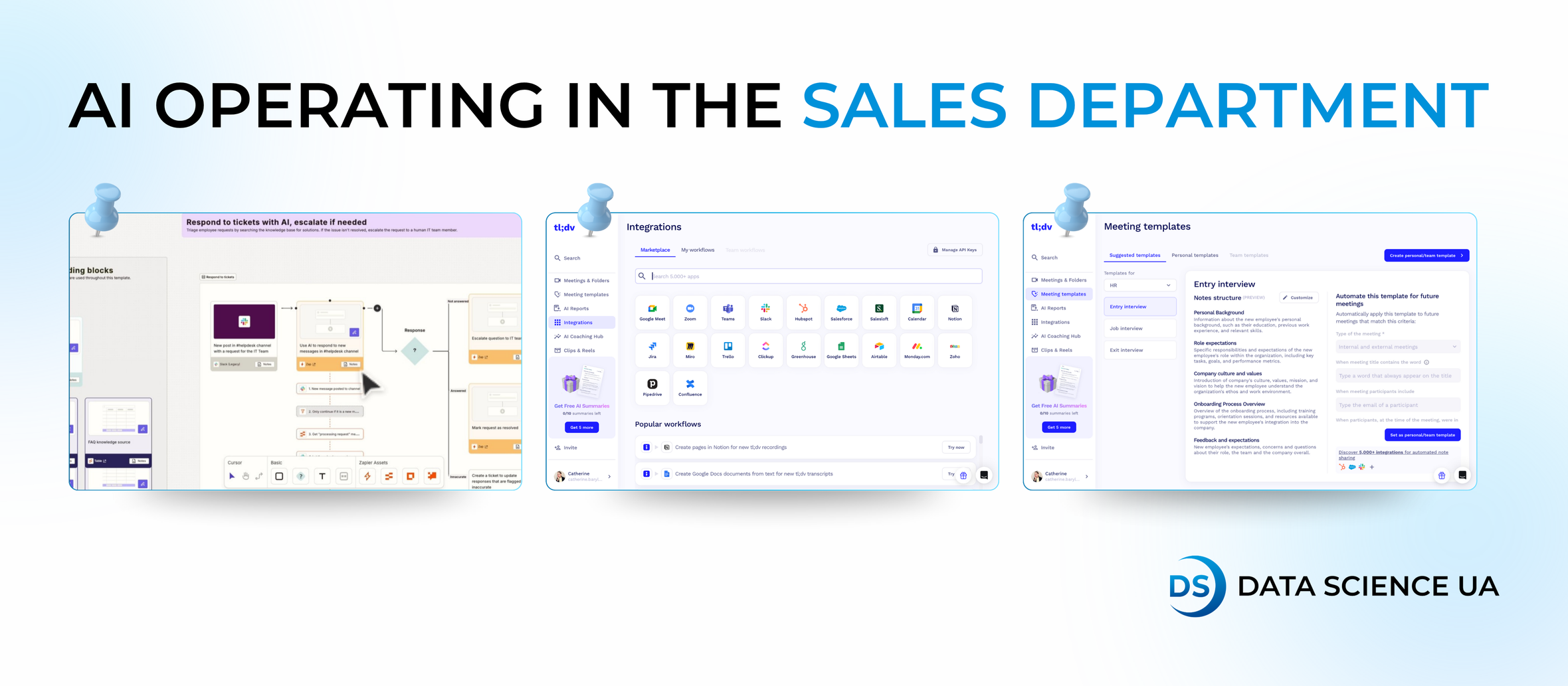
You don't have to implement expensive systems. There are already free or low-cost alternatives: tl;dv.io or Bluedot transcribes calls, highlights key points, and helps sales managers analyze which arguments work best. These tools are also handy for internal team management, as you can share best practices within the sales department more quickly through decryption.
2. CRM with AI functions
In addition to major players like HubSpot or Salesforce, there are affordable solutions: Zoho CRM or even Notion Zapier with connected AI plugins. They suggest which leads to focus on, offer follow-up, and help not lose funnel clients.
3. Integration approach
With the help of transcription, you can identify successful phrases in dialogue, and marketing can adjust advertising messages accordingly.
The real impact on ROI is a shorter deal cycle, higher conversion, and more retained customers, and most importantly, all of this is available even to small teams without huge budgets.
Method #2: Utilizing AI in content marketing
After seeing the headline, the marketing team is probably already updating the resume. However, it's too early to panic: AI doesn't come as a competitor, but as an ally. Instead of replacing specialists, technology frees them from routine, turning hours of monotonous work into minutes of effective results. Let's see what it looks like in practice:
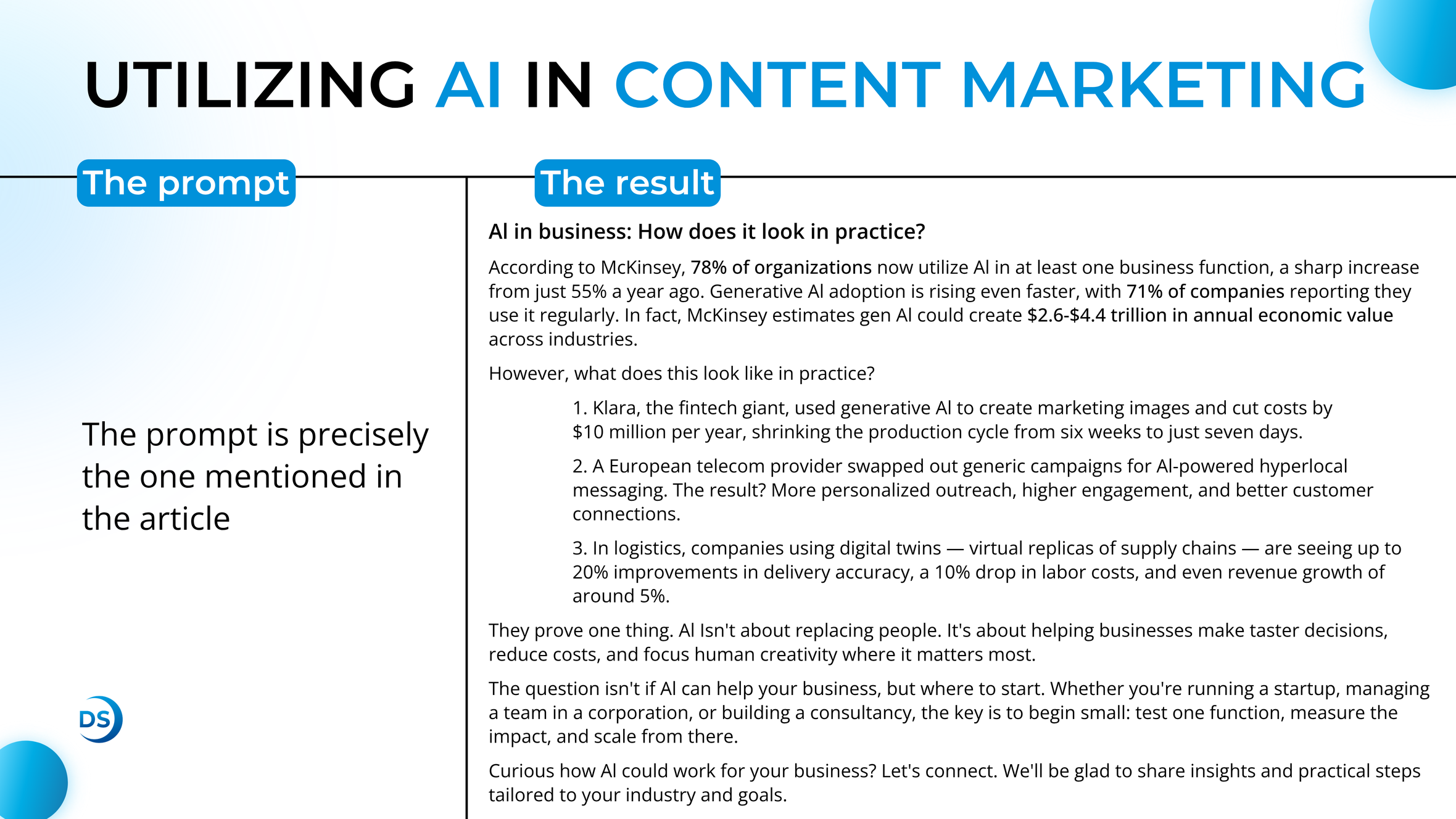
Generative model algorithms process data arrays, from articles and posts to dialogues, and create text, images, or videos based on them. The main advantage here is speed. What used to take a marketer 2–3 days (preparing Reels, a product photo shoot, writing articles) now turns into 20 minutes of working with a draft from AI. It directly affects ROI: in the same amount of time, a specialist can complete more tasks, and the company saves content production budget, minimizing the costs of photo and video shoots.
To create text using AI, you will need:
Tools: ChatGPT, Claude AI, Gemini;
How can it help you: campaigns, articles, or updates can be launched quickly, resulting in earlier customer engagement and increased revenue.
Prompt to try: Imagine that you are an experienced copywriter with 10 years of experience. Your task is to create a selling, attractive, and convincing 300-word LinkedIn post text on the “How to use AI in business” topic for my target audience, which consists of [target audience description]. Include in the text [Specify the information that needs to be included in the text], do not use such information [Specify the information that does NOT need to be used]. ToV: An easy-to-read text with a friendly style.
To create an image using AI, you will need:
Tools: Midjourney, DALL-E, Nano Banana, Pixlr, Leonardo AI;
How can it help you: No need to hire photographers or subscribe to stock image services for every project. Instead of waiting days for design drafts, AI generates mockups, ads, or social posts instantly, resulting in cost and time reductions for creating images.
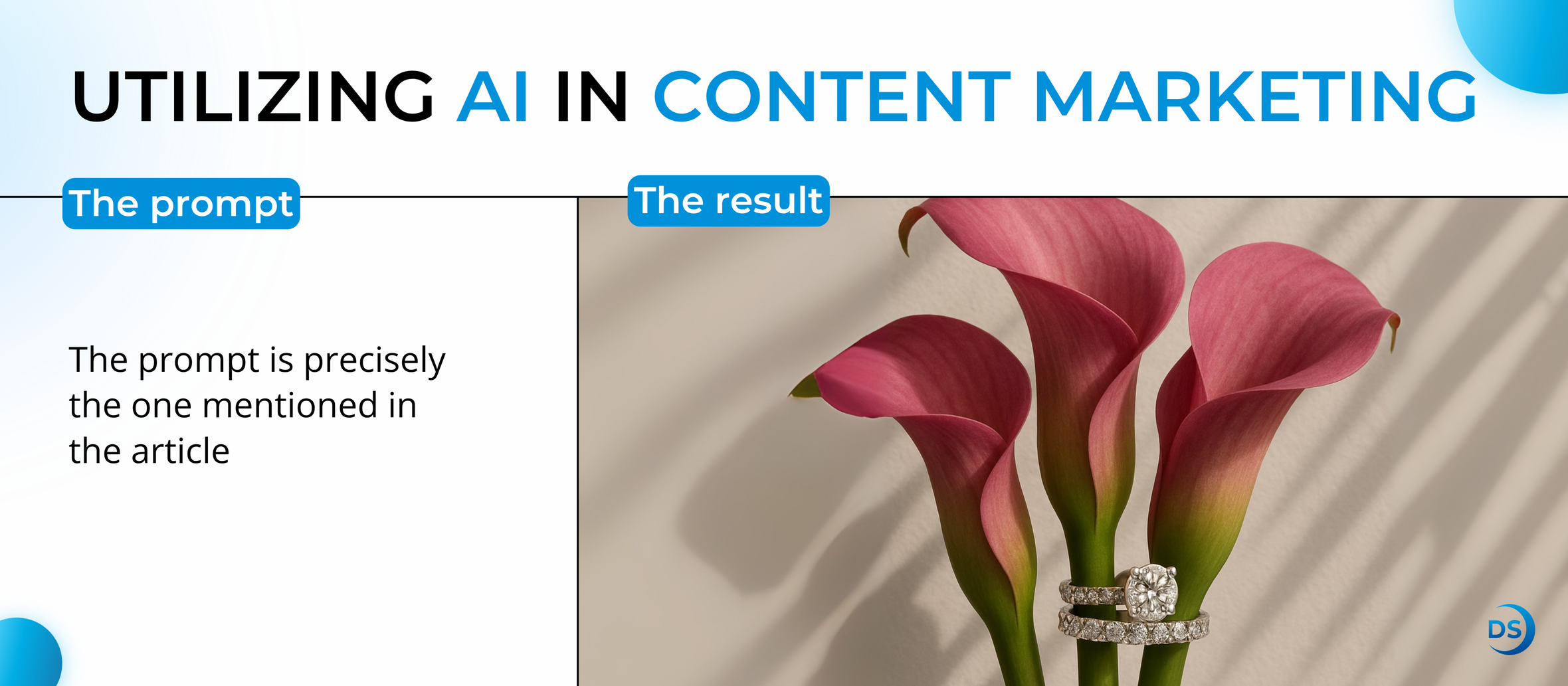
Prompt to try: Imagine you are a photographer. Generate a close-up studio photo of a single pink calla lily flower with a pair of luxurious diamond rings on its green stem, white background, soft natural lighting, high-end jewelry advertisement, ultra-realistic, macro photography style, high detail, minimalistic composition, style photographic, camera: Nikon D850, shallow depth of field --ar 4:5 --style raw --v. 6, background with shadows.
To create video materials using AI, you will need:
Tools: Runway Gen-2, Kling AI, Sora;
How can it help you: traditional video requires filming, editing, actors, and studios. AI tools create explainers, ads, or training content with virtual presenters in minutes
Prompt to try: Low-angle tracking shot: a red fox darts through a misty pine forest at dawn. The soft, golden early light filters through tall pine trunks, casting long, shifting shadows across mossy ground. Pine needles scatter under the fox’s quick steps. The camera follows closely from behind, slightly low to the ground. It captures glistening dew on spider webs, subtle movement of curl-fog wrapping around exposed roots. Atmosphere is tranquil but alive, with gentle rays of sunlight piercing mist, cool tones in shadows, warm tones in highlights. Texture-rich: bark detail, moss, needle litter. Movement is smooth, pacing brisk as a fox moves, camera tracking so the forest seems to slide by. Style: photorealistic, cinematic, soft focus in background with depth of field, high detail in the foreground. Audio ambiance: distant birds, soft rustling, faint breath of wind.
To create audio materials using AI, you will need:
Tools: Suno AI; Soundraw; AIVA, ElevenLabs (for AI text-to-speech tech)
How can it help you: no need for expensive studios or announcers; modern text-to-speech tools instantly create professional, accent-free recordings, allowing brands to localize podcasts, ads, or product explanations into multiple languages at a fraction of the cost.
Prompt to try: Create an electronic track with a medium tempo, elements of ambient-pop, and a melancholic but hopeful atmosphere. The song should feature a predominance of synthesizer pads, delicate piano melodies, and a steady electronic rhythm. Turn on atmospheric sound textures and a warm bass line with reverb that creates depth.
Structure the song as: Intro → Verse 1 → Chorus → Verse 2 → Chorus → Bridge → Final Chorus → Outro
Thematically, the composition should explore the concept of digital transformation and human adaptation to technology, a thoughtful play about finding a balance between innovation and authenticity. The mood should convey evening reflections, with elements that create emotional resonance without excessive drama.
If you want to master any of these AI tools at an advanced level, there are many courses available online. Different platforms offer detailed tutorials on advanced prompt creation techniques and professional workflows with AI-generated content, which directly impact ROI.
Instead of employees learning through trial and error, professional corporate training ensures that your team develops practical skills that solve real business problems from day one.
Method #3: AI in finance: from dull tables to smart decisions
Finance is the 'nervous system' of a company. When it comes to financial management, AI quickly evaluates records, detects anomalies, and ensures money flows are under control.
Instead of manually sorting checks and invoices, the AI understands that they are for business travel, office supplies, or payments to a supplier, and automatically categorizes them accordingly. Reports are updated in real-time, bank reconciliation happens instantly, and tax documents are prepared automatically.
You can try using ChatGPT with this prompt: “You are the chief accountant at an IT company with a $5 million annual turnover. Today is the middle of the month, and you need to urgently process the accumulated invoices from suppliers of office equipment, software, and utilities to close the month (8 invoice images attached). Extract from each invoice: the name and tax ID of the supplier, the date of issue, document number, amount without VAT, VAT amount (20%), total amount payable, currency, and a breakdown of the services/goods. Organize the data in an Excel table with separate columns for each parameter and number the rows. If the text on the image is blurred or unreadable, indicate "Data not recognized”.

If you want to build a diagram, you can try this one: “You work as a financial analyst at an investment fund specializing in tech startups. Your supervisor asked you to urgently prepare a brief analytical report on the company's financial performance for the last quarter based on the table with key metrics (image attached). Analyze the data and prepare a structured report of 300-500 words, including: a summary of the main trends, analysis of revenue and profitability dynamics, assessment of financial stability, identified risks, and growth opportunities. Use professional terminology and support your conclusions with specific numbers from the table. If any data in the table is illegible or missing, indicate this as a limitation of the analysis and do not make assumptions about the missing indicators”.
Although you shouldn't share confidential data with ChatGPT, as there's a possibility of data leakage, the secret is that there are ways to mitigate this.
AI-powered software also works like an auditor, noticing strange amounts, repeated payments, or unusual expenses. If a company suddenly starts spending 3 times more on office supplies than usual, the system will definitely report it. It monitors compliance with all rules and laws, compares expenses with the budget, and warns of overruns before they become a problem.
It's critical for ROI. When a company receives clean data quickly, it can make faster decisions about where to invest, where to optimize, and which projects to scale. There are fewer mistakes, more decisions, and thus, profits grow.
What can be used right now:
- ChatGPT or Gemini for analyzing transactions and finding optimization points;
- Kasisto and Gupshup for AI analytics;
- ForwardLane to detect anomalies, analyze markets, and the targeted audience.
Method #4: How AI operates in HR: Less routine = more ROI
To be honest, HR generalists and recruiters always face the same challenge: they want to work more with people, but most of the day is spent on endless routine. Resumes, letters, and responses to the same questions all eat up time and energy. This is where AI comes in.
Search tools like SeekOut find suitable specialists on LinkedIn and even among “passive” candidates who are not actively looking for a job. When it comes to interviews, AI assistants (Paradox.ai, X.ai) pick convenient slots and send reminders, taking away dozens of emails and calls from recruiters.
In communicating with candidates, chatbots like Tidio help by answering common questions such as “what are the stages of the selection process?”, “what is the social package?”, or “how many interview stages are there?”. It saves HR hours and speeds up communication, while candidates receive quick responses and feel engaged.
Already after hiring, AI works on retention and adaptation. Cody and Leena AI turn into internal assistants that answer employee questions about vacations, insurance, or certificates. ChatGPT or Canva Magic Write help HR create internal letters, presentations, and documents in just a few minutes. Platforms like CultureAmp or Lattice analyze survey results and identify hidden risks of burnout or dissatisfaction.
Why is this important, specifically for ROI? It's simple: every extra minute on repetitive tasks costs the company money. Automation allows HR to fill vacancies faster, adapt employees more cheaply, and reduce recruitment costs.
What you can try right now (and for free):
Take ChatGPT or Claude AI to avoid scrolling through resumes manually: AI will highlight skills and compare them to job requirements.
Connect chatbot like Tidio so that candidates receive answers to basic questions immediately, not in 2 days.
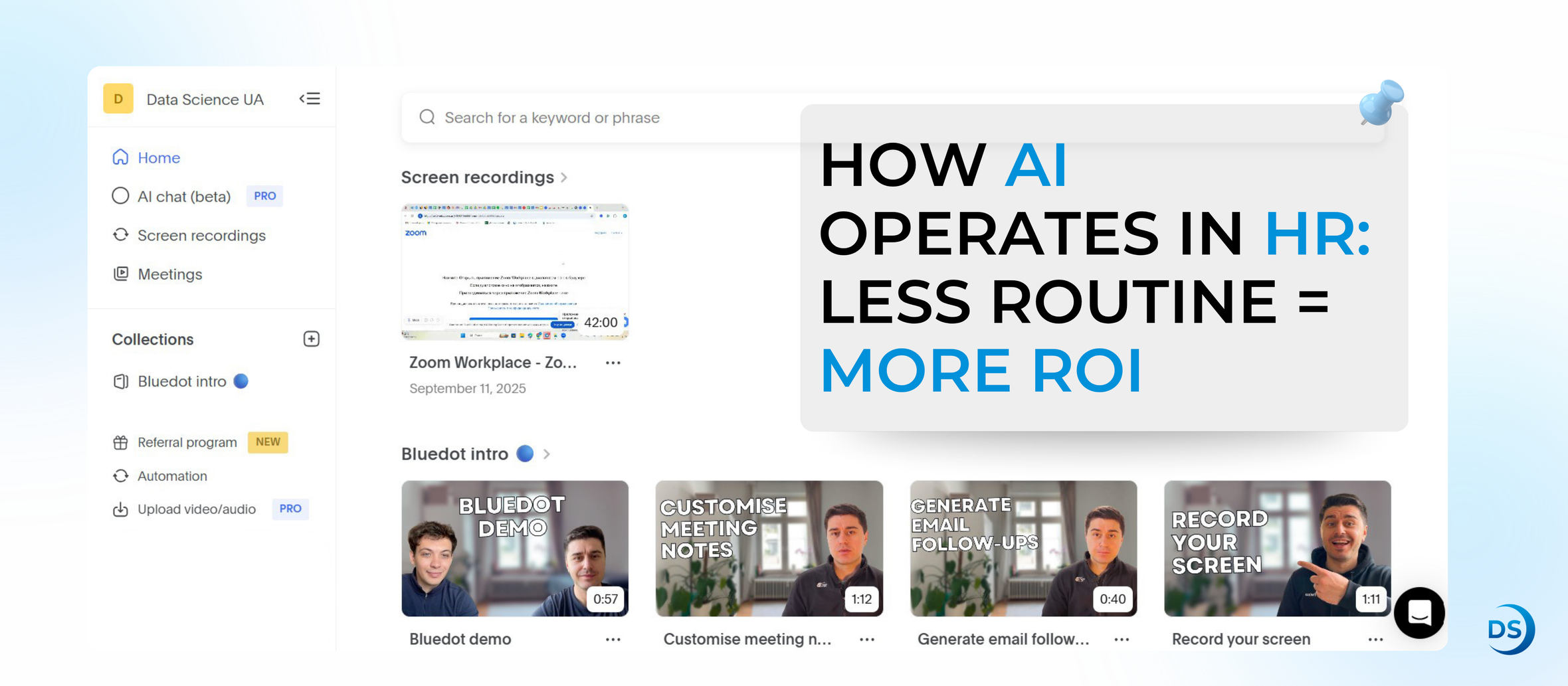
Use BlueDot for call recording, transcription, and summarization tools to make sure no important details about candidates or employees get lost.
Use Canva Magic Write when you need to put together a presentation.
By the way, if you have an HR team and want to bring your processes to a more systematic, serious level, there are already ready-made solutions, but they won’t work effectively if you rely on just one specialist.
Ready-made tools cover basic tasks, but when a company really wants to increase ROI, it makes sense to develop its own AI assistant. Why? Because an individual solution does exactly what your processes need:
Automates routine HR or finance tasks completely, from resume review to report preparation, without constant manual corrections.
It integrates with existing systems (CRM, ERP, HRIS) so that AI isn’t a separate application, but a part of daily work processes.
Analyzes and predicts trends in data: risks of layoffs, budget overruns, revenue forecasts, and provides management with quick insights for decision-making.
Developing such AI solutions is what companies like Data Science UA do.
Method #5: AI Analytics and forecasts
Collecting data from CRM is only half the job. It’s important to understand what they mean and which actions to take. Previously, entire analytical departments were needed for this, but now tools with AI modules are enough.
AI can help you there: start by connecting existing data sources, CRM, sales systems, advertising platforms, and warehouse management systems to an AI analytics platform like Tableau AI with Einstein Copilot.
It offers simple integrations that don't require technical expertise. Start with one specific use case, such as sales forecasting or customer behavior analysis, instead of trying to analyze everything at once.
Set up automated dashboards that track your key metrics and let AI identify patterns you might miss. For example, if you're in retail, set up a system to analyze seasonal trends, buying patterns, and inventory turnover. AI will start studying the patterns of your business within a few weeks of data collection.
What is already real right now:
Demand forecasting: Data Science UA has already developed such an AI solution for a major Ukrainian retailer, Eva. We used AI to analyze sales and seasonal trends. The system predicts peak demand and helps optimize purchases. As a result, the new recommender engine increased the average basket size by 0.4 items.
Market trend prediction: Tableau AI with Einstein Copilot will tell you where exactly your company is losing effectiveness, where to cut the budget, and where to increase it. It allows you to respond to market changes in time, rather than chasing competitors.
P.S.: BONUS method #6
All of the previous methods are useful if you want to quickly test the capabilities of AI and see the first results tomorrow: reduce the time needed to prepare content, speed up customer responses, or get analytics that were previously unavailable. If you're just discovering AI and want to experience what results it can produce, these solutions are perfect for you.
However, when a company reaches a new level and the tasks become more complex, there are fewer simple solutions. A systematic approach is needed: it is necessary not only to implement individual AI tools, but also to form internal expertise, so that the integration of AI becomes part of the corporate strategy.
Many organizations face a paradox: access to powerful AI tools exists, but understanding how to derive real value from them does not. Teams are experimenting with ChatGPT and testing automation platforms, but these attempts often remain disjointed experiments that don't yield measurable results.
A key difference between successful companies is that they invest in developing the AI competencies of their employees. Instead of chaotic attempts, the team learns to create prompts that truly save time, build automation that solves real business problems, and analyze the impact of AI on key performance indicators.
ROI from a systematic approach to AI is comprised of 4 main factors:
1) Eliminating “dead” costs: companies spend an average of $5,000-15,000 per month on AI tools, but only use 20% of their capabilities. A systematic approach allows these expenses to be recouped.
2) Personnel savings: an AI-trained employee replaces 2-3 regular specialists, resulting in significant annual savings for each position.
3) Increased revenue: Automation of personalization and analytics increases conversion, which means an additional $200,000-500,000 per year for businesses.
4) Loss prevention: misuse of AI can cost a company 10-30% of customers due to poor customer experience, resulting in losses of hundreds of thousands of dollars.
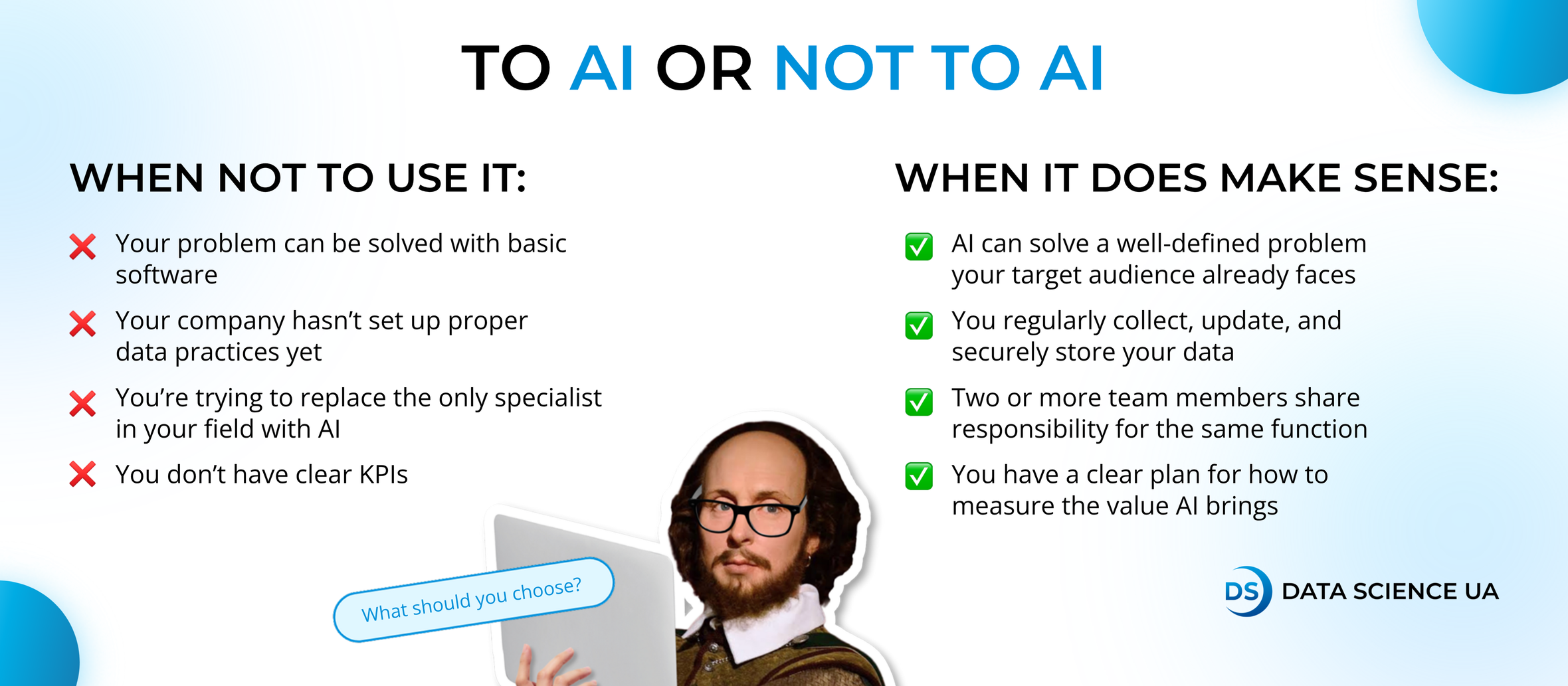
P.P.S: What should you choose?
It’s important to understand: there is no universal recipe for which tool is right for your company. For some, the first step will be a chatbot that will take the burden off support, for others, feedback analysis or e-mail automation, and for others, a pilot in content generation.
The key here is to start with testing, measuring, looking at ROI, and gradually moving from point-to-point solutions to the systematic use of AI.
That's when technology ceases to be a “fashionable toy” and turns into a real growth driver.