
Ranking #1 for "crypto license" doesn't mean clients: how to market a law firm after MiCA

When a law firm shows me a number one ranking for "crypto license", I ask for the next report: who got in touch, with what business, for which market, and which matters the team took on. The ranking explains only part of the path. Between it and a signed contract sit the searcher's intent, how current the service is, trust in the lawyer and the way enquiries are qualified.
Below I go through where enquiries get lost along that path and how to check it on your own data. I'm a marketer and I don't practise law. The regulatory dates come from ESMA and were checked on 26 November 2026. Which regime applies to a particular business is for a qualified lawyer to say.
One term first. An SQL (sales-qualified lead) here is an enquiry that the person responsible for sales has checked against agreed criteria and accepted. A submitted form, a downloaded document or a booked call doesn't become an SQL by itself.
What "we rank first" means
The first question to put to a ranking screenshot: in which country, in what language, on what device, and when was it taken? On 26 November I ran the query "crypto license" on Google in English with three country settings. In the US the first organic result belonged to New York State's financial regulator. In Germany it was a licensing consultancy. In Lithuania it was the Bank of Lithuania. In all three, Google's AI Overview sat above the organic results. These are three snapshots from my own browser, each taken once, so they show the spread and say nothing about stability. Even so, "number one" with no country and no date tells you little.
The second question is what people mean by the query. The same day, Google's autocomplete for "crypto license" (English, US) offered Pakistan, Dubai, India, UAE, South Africa, Czech Republic, Malaysia, Poland and "license plate", the kind on a car. For "crypto license for", the first suggestion was "for sale". For "crypto license lawyer" there were no suggestions at all. Autocomplete shows how people phrase things and nothing about volume. Here eight of nine phrasings are about a country and none is about a lawyer.
Third, the position in Search Console is an average across a period, countries and devices, while a results snapshot shows one moment. They are different numbers, and a report should label which is which.
A high ranking is still a useful intermediate measure, though it doesn't stand in for sales.
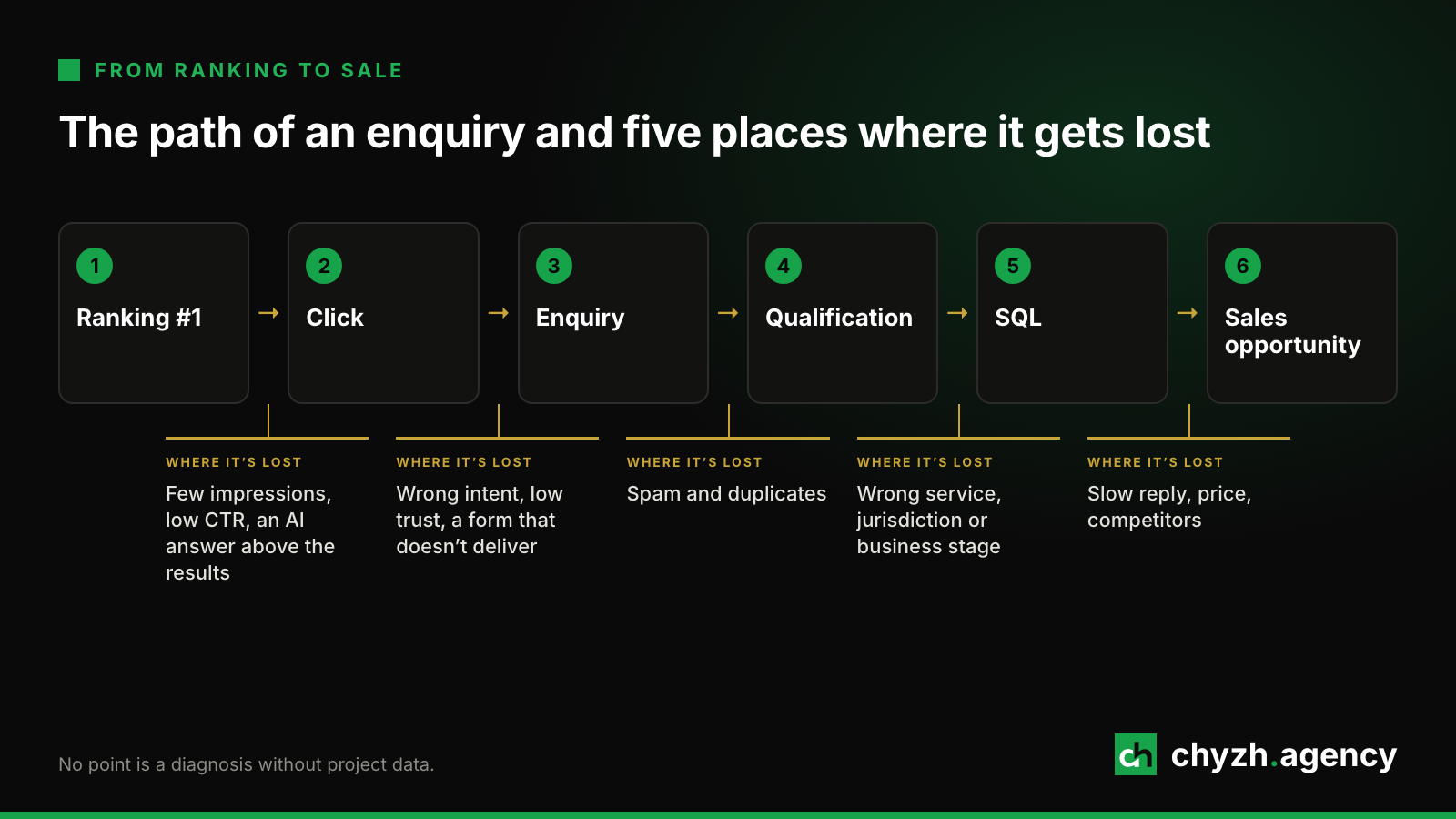
Where enquiries get lost: five different problems
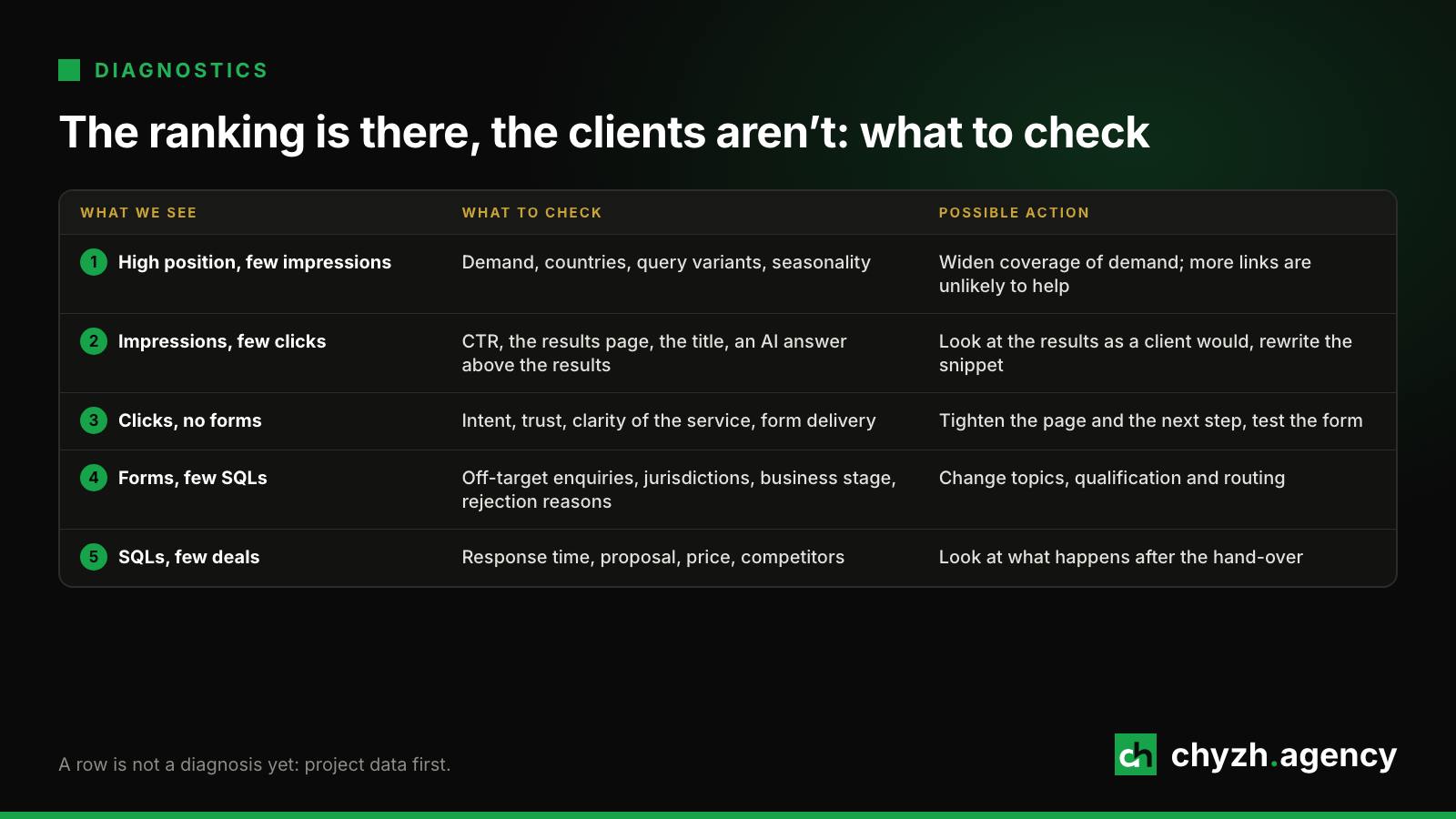
When the ranking is there and the clients aren't, the cause can sit in five different places. Each is checked with its own data.
- High position, few impressions. Check demand, countries, query variants and seasonality. Possible action: widen your coverage of demand. More links are unlikely to help here.
- Impressions, few clicks. Check CTR, what else is on the results page, the page title and whether an AI answer sits above the results. Possible action: look at the results page as a client would and rewrite what the snippet promises.
- Clicks, no forms. Check visitor intent, trust in the page, how clear the service is and whether the form delivers messages at all. Possible action: tighten the page and the next step, and test delivery.
- Forms, few SQLs. Check the share of off-target enquiries, jurisdictions, business stage and rejection reasons. Possible action: change topics, qualification and routing.
- SQLs, few deals. Check response time, the proposal, price and competitors. Possible action: look at what happens after the hand-over. SEO probably has little to do with this one.
None of these lines is a diagnosis yet. A drop in CTR doesn't prove by itself that AI Overviews took the clicks. A change in regulation doesn't prove by itself that demand fell. Project data first, conclusion second.
How MiCA changed the legal context of service pages
Three facts as of 26 November 2026:
- MiCA has applied since 30 December 2024. Titles III and IV, on asset-referenced tokens (ARTs) and e-money tokens (EMTs), have applied since 30 June 2024 (ESMA, Article 149).
- The transitional period for providers that operated under national rules ended on 1 July 2026 at the latest, and member states could shorten it (ESMA statement of 23 June 2026).
- Crypto-assets that qualify as financial instruments are excluded from MiCA (ESMA, Article 2). Tokenization doesn't make MiCA apply automatically.
For content, several things follow.
- A page that urges readers in late 2026 to "get ready before MiCA" describes the past as the future.
- A historical VASP registration and the current route to providing crypto services in the EU are different things. VASP is still a live term in other jurisdictions and in AML rules, so deleting it everywhere would be a mistake.
- Registration, authorisation and notification are different routes. Which one applies to a given entity is for a lawyer to confirm. Reducing all of it to "buy a licence" misleads the reader.
- In place of "cheap and fast", the page explains who the service suits, what the team handles, what the limits are and what is needed for a first assessment.
- MiCA is an EU regime. The UK, the US and the UAE have their own, and a copied description doesn't carry over.
I make no claims such as "MiCA shrank the market by so many per cent" or "nobody searches for crypto license any more". I have no data for them.
Rebuilding demand: from a broad query to a real task
I keep the broad query in the plan and don't build the whole strategy around it. I split demand into four groups of intent. The queries below are examples, and I attach no volume or conversion figures to them.
- Choosing a jurisdiction. Example: "MiCA jurisdiction comparison". Next: a comparison of criteria, then the page for the relevant jurisdiction.
- Legal launch. Example: "CASP authorisation legal support Lithuania". Next: the specific service and the lawyer responsible.
- Classifying the business model. Example: "does tokenization fall under MiCA". Next: an explanation of the boundaries and a legal assessment.
- Supporting an operating business. Example: "MiCA ongoing compliance legal support". Next: the support service and a scoping conversation.
The route runs: country or market, business model, regulatory task, service, lawyer, qualified conversation. It isn't linear, and a client may start by choosing a firm. Two limits apply. A firm promotes only the services it can deliver. And a narrow query doesn't necessarily convert better than a broad one: that is a hypothesis to test on enquiries.
What a page that prepares an SQL needs
- Which business and task the service is for, and who it doesn't suit.
- The jurisdiction and the team's real ability to work there: its own specialist or a named local partner. No invented offices or admissions.
- Scope of work, what the first consultation produces, exclusions and dependencies.
- A named lawyer with qualifications that can be checked, and the languages they consult in.
- The date of legal review, primary sources and relevant evidence of experience.
- A clear next step, such as a first conversation to assess the task. The form doesn't promise a full legal opinion.
The pages join into a cluster: practice, services, jurisdiction pages that earn their place, articles on documents, classification and choice, and lawyer biographies. Links in the text take the reader to the service they need. For language versions I separate three things: the visitor's country, the jurisdiction of the service and the language. Legal facts live in one register, and translations are updated with it. I wouldn't create ten pages that differ only in the country name.
Where GEO fits, and why a mention in an AI answer isn't a sale
GEO stands for generative engine optimisation: visibility in generative search systems. It has nothing to do with geography.
AI answers are already one of the places where a client finds out about a firm and checks options. On 26 November we put six client questions about crypto licensing to four systems: ChatGPT, Perplexity, AI Overviews and AI Mode. Of the 24 answers, 13 had a law firm's site among their sources and 11 had none. Regulators were a source in 15 answers, directories and rankings in 14, licensing consultancies also in 14. On the question about choosing a firm, all four systems cited at least one directory or ranking. This was one run on one day, so I treat it as an observation: for a place among the sources, a law firm competes with the regulator, the directory and the consultancy.
What to do about it. Check which sources the systems cite for your target questions. Keep your own explanations current and checkable. Appear in real industry publications. Bought "independent" rankings are not part of this.
I count four events separately: a page being cited, the brand being mentioned, the firm being recommended, and an SQL. One doesn't turn into the next automatically. Google asks for no special markup for AI Overviews or AI Mode: a page has to be indexed and eligible to be shown with a snippet (Google Search Central). And without observations and data from the project in question, I won't name AI as the reason a firm lost leads.
Agreeing with sales on what counts as an SQL
Here is a working model I'd start from. I don't think a universal standard exists.
- Behind the enquiry is a real organisation or founder with a specific business model. Spam, job applications and personal investment questions are filtered out.
- The task matches a service and the jurisdictions the firm covers.
- There is contact with someone who can arrange a decision or the next substantive conversation. It needn't be the final signatory.
- The need, the stage and an approximate timeline are agreed.
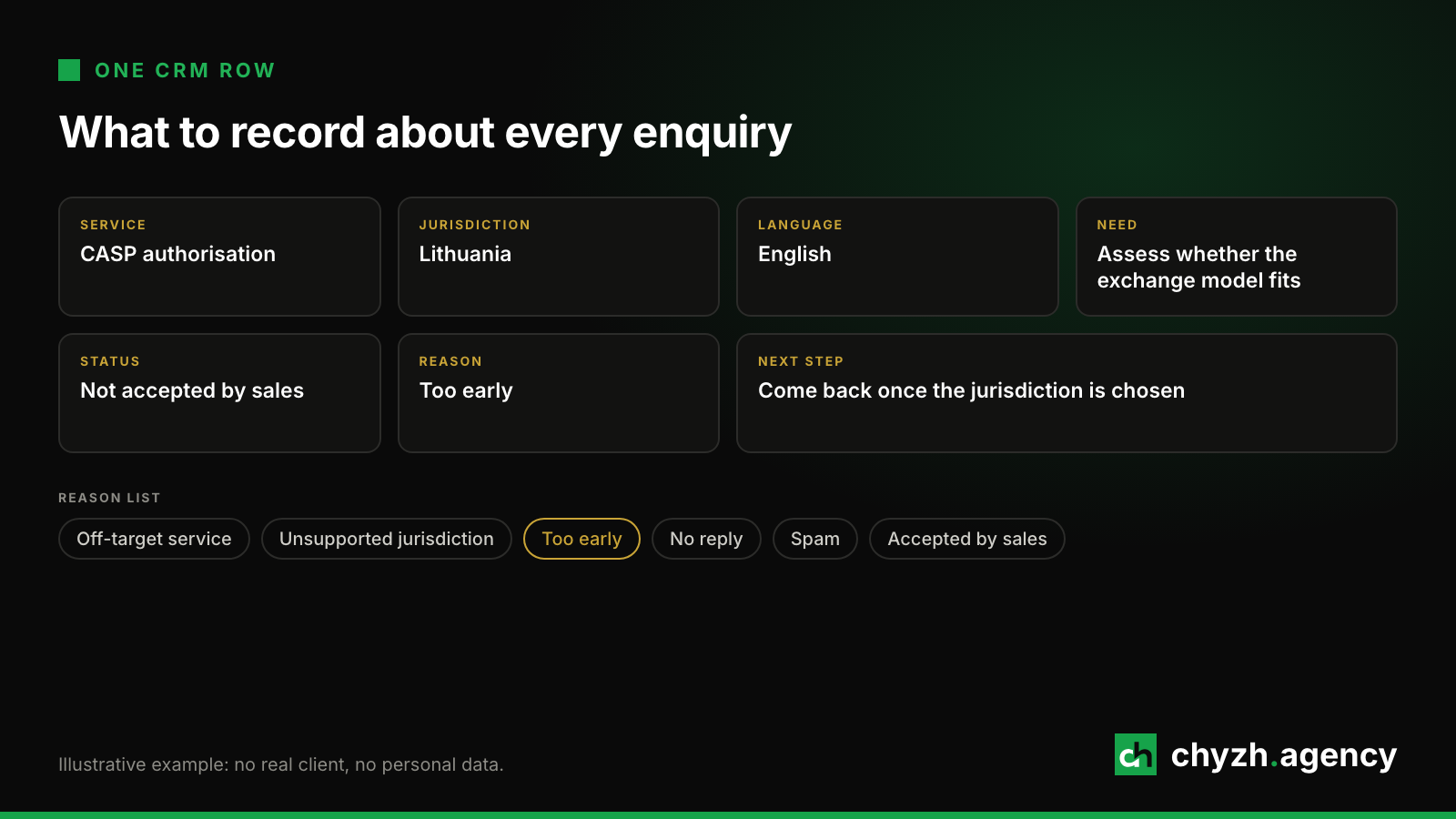
- The person responsible for sales has accepted the enquiry and recorded the next step in the CRM.
The first form is short: contact, company or website, business model, market, a few words about the task. The rest comes out in conversation. An open form doesn't ask for passports, KYC documents or anything else confidential. And marketing qualification doesn't replace the firm's legal client-acceptance checks.
Reasons are recorded from one fixed list: off-target service, unsupported jurisdiction, too early, no reply, spam, accepted by sales. "Too early" usually means come back later, so the record stays.
The report to ask for in place of one ranking screenshot
The chain in the report: visibility, clicks, unique enquiries, SQLs, sales opportunities, deals. I ask for three measures with an explicit denominator.
- SQL share = SQLs accepted by sales / unique valid enquiries × 100%. Spam and duplicates are shown on a separate line.
- Cost per SQL = agreed acquisition costs / number of SQLs. What goes into the costs is disclosed: work, content, placements. With zero SQLs the measure is "not calculated". A cost of zero doesn't exist.
- SQL to opportunity = SQLs with an opportunity created / SQLs in the same group × 100%. An opportunity is a specific project with a next step. An SQL isn't a deal yet.
I compare like-for-like groups by date of first enquiry and give sales time to mature, because the legal sales cycle is long. Segments: service, jurisdiction, language, first landing page. I keep source and UTM data where that is technically possible and lawful, and add the question "how did you hear about us?". The answer "from ChatGPT" is a separate piece of evidence and doesn't give full attribution. Search Console, for its part, can't reliably tie a specific search query to a specific SQL.
Where I'd start: a 90-day rebuild
- Days 1-15. Agree the SQL definition with sales. Test form delivery. Bring Search Console, analytics and the CRM together. Go through the last 30-50 enquiries by hand, and if there are fewer, record the real number.
- Days 16-30. Pick one or two services and markets by competence and business sense. Check the legal facts. Draw the map of intents and content.
- Days 31-60. Update landing pages, language versions, links to lawyers and the form. Publish the explanations that are missing. Start external publications.
- Days 61-90. Compare visibility, enquiries and rejection reasons. Repeat the AI answer measurements. Adjust topics and lead hand-over.
Ninety days here is an organisational horizon. I don't promise payback or an SEO result in that time: with a long sales cycle, day ninety shows early signals, and closed deals may not be there yet.
If you market a crypto law practice, I'd start by checking one route: which businesses come in, what task they have and why sales accepts or rejects the enquiry. At CHYZH we help connect that route with SEO, GEO and content for specific markets: SEO and GEO for specialist law firms.
Our observations, all from 26 November 2026: three Google results snapshots for "crypto license" (English; US, Germany, Lithuania); Google autocomplete (English, US); six client questions in four AI systems, 24 answers, one run, source types sorted by our team.
By Yevhenii Chyzh, founder of Chyzh Agency.