

Video editing is not a technical add-on. What is it then? Behavioral engineering in disguise of timeline management. On one hand, cameras may record reality but on the other hand, it is the editing that determines what the reality is. When branding is organized perception, then the control mechanism is editing.
The three variables of operation that can be used to define how a video reinforces or silently undermines a brand are the tempo, tone and trust.
Let’s dissect them properly.
Tempo: The Mathematics of Attention
Tempo is rhythm. Not music rhythm. Cognitive rhythm.
It is the pace of information flow, of making cuts, of transiting and of letting shots breathe. Mankind processes visual information in patterns. In cases where tempo is edited in line with cognitive expectation, the brain rests. When it collides, the attention breaks.
Vitality is expressed, freshness is expressed, and the speed of tempo conveys urgency. Think tech startups, product launches, fintech dashboards flying in with aggressive motion. Slow tempo communicates authority, heritage, luxury. Long takes, deliberate pauses, restrained movement. Luckily, there are plenty of apps out there that can help. Clideo, for one. It lets you edit and compress video content, add subtitles, etc., which is perfect for a small business.
The mistake? A lot of brands mimic platform tempo rather than brand tempo.
Social media in short form has trained viewers to look at fast cuts 1-2 seconds long. That does not mean your law firm, medical platform, or institutional finance product should edit like a caffeine overdose.
The tempo must be brand-consistent. When your brand declares to be stable, only to edit your posts like a nervous TikTok reel, the contradiction is subconsciously perceived. It may not be expressed by the viewers, but they experience it.
Good tempo answers:
- How long does information need to land?
- How much cognitive load can the viewer process?
- What emotional state are we inducing?
Bad tempo screams:
- We’re afraid you’ll scroll.
- We don’t trust our own content.
And that is where tempo starts bleeding into trust.
Tone: The Emotional Signature
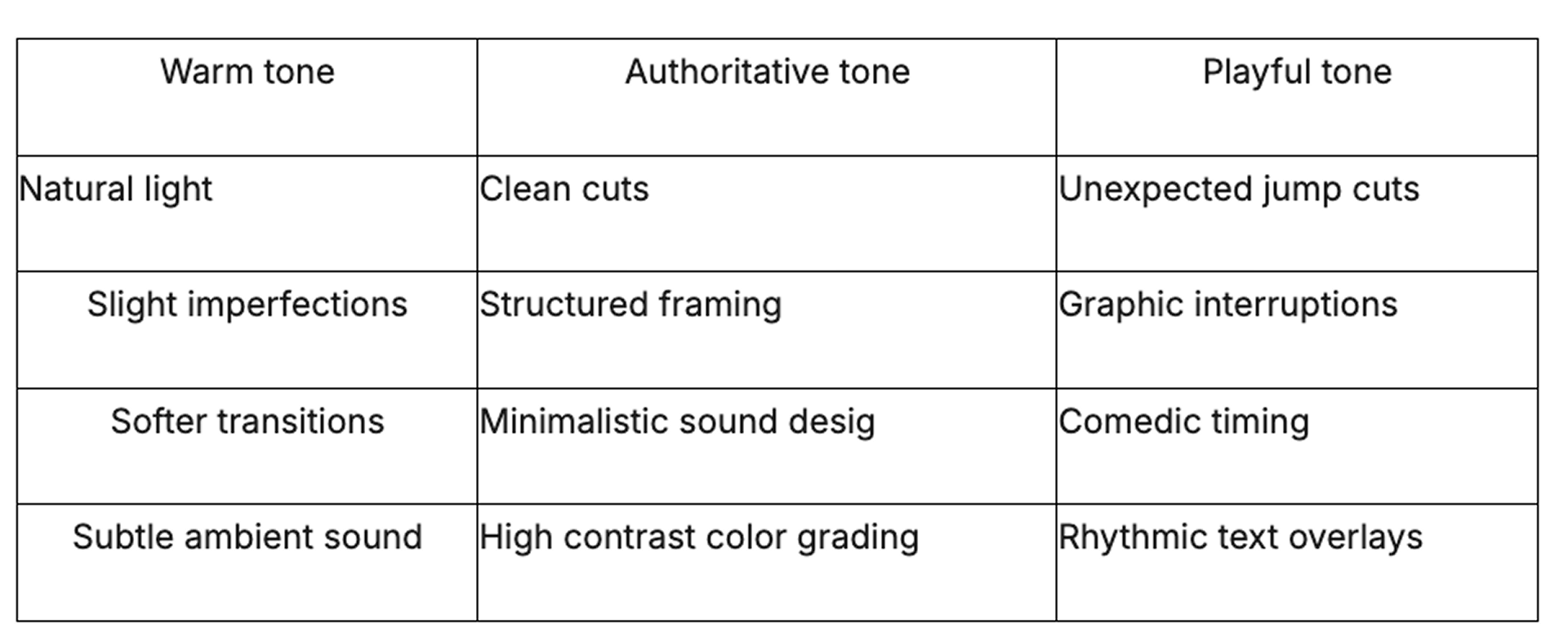
Color grading is not the only form of tone in editing. It is the emotional framing created by means of pacing, sound design, choice of shots, typography, silence, and sequencing.
A brand can say, “We are human.” However, once the edit is cold, sterile, devoid of breathing space, the message dies.
Tone lives in micro-decisions:
- Do we cut before or after the speaker finishes a sentence?
- Do we leave in the imperfect smile?
- Do we hold eye contact for an extra half second?
Those are not accidents. Those are tone choices.
One of the quickest methods of undermining brand identity is tone variance between campaigns. When your site is high-class, and your video is messy then there is a psychological incongruency in what your audience perceives.
Tone is cumulative. Each edit brings an addition to the brand architectural perception of the long term. And there is the unpleasant fact that tone is usually lost in committee criticism.
Can we make it more dynamic? Can we make it more emotional? Can we make it more corporate? A combination of those three requests normally yields something that is confusing on an emotional level.
Trust: The Invisible Metric
Trust is the outcome variable. Tempo and tone are the inputs.
It takes the viewers a matter of seconds to determine the credibility of a video. Not based on resolution. Not based on budget. Based on coherence.
Trust increases when:
- Editing pace matches subject matter.
- There is consistency in visual language.
- Cuts feel intentional rather than reactive.
- Transitions are used to provide narrative clarity.
Trust decreases when:
- Stock footage is inconsistent with reality.
- Excessive editing is an indication of insecurity.
- Minor assertions are overstated by dramatic music.
- Jump cuts conceal discomfort of the script.
The graphic analog of overexplaining is over-editing. It implies nervousness. Silence, however, means confidence.
When a CEO naturally pauses and the editor does not want to cut all his breaths, the viewers perceive authenticity. Removing every microsecond of quiet surgically automatically makes the result rehearsed- even when the words are truthful.
Trust is also technical consistency. Inconsistent audio levels, abrupt transitions, mismatched color temperatures. All degrade credibility. Not consciously, but perceptually. And perception is brand.
The Interaction Effect
Tempo without tone becomes mechanical. Tone without tempo becomes indulgent. Without trust it makes no difference. Imagine a healthcare brand using frantic editing. Although the images may be gorgeous, the rhythm goes against the promise of stability and care. Imagine a fintech platform with soft, sentimental editing. It can be human- but not always competent.
Editing must reflect strategic positioning.
Many brands overestimate pre-production and underestimate post-production at this stage. They spend a lot of money on shooting, scripting, art direction, and then regard editing as squeezing and cost-cutting. Editing is not trimming. It is alignment.
Practical Calibration
Before editing begins, three questions should be answered clearly:
- What emotional state should the viewer leave with?
- What tempo matches our positioning?
- What would undermine credibility for our audience?
If those are undefined, editing becomes reactive instead of intentional. Brand-consistent editing systems can even be documented:
- Standard cut lengths
- Approved color grading presets
- Typography motion rules
- Audio treatment standards
That turns editing from artistic improvisation into structured brand governance.
Humor Break (Because We’re Human)
If your brand claims to be “premium” but your edit includes:
- Five stock handshake clips
- A dramatic whoosh transition every 3 seconds
- Background music that sounds like an elevator trying to feel ambitious
We need to talk. And gently. Very gently. Video editing is often mistaken for software proficiency. In reality, it is strategic choreography. Tempo regulates cognitive comfort. Tone encodes emotional meaning. Trust determines whether the message survives scrutiny.
When the three align, editing disappears. The viewer does not notice cuts, color grading, or transitions. They notice clarity. They feel coherence. And coherence is brand strength in motion.
If branding defines how you are remembered, editing defines how you are experienced. That’s not post-production. That’s perception engineering.