

This autumn we went through our own agency site's data to see what AI Overviews had cost us in clicks. Before we got to that number, we found four ways our own data had misled us.
The site is Ukrainian-language, so these are lessons about measurement, not figures for the US market.
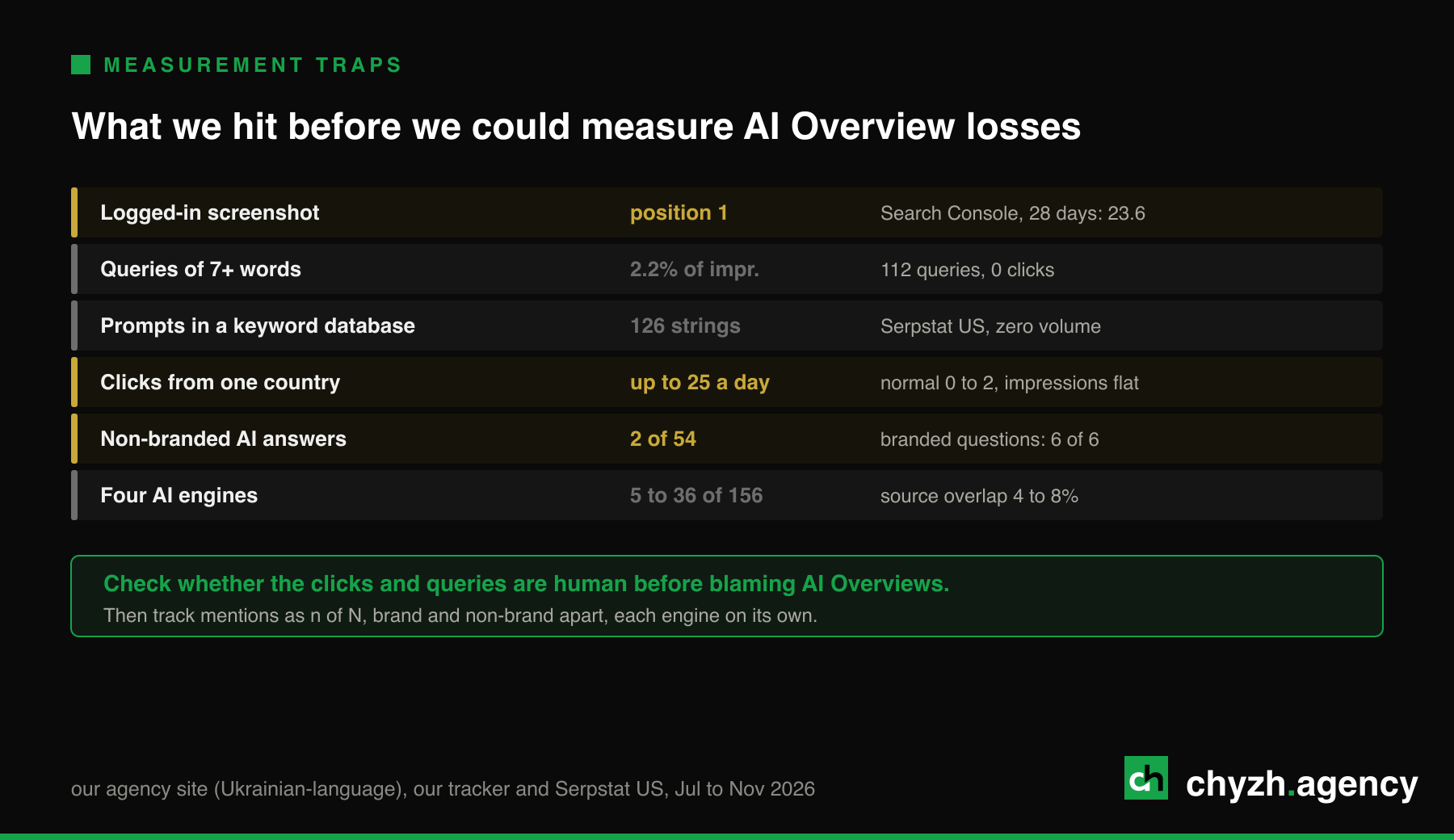
A screenshot put us first. Search Console said 23.6
On 12 November 2026 a Google search in a logged-in Chrome session showed our site in first place for one query. Search Console's average position for the same query over the previous 28 days was 23.6.
A personalized screenshot is the cheapest evidence there is and the most forwarded. We now take positions from Search Console only, and snapshots logged out, on several days.
We also saw rows with position 1.0 and zero clicks. They might be links sitting inside an AI Overview, but that's a hypothesis we're still checking, not a rule for a report.
Queries no person typed
Our Search Console had 112 queries of seven or more words between 19 July and 17 October 2026. Together they took 2.2% of impressions and got 0 clicks. At ten or more words there were 28 queries, 0.3% of impressions and, again, 0 clicks.
They read like prompts, not searches. Whoever sends them, they add impressions and no clicks, so CTR falls with nothing real lost. We filter them out before comparing periods.
Keyword databases carry the same noise. On 19 November 2026 our US pull from Serpstat for this topic had 126 zero-volume "keywords" that read like tracker prompts, such as "best ai overviews rank tracker my location is usa". We can't say where they came from, only that they'd land in anyone's keyword list.
Bot clicks that looked like growth
From 2 to 5 November 2026, clicks from one country ran at 25, 15, 20, then 15 a day. The normal level there is 0 to 2. Impressions didn't move. Pages ranking 12th to 56th were getting almost one click per impression, and people don't click like that.
That was about 75 clicks, roughly 29% of the site's 261 clicks from 1 October to 9 November. If a fake spike can pass for growth, its end can pass for an AI Overview loss. So we split any change in clicks by country and position and read impressions next to it.
Brand questions hide the real picture
We asked three AI systems 18 questions that didn't mention our name on 12 November, which gave 54 answers. We were named in 2 of them, and ChatGPT named us in 0 of 18. Branded questions named us in 6 of 6 answers.
Mix the two and the total looks healthy while meaning very little. Branded and non-branded questions go in separate rows, each with its own denominator.
Four engines, four different answers
We ran 78 prompts through four AI engines on 23 and 26 October (two runs, 624 answers).
- Gemini: named us in 36 of 156 answers
- Perplexity: named us in 27 of 156 answers
- ChatGPT: named us in 5 of 156 answers
- Google AI Mode: named us in 5 of 156 answers
On the same question, the engines' source domains overlapped by 4 to 8% on average. Between runs the yes-or-no verdict held for 73 to 77 of 78 prompts, but ChatGPT and AI Mode sources overlapped only 27 to 29%. AI Mode seems to behave like its own surface, separate from AI Overviews and from ChatGPT, so we measure each one on its own.
Being in the AI Overview has levels
In our published AP University case (Ukraine), over 16 months to 31 August 2026 the site had 242K impressions, 3.65K clicks, a 1.5% CTR and an average position of 12.1. In August 2026 the AI Overview named the university in its answer text for "online university" and "distance higher education". For "admission without NMT" in September, the site was linked in the answer body and as a source card, with no brand name in the text. The case lists 134 clicks for that query.
A brand name in the answer text and a source card are different results. A report that counts both as one "citation" loses that.
What we track instead of clicks alone
- Clicks and impressions by country and position. Shows whether a change is human at all. Limit: says nothing about the cause.
- CTR without queries of 7+ words. Shows the CTR change people actually caused. Limit: the cut-off is our own convention.
- Average position from Search Console, 28 days. Shows where we really rank. Limit: an average hides SERP features.
- AI impressions from the Generative AI report. Shows how often we show in AI features. Limit: no clicks, never added to totals.
- Mentions as n of N, brand and non-brand apart. Shows AI visibility with a denominator. Limit: one run is not a frequency.
- Each AI engine separately. Shows which surface moved. Limit: sources change between runs.
- Lead's self-reported source and conversions. Shows what reaches sales. Limit: works only if every lead is asked.
Search Console's Generative AI report shows impressions but no clicks or queries, and the same data already sits inside the overall Performance report. We read it next to the totals and never add it in.
Clicks still matter. We just don't let one click chart decide whether AI Overviews took our traffic.
What we don't claim
We don't claim AI Overviews cost our site any particular share of clicks. We haven't isolated that effect, and the traps above are why we didn't try on raw data.
None of it is a US figure. The long queries and the database entries show that the noise exists, not who creates it. The bot spike is one site over four days, and every AI measurement here is one or two runs: a snapshot, not a trend.
Prepared by Yevhen Chyzh, founder of Chyzh Agency, and Dmytro Popriadukhin, Head of SEO.
