

GEO does not arrive to replace SEO. It sits on top of it. An AI system physically cannot cite a page it never retrieved and never read, so the entire technical foundation of search optimisation stays mandatory. But retrievability on its own earns you nothing, because the selection of a source inside an AI answer runs on different rules than ranking does. Two layers. Drop either one and the result is zero.
People ask me regularly whether it is time to wind down SEO and move to GEO. The question is asked seriously, because the market has spent the past year talking in extremes. One camp sells GEO as a new discipline that cancels the old one. The other waves it off as SEO in fashionable packaging. Both positions are convenient to sell. Both are wrong.
Why "instead of" is impossible, mechanically rather than ideologically
Start with the mechanics, because they settle most of the argument.
For your text to appear in an AI answer, the system has to retrieve it. That means the page exists, is open to the agent, returns readable content, responds without an error and fast enough. All of this is classic technical optimisation, the same work people were doing ten years ago.
Break any link in that chain and GEO becomes pointless. An agent blocked in robots.txt reads nothing. A page that returns an empty shell instead of text is, as far as the system is concerned, blank. A site missing from the index a given engine draws on will not enter the candidate pool at all.
So "instead of SEO" is not wrong as an opinion. It is wrong as physics. It is like saying you no longer need a foundation because you have moved on to the roof.
Why "it is the same thing" fails too
Now the opposite extreme, which is more common among experienced practitioners.
Classic optimisation answers one question: which page best matches this query. The unit of competition is a URL, and the result is measured in positions.
An AI system is solving something else. It assembles an answer and pulls fragments from several sources to build it. The unit here is not a page but a paragraph, and the question changes shape: which chunk of text can be dropped into an answer safely, staying comprehensible without the reader needing anything around it.
Which produces a consequence that breaks the familiar logic. A page can be flawless by every classic measure and still be unusable for citation. When the key idea is smeared across three paragraphs. When a claim leans on the previous section to make sense. When generalities sit where specifics should be. Ranking tolerates all of that. Fragment selection does not.
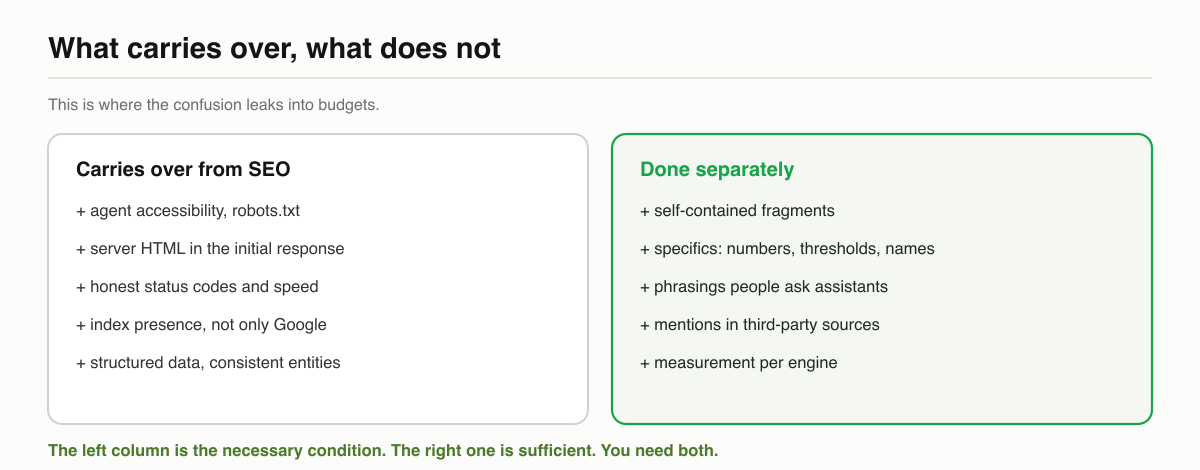
What carries over, and what you have to do separately
This is the practical part, and it is where confusion tends to leak into budgets.
Carries over from SEO in full: accessibility for agents and a correct robots.txt; server-rendered HTML, meaning text present in the initial response rather than painted in by scripts; honest status codes and reasonable speed; presence in the index, and not only Google's; consistent entity naming, structured data, a clear heading structure.
Does not carry over and has to be done separately: cutting text into self-contained fragments, each readable when pulled out of context; specifics instead of generalities, meaning numbers, thresholds, names and dates, because those are what the system takes willingly; covering the phrasings people use when asking an assistant rather than the ones they type into a search box; presence in third-party sources where others describe you; separate measurement per engine, because they do not behave alike.
The last two are the hardest, and they deserve their own sections.
Two different indexes, not one
This one costs real money for teams used to living inside a single dashboard.
Different AI services draw candidates from different places. Being in Google's index does not automatically put you in whatever another assistant pulls from. That is not a judgment on your site's quality. It is a question of whose index you happen to be in.
The practical conclusion is dull and unavoidable: check each engine separately instead of drawing a conclusion about "AI in general" from one surface. We run measurement that way, and the gap between engines is often wider than the gap between competitors inside a single one.
Page versus entity
Another structural difference that rarely gets said out loud.
Classic optimisation works on what you control: your pages, your structure, your copy. GEO works partly on what you do not control, because AI leans readily on reviews, roundups, industry platforms and discussions. Sources where other people describe your company, rather than your own site where you describe yourself.
That changes the nature of the work. You can no longer just rewrite a page and wait for results. You have to care whether your name, your specialisation and the facts about you are phrased consistently in places where you are not the editor.
And it is the origin of a very common budget mistake. A team pours everything into its own site, polishes it to a shine, and stays invisible in AI answers because the system is not building its picture from that site alone.
The honest scale, without which every number lies
Here comes the part the industry will not enjoy, and without it this piece would be an advert.
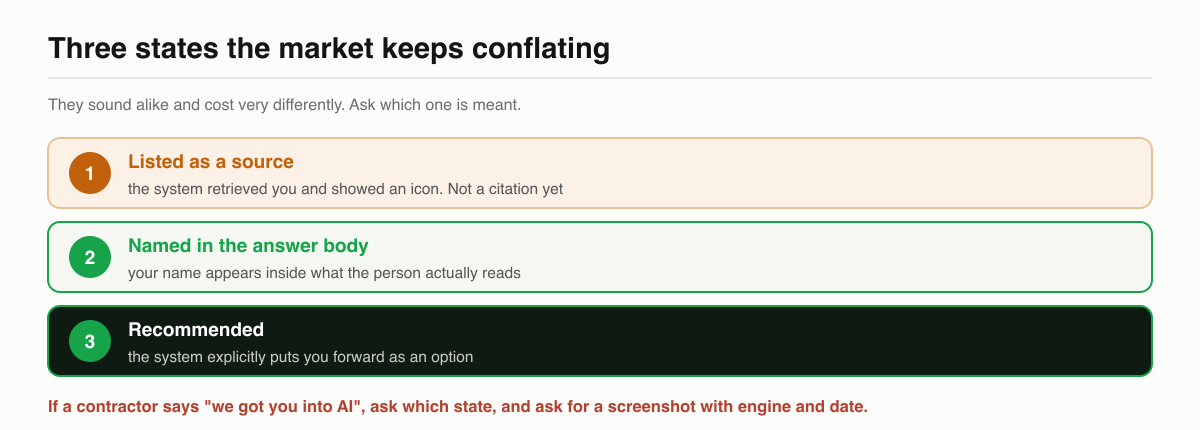
Conversations about AI visibility constantly blur three different states, and each one is worth considerably more than the last.
First: you appear in the source list. The system retrieved you and showed an icon. That is not a citation yet.
Second: you are named in the body of the answer. Your text or your name appears inside what the person actually reads.
Third: you are recommended. The system explicitly puts you forward as an option to choose.
The difference is fundamental and the wording sounds nearly identical. So when a contractor says "we got you into AI", it is worth asking which of the three they mean, and asking for a screenshot.
We hold ourselves to that rule strictly. We do not write "cited" when the brand only sits in the source pool, and we always state the engine and the date of measurement. Not out of a love of honesty, but because the composition of an answer shifts, and a number without a date is worth nothing.
What this looks like as actual work
The sequence I consider workable is simple and unexciting.
Technical foundation first, because nothing else matters without it. Then text structure aimed at fragment extraction. Then work on the phrasings people use when they ask an assistant. And in parallel, presence in third-party sources, because that is the slowest track by a wide margin.
Measurement runs separately: classic positions and visibility on one side, state in AI answers on the other, per engine, with dates attached. Folding them into a single number is a way of lying to yourself.
What I am not claiming
A few honest limits, so this does not read as a promise.
Being in the HTML does not guarantee a citation. The technical layer only buys you the right to be considered. What gets chosen among dozens of candidates runs on logic nobody outside can fully observe.
The rules change faster than the industry manages to document them. What holds today may be stale in a quarter, so test on your own project rather than trusting articles, this one included.
And I do not know a reliable metric you could put into a contract in place of positions. Mention counts in AI answers are unstable, shifting with region, phrasing and even session. That is a genuine unsolved problem in this field, and I am not going to pretend otherwise.
Common questions
Can you do GEO alone, without SEO? No. The technical base is shared: if the agent never retrieved your page, or got an empty response, there is nothing to cite.
Is SEO enough to appear in AI answers? Not enough. Retrievability is a necessary condition, but fragment selection runs on rules different from page ranking.
Where do you start on a limited budget? With the technical base, and with checking that your server actually returns text. It is the cheapest stage and nothing else works without it.
Why is a competitor in the answer when they rank below us? Most likely third-party sources write about them, or their text is simply easier to cut into fragments. Ranking and citability are separate contests.
How do I know a contractor is not inventing results? Ask for specifics: which engine, which date, which query, and a screenshot. And clarify whether the brand sits in the answer body or only in the source list.
Summary
GEO does not cancel SEO. It is built on top of it: without retrievability, server-rendered text and presence in the right index, there is simply nothing to cite. But SEO on its own is not enough either, because AI selects fragments rather than pages, and does it by different rules. In practice that means two parallel tracks of work and two separate measurements, not one replacing the other.
And keep the honest scale in view: presence in sources, a mention in the answer body, and a recommendation are three different things the market keeps conflating.
One last practical note. If someone is currently selling you one instead of the other, in either direction, that is a reason to ask a few clarifying questions before you sign anything.