
Customers Don’t Understand the Product — So They Don’t Buy: Why Green-Tech Brands Need Decision Content

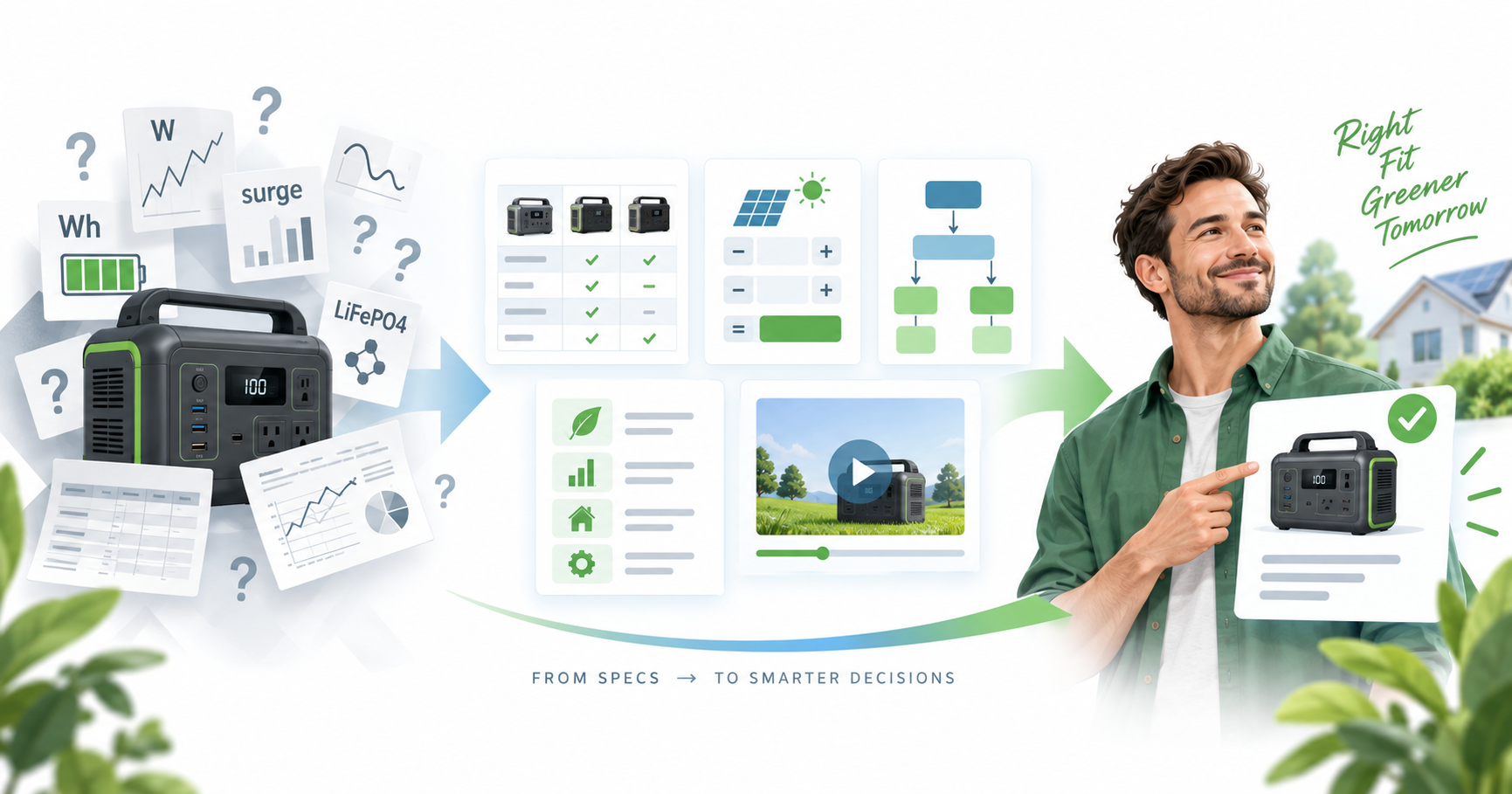
The problem with complex technical products is often not a lack of information. It is the opposite: there is too much of it.
A product page may contain specifications, charts, tables, certifications and performance claims, yet after several minutes of reading, a potential customer may still be unable to answer the only question that really matters: is this product right for me?
Green-tech products make this problem especially visible. Someone comparing a portable power station, home battery or backup power system may see figures such as 2,048 Wh, 2,200 W, 4,400 W surge, LiFePO4, 4,000 cycles and 80% DoD. But those numbers do not automatically answer practical questions. How long will the refrigerator run? Will the system start a pump? Is the battery large enough to last through the night? Why does one model cost more than another?
This is where technical information can start creating decision friction instead of reducing it. The customer opens more tabs, searches Google, YouTube or Reddit for explanations, compares competitors, asks sales teams basic clarification questions, or simply postpones the decision.
That is where decision content becomes useful. Instead of merely describing a product, decision content helps customers move from specifications to a practical choice. For marketers, this means changing the question from “What should we tell people about the product?” to “What does the customer need to understand before they can confidently choose?”
Battery storage is a particularly clear example, but the same principle applies far beyond batteries: to SaaS, industrial equipment, fintech, automotive products, electronics and almost any category where customers must translate technical specifications into real-world consequences.
Product Specs Are Not Decision Content
A specification sheet answers a technical question: what does this product contain, support or deliver?
Decision content answers a different question: what do those specifications mean for the customer’s actual situation?
That distinction looks small, but it changes the role of product content completely.
Consider a portable power station advertised with the following specifications:
- 2,048 Wh battery capacity
- 2,200 W continuous output
- 4,400 W surge output
- LiFePO4 battery chemistry
- 4,000-cycle rating
Every number may be accurate. But a buyer still has to translate them.
A 2,048 Wh capacity figure does not directly say how long a refrigerator, laptop or medical device will run. A 2,200 W output rating does not tell the customer whether a motor-driven appliance will create a higher startup load. A 4,000-cycle claim says little unless the buyer understands the conditions under which those cycles were measured.
Even the difference between average and peak power can determine whether a product is suitable for a specific appliance. A system that appears powerful enough based on normal consumption may still struggle if the device requires a much higher startup load. That distinction is explained in more detail here:
https://digitalowl.fika.bar/average-power-vs-peak-power-01M2K4KCTV720ZHP7EVSTJP6M6
This is where many technical product pages stop too early. They provide the data but leave the interpretation to the customer.
A better approach is to translate each specification into the question it helps answer:
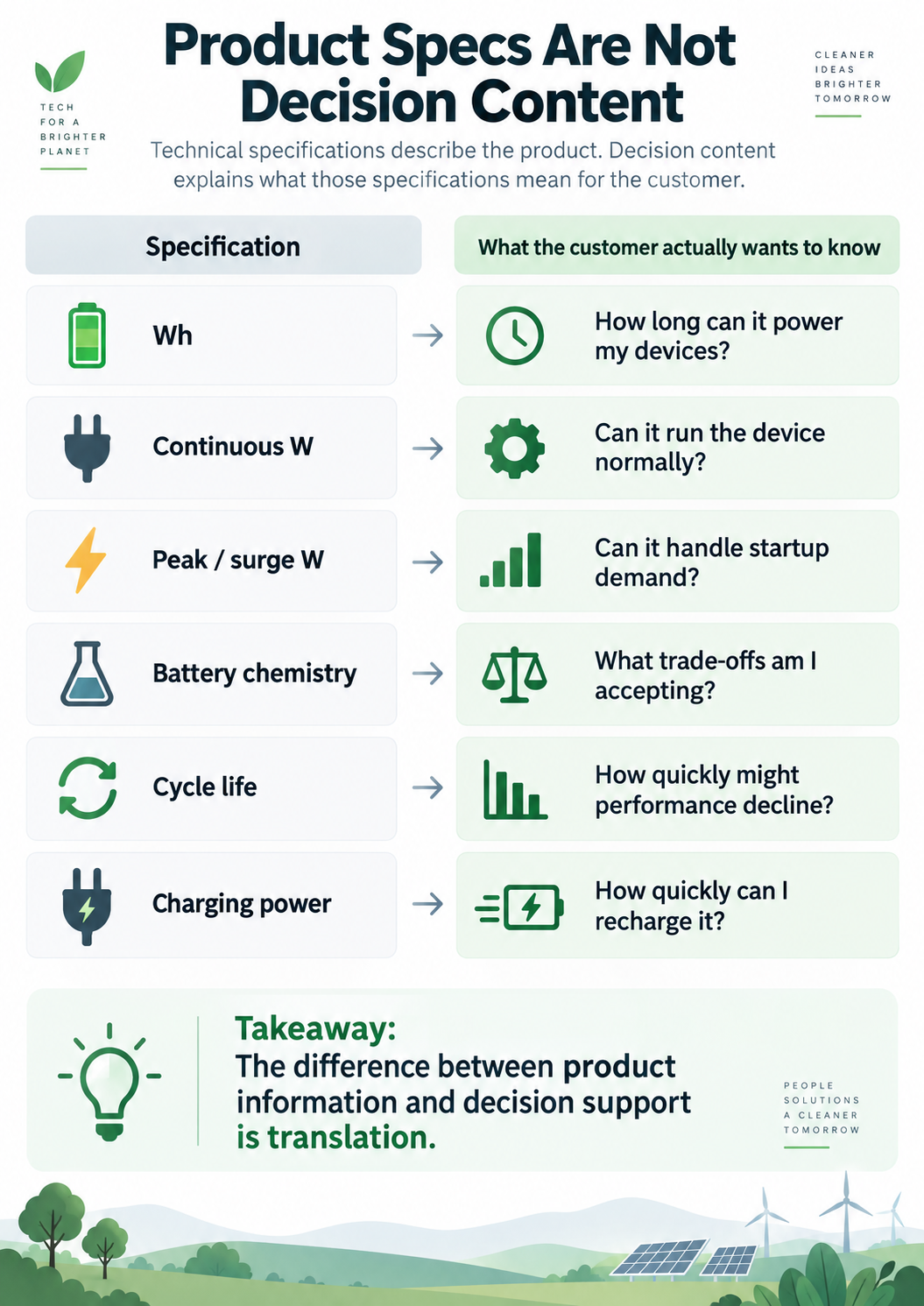
This translation layer is the difference between product information and decision support.
For marketers, the practical implication is simple: listing more specifications does not necessarily make a product easier to choose. Sometimes it does the opposite. The more technical variables customers have to interpret on their own, the more opportunities there are for uncertainty to enter the buying process.
Confusion Creates Friction Before the Sale
When customers have to interpret too many technical variables on their own, the problem is not simply that the product feels complicated. The buying process becomes slower, less confident and harder to complete.
A customer may understand that one battery has 2,048 Wh while another has 3,000 Wh, but still not know whether the larger model is actually necessary. They may see a 2,200 W output rating without understanding how it differs from surge power. They may compare LiFePO4 and NMC chemistry without knowing which trade-off matters for their use case.
Each unanswered question adds another decision step.
The customer opens more tabs, searches for explanations, watches reviews, checks forums, returns to the product page and then repeats the same process with a competitor. In B2B sales, the same uncertainty often moves into calls, technical consultations and long email threads.
That creates decision friction: the extra cognitive and practical effort required before someone feels confident enough to choose.
Decision friction can show up in several ways:
longer comparison cycles;
more dependence on sales or support teams;
repeated questions about basic specifications;
customers choosing an oversized or undersized product;
unrealistic expectations about performance;
postponed purchases;
attention shifting to competitors that explain the decision more clearly.
This does not mean technical details should be removed. Complex products often need detailed specifications.
The problem begins when the specifications are presented without a clear path from data to decision.
A customer does not necessarily need less information. They need better structure around the information that already exists.
For marketers, the practical implication is important: technical content should not only increase product knowledge. It should reduce the amount of interpretation the customer has to do before acting.
The Green-Tech Problem: Customers Have to Compare Different Types of Numbers
Green-tech products make decision friction especially visible because customers are rarely comparing one simple metric. They are often comparing different types of numbers that answer completely different questions.
A portable power station, home battery or backup system might be described using:
watts (W);
watt-hours (Wh);
amp-hours (Ah);
voltage;
continuous output;
surge power;
charging power;
cycle life;
depth of discharge;
battery chemistry;
estimated runtime.
To an engineer, these metrics describe different parts of the system. To a customer, they can easily look like competing ways to express the same thing.
They are not.
Watts describe power. Watt-hours describe energy. A 2,000 W power station is not automatically “bigger” in the same sense as a 2,000 Wh battery. One number helps answer whether the system can run a load; the other helps estimate how long it can keep that load running.
The distinction between watts and watt-hours is explained in more detail here:
https://digitalowl.fika.bar/watts-vs-watt-hours-what-s-the-difference-01M2GNJJ68FM3605JW1JW54A99
The same problem appears throughout the specification sheet. A high surge rating may matter for a pump or compressor but be almost irrelevant to a laptop. A large cycle-life number sounds impressive, but it does not tell the customer how much energy the battery stores. LiFePO4 describes chemistry, not runtime. Charging power describes how quickly energy can be put back into the battery, not how much energy it can hold.
This creates a marketing challenge: customers are being asked to compare numbers that operate on different dimensions.
The solution is not simply to add more definitions. Good decision content reorganises those metrics around the questions the buyer is actually trying to answer:
Can it run my device?
How long will it run?
Can it handle startup power?
How quickly can I recharge it?
How long might the battery last?
Which chemistry fits my priorities?
Once specifications are organised around customer questions instead of engineering categories, the product becomes easier to compare — without removing any of the technical detail.
Decision Content Translates Specs Into Questions Customers Actually Ask
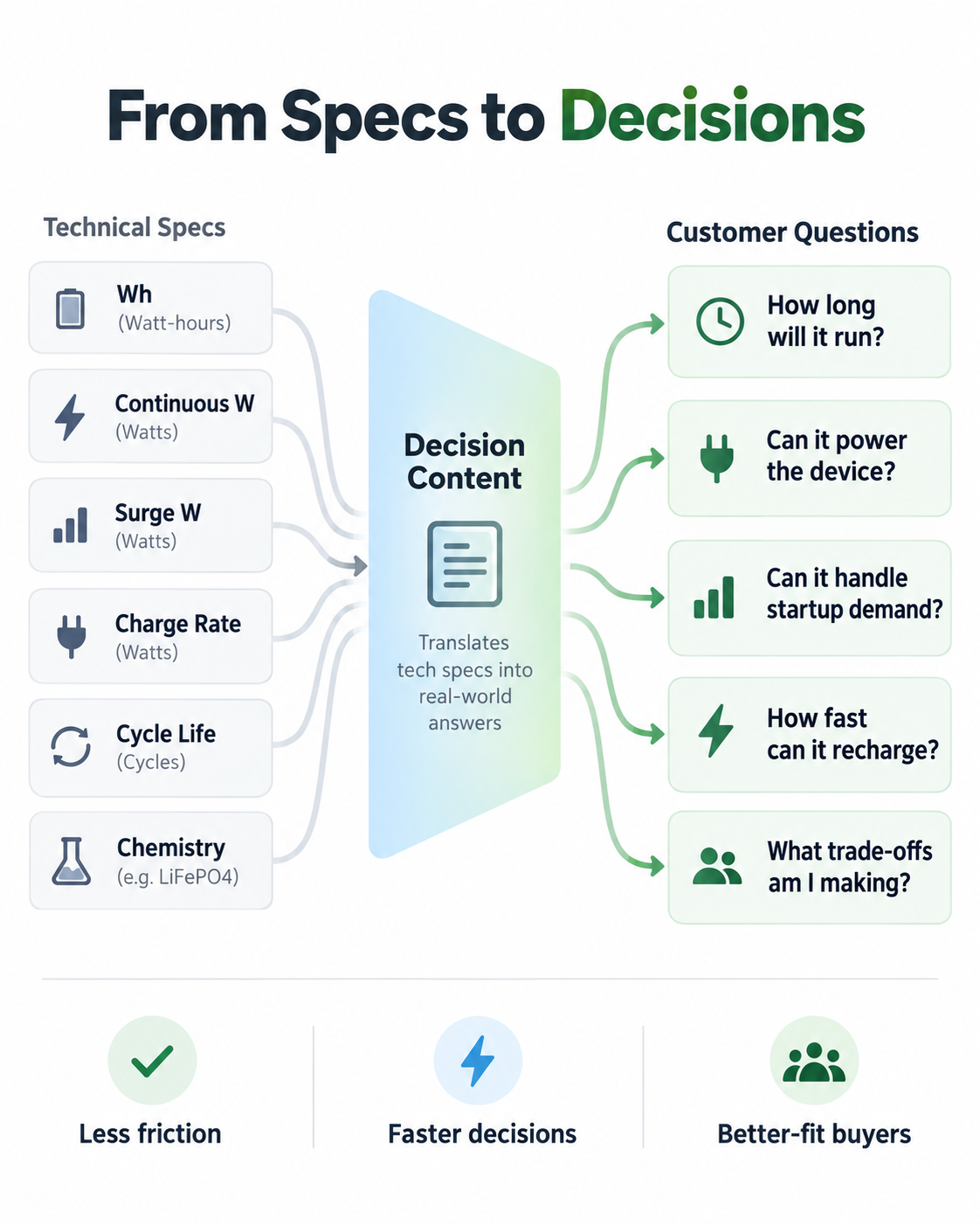
The most useful decision content does not begin with the specification itself. It begins with the question the customer is trying to answer.
That changes the structure of the content.
Instead of organising a page around technical categories such as capacity, output, chemistry and cycle life, marketers can organise it around practical decisions:
How long will it run?
Can it power the device?
Can it handle startup demand?
How quickly can I recharge it?
How long is the battery likely to remain useful?
Which chemistry fits my priorities?
The underlying specifications still matter. They are simply translated into a more useful framework.
For example:
- Wh → How long can it run my devices?
- Continuous W → Can it power the load normally?
- Peak or surge W → Can it handle startup demand?
- Charging power → How quickly can I recharge it?
- Cycle life → What does long-term use look like?
- Battery chemistry → Which trade-offs am I accepting?
- Depth of discharge → How much of the available capacity is typically being used?
This translation is especially valuable when several products look similar on a specification sheet.
A customer may be choosing between two power stations with similar capacity, but one has a much higher surge rating. That difference matters only if the customer plans to power equipment with high startup demand. Another buyer may care far more about weight, cycle life or recharge time.
The “best” specification therefore depends on the decision context.
This is why comparison tools and decision trees can be more useful than another long table of features. They reduce the amount of technical interpretation the customer has to perform and connect specifications directly to use cases:
https://seolabsdp.blogspot.com/2026/09/comparison-tools-and-decision-trees.html
A good decision tree might ask:
What do you need to power?
For how long?
Does the device have a startup surge?
Will the system be used every day or only during outages?
Is portability important?
How quickly does it need to recharge?
Each answer removes irrelevant specifications from the decision.
That is the core difference between information architecture built for a product database and content architecture built for a buyer.
One stores the facts.
The other helps the customer decide which facts matter.
Example: “Which Battery Do I Need?” Is Better Than “Here Are Our Battery Specs”
A strong piece of decision content becomes useful when it moves from explanation to a real buying scenario.
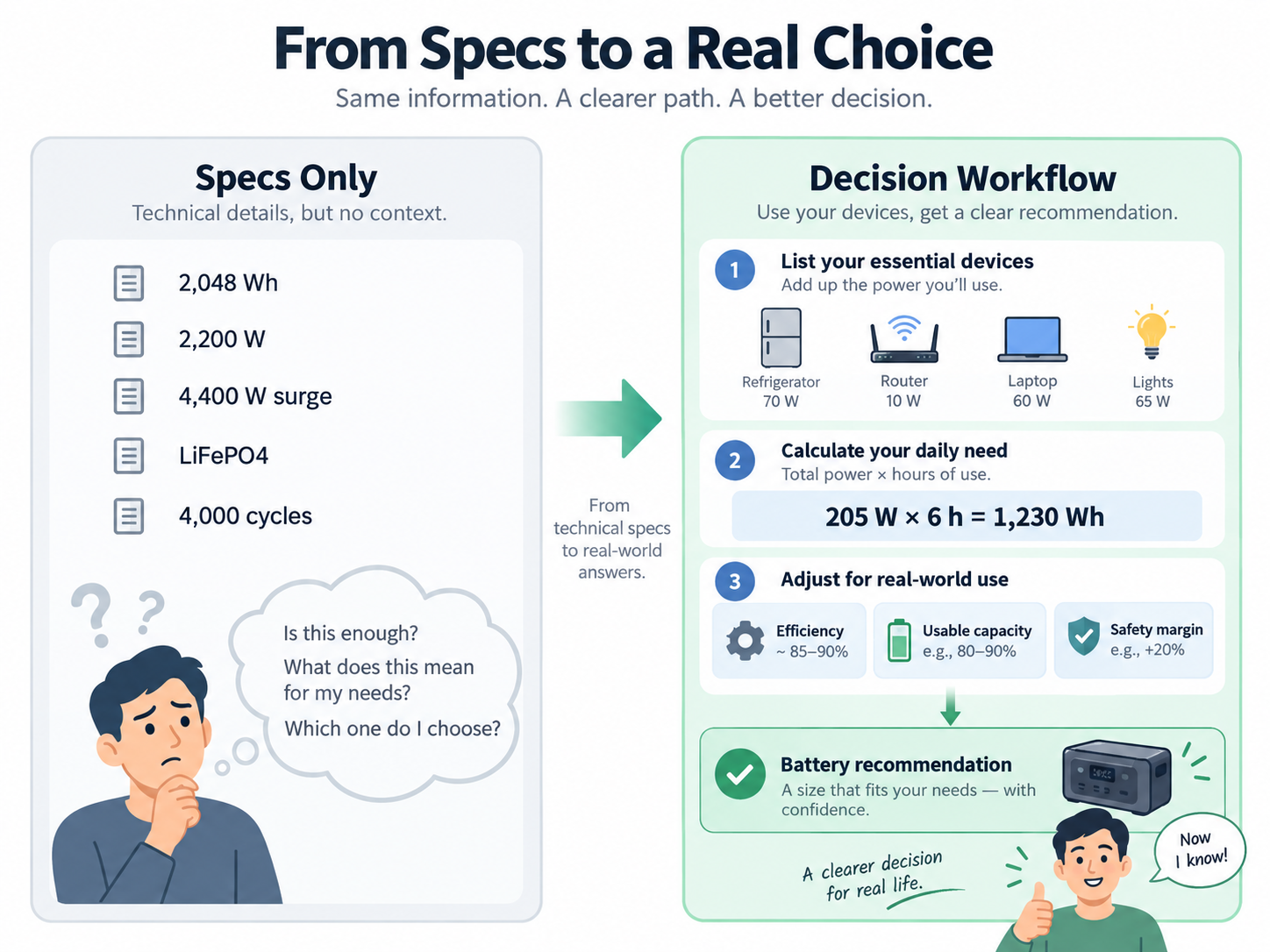
Imagine a customer who wants backup power for four essential loads during an outage:
- refrigerator — 100 W average;
- router — 15 W;
- laptop — 60 W;
- lights — 30 W.
The customer does not primarily want to know whether a battery has 2,048 Wh or 3,072 Wh. They want to know whether the system can keep those devices running for six hours.
That changes the content task completely.
A weak product page might present:
2,048 Wh capacity
2,200 W continuous output
4,400 W surge
LiFePO4 chemistry
4,000 cycles
A decision-focused page would help the customer move through a simple sequence:
Which devices need power?
How many watts do they use?
How many hours should they run?
What conversion losses should be expected?
How much reserve or safety margin is sensible?
That sequence converts a technical specification into a real requirement.
The basic energy calculation starts with:
Power × Time = Energy
If the four example loads total 205 W on average and need to operate for six hours:
205 W × 6 h = 1,230 Wh
That figure is only the starting point. Real systems also need to account for inverter efficiency, varying loads, usable capacity and an appropriate safety margin.
A complete practical workflow for doing that calculation is available here:
For customers who first need to understand how much capacity a particular device requires, this guide breaks the problem down from the device side:
https://digitalowl.fika.bar/how-much-battery-capacity-does-a-device-need-01M2JVYX8GC5RDZQS859RWT5XB
The important marketing lesson is not the specific 1,230 Wh result.
It is the change in perspective.
The product page no longer asks the customer to interpret a battery specification. It helps them calculate their own requirement first, then evaluate which product satisfies it.
That makes the comparison more meaningful because the customer now has a reference point.
A 2,048 Wh battery is no longer simply “smaller” than a 3,072 Wh battery. It may already provide enough capacity for the customer’s actual use case. The larger model may offer more reserve, but the buyer can now decide whether that extra capacity is valuable enough to justify additional cost, weight or size.
This is what decision content does well: it turns the customer from a passive reader of specifications into someone who can evaluate the product against a concrete need.
Chemistry Is Another Decision Problem, Not Just a Specification
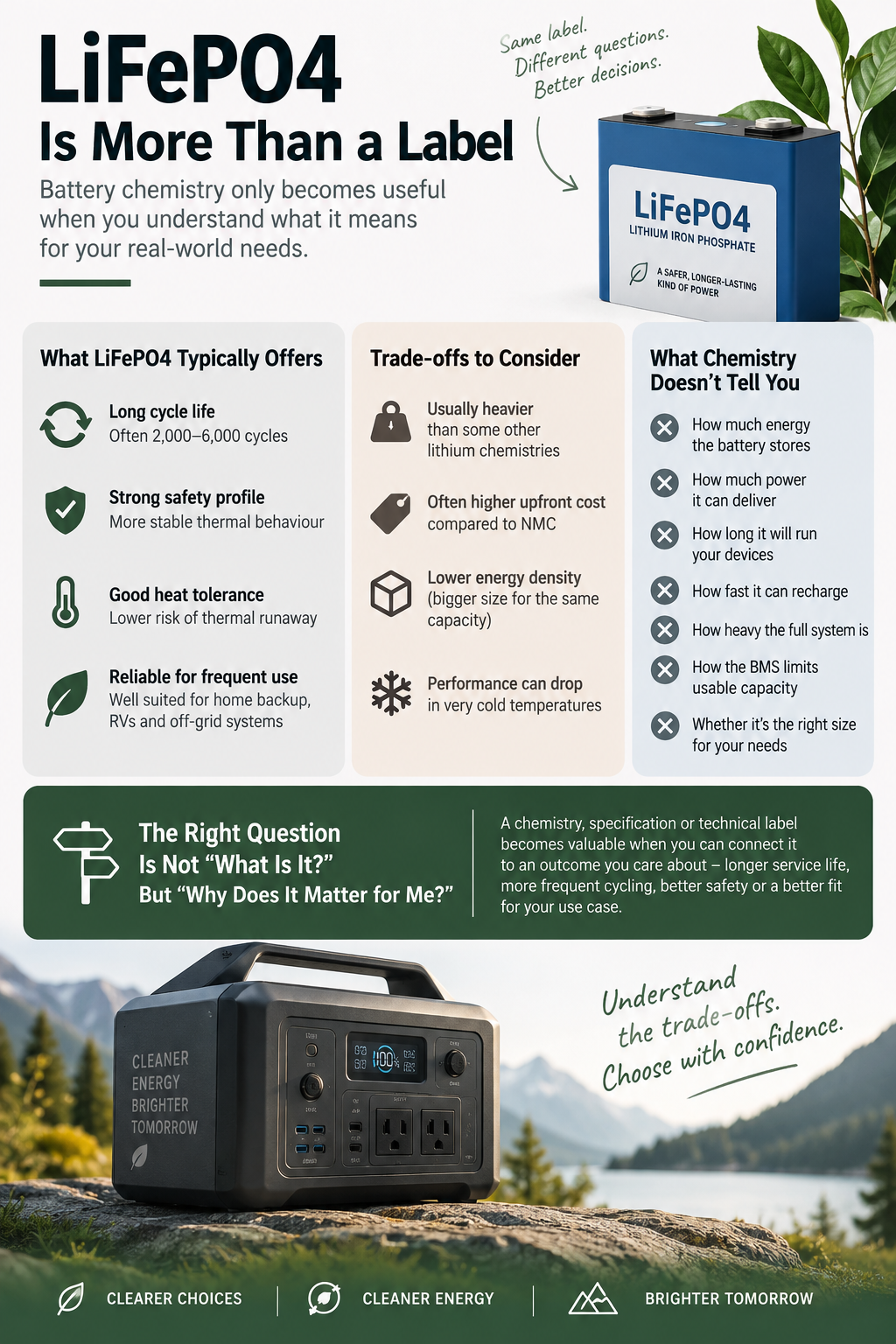
Battery chemistry is a good example of a technical label that looks informative but still leaves the customer with work to do.
A product page may say:
LiFePO4 battery
To an engineer, that immediately communicates something about the cell chemistry. To most buyers, it raises a new question:
Why should I care?
That is where decision content has to translate chemistry into trade-offs.
For example, LiFePO4 is often associated with long cycle life, strong durability and comparatively stable thermal behaviour. Those characteristics can make it attractive for backup power, home storage, RVs or systems that may be cycled frequently.
But chemistry does not answer every buying question.
A LiFePO4 label does not tell the customer:
- how much energy the battery stores;
- how much power the system can deliver;
- how fast it can recharge;
- how heavy the complete pack is;
- how long it will run a particular load;
- how the BMS limits usable capacity;
- whether the product is oversized or undersized for the application.
A useful explainer of what LiFePO4 actually means is here:
https://digitalowl.fika.bar/what-is-a-lifepo4-battery-01M2ZXCSGCM7R3AZWCTMWBDNGP
For marketers, the lesson is broader than battery chemistry.
Technical labels should not be treated as benefits by default.
A chemistry, protocol, material, certification or architecture only becomes useful decision content when the customer can connect it to an outcome they care about.
Instead of writing:
“Uses LiFePO4 cells.”
decision content should help answer:
“Why does that matter for this buyer?”
That might mean longer service life, more frequent cycling, different weight or size trade-offs, different thermal behaviour, or a better fit for a particular use case.
The same principle applies across complex products. A technical term is not automatically a value proposition. It becomes one only after the content explains what decision it should influence.
Good Decision Content Can Replace Part of the Sales Explanation
Good decision content does not replace sales teams. It reduces the number of basic questions customers need to ask before a sales conversation becomes useful.
In complex product categories, sales teams often spend time explaining the same issues repeatedly:
- Which model is large enough?
- What is the difference between capacity and output?
- Will this system run a specific appliance?
- Why does one chemistry cost more?
- Is the larger model actually necessary?
- What does a cycle-life number mean in practice?
- How quickly can the system recharge?
These are not always sales questions. Many are education questions that could have been answered before the customer ever contacted a salesperson.
When product pages, calculators, comparison tools and explainers answer those questions clearly, the sales conversation can start at a higher level.
Instead of:
“What does 2,000 Wh mean?”
the conversation can become:
“I need six hours of backup for these loads. Which of these two models gives me the better balance between reserve capacity and price?”
That is a much more valuable conversation for both sides.
The customer arrives with a clearer understanding of the product category. The sales team spends less time translating basic specifications and more time discussing fit, constraints, implementation and trade-offs.
This is especially important for businesses selling products with many configuration options. The more combinations customers have to compare, the more expensive it becomes to rely on human explanation for every early-stage question.
Decision content creates a form of self-service product education.
A useful comparison page can explain which model fits which use case. A calculator can estimate required capacity. A decision tree can remove irrelevant options. A short video can explain one difficult concept before the customer reaches the product page.
None of these eliminate the need for sales.
They improve the quality of the questions customers bring to sales.
For businesses, that can make content useful beyond traffic generation. The same article or tool can support marketing, customer education, sales enablement and post-click conversion at the same time.
That is a very different role from publishing content only to attract visits.
The Best Formats Are Usually Interactive or Visual
The more complex the decision, the less useful another wall of text can become.
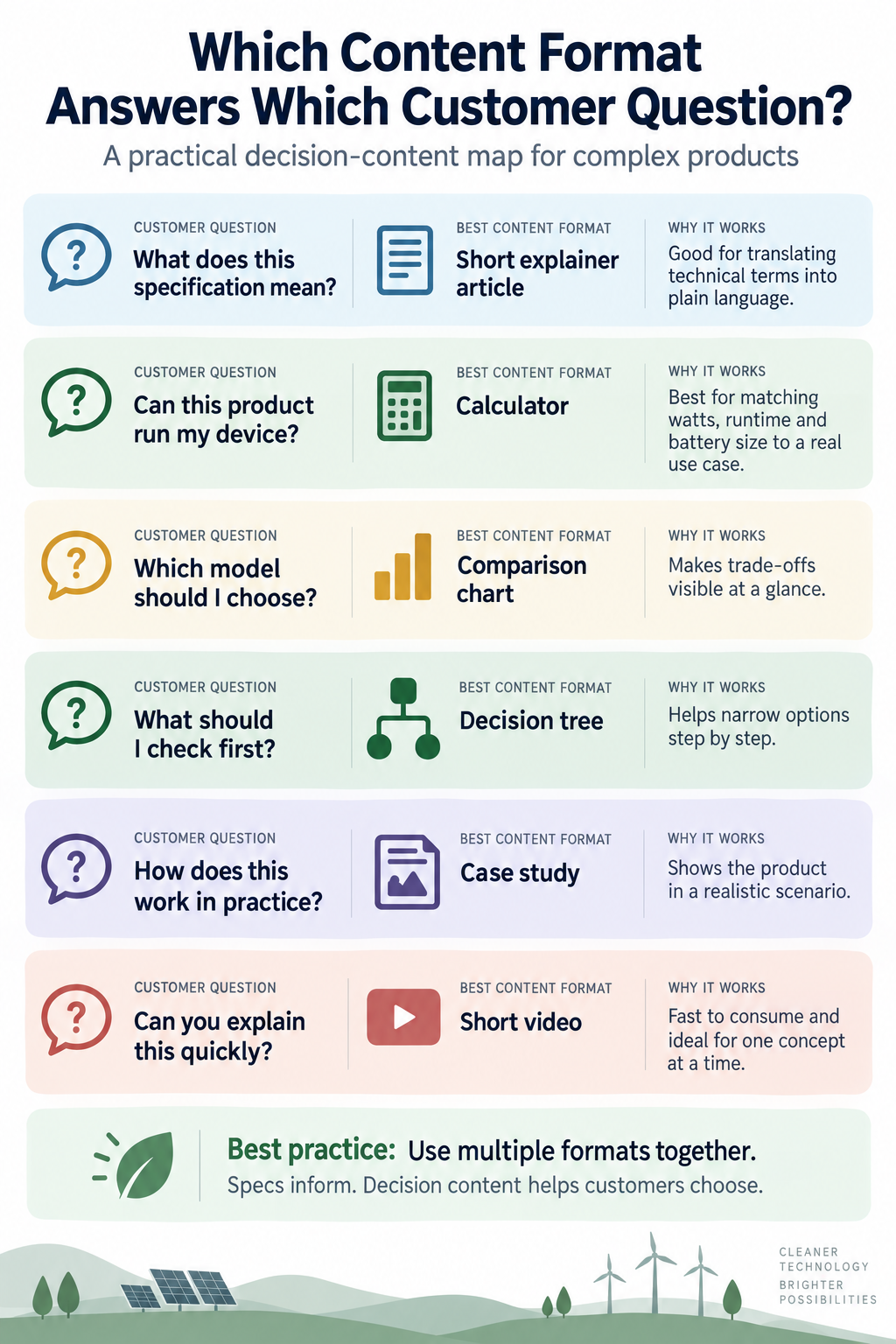
Customers often understand technical products faster when information is turned into a comparison, calculator, decision tree, diagram or short visual explanation. These formats reduce the amount of interpretation the buyer has to perform before reaching a useful conclusion.
Different formats are good at answering different types of questions:
Explainer article — What does this specification mean?
Comparison chart — How are these two models different?
Calculator — What size or capacity do I need?
Decision tree — Which option fits my situation?
Infographic — How do several concepts connect?
Short video — Can you explain one difficult idea quickly?
Case study — What does this product look like in a real-world situation?
The advantage is not simply that visual or interactive content is more attractive. It can change the structure of the decision itself.
A customer comparing three power stations may struggle with several specification tables. A comparison chart can immediately reveal that one model has more capacity, another has higher output, and a third recharges faster.
A calculator goes further. Instead of asking the customer to interpret a generic capacity number, it allows them to enter their own appliances, runtime or energy consumption and receive a result relevant to their situation.
A decision tree can remove unnecessary options step by step:
Do you need portability?
Do you need to run motor-driven appliances?
How long should backup power last?
Will the system be used daily or only during outages?
Each answer reduces complexity.
This is also where data visualisation becomes more than decoration. A useful chart or infographic can become a reusable reference that works in product pages, articles, presentations, social posts and outreach. The principles behind using data visualisation as a broader content asset are explored here:
https://seolabsdp.blogspot.com/2026/09/data-visualisation-as-linkable-asset.html
Short videos solve a different problem. They are particularly useful when the customer does not need a complete guide but does need one concept explained before continuing the buying journey. A 60–120 second explanation of surge power, battery chemistry or runtime assumptions can remove a specific point of confusion faster than a long article.
The most effective strategy is often not to choose one format.
It is to build several formats around the same decision:
article for depth → infographic for scanning → calculator for personalisation → short video for fast explanation → comparison tool for the final choice.
That turns content from a collection of separate assets into a decision-support system.
One Decision Tool Can Become an Entire Content System
A useful decision tool does not have to live on one landing page.
Once a brand has built a good calculator, comparison framework or decision tree, the same logic can become the foundation for an entire content system.
Take battery sizing as an example.
The core decision may be simple:
What do you need to power, for how long, and under what real-world conditions?
That one framework can be repurposed into:
a long-form guide;
a calculator;
an FAQ series;
a comparison chart;
a downloadable checklist;
several infographics;
Pinterest pins;
short “listen first” videos;
sales enablement material;
newsletter content;
social posts;
customer-support resources.
The value comes from reusing the decision logic, not simply repeating the same article in different formats.
A calculator might help the customer estimate required battery capacity. A short video can explain why efficiency losses matter. An infographic can visualise the sizing workflow. A sales team can use the same logic during consultations. A comparison page can turn the result into a product recommendation.
This also changes how content earns attention.
A useful tool, framework or reference can become a linkable asset because other publishers have a reason to reference it when explaining the same problem:
https://seolabsdp.blogspot.com/2026/09/what-is-linkable-asset.html
For a green-tech brand, this creates a particularly useful cycle:
customer question → decision framework → useful tool → reusable content → wider distribution → more entry points into the buying journey
Instead of treating content production as an endless sequence of unrelated blog posts, the brand builds around a small number of useful decision systems.
That usually creates stronger consistency, clearer messaging and more opportunities to reuse the same expertise across marketing, sales and education.
How to Audit a Green-Tech Product Page
A practical way to evaluate a product page is to stop reading it like the company that created it and start reading it like a customer who does not already understand the category.
The first question should not be:
“Did we include all the specifications?”
It should be:
“Can the customer make a useful decision with the information on this page?”
A simple audit can start with these questions:
Are the important specifications explained?
A number should not require the customer to leave the page just to understand what it measures.Does the page explain which specifications actually matter for different use cases?
Not every customer needs to care equally about surge power, cycle life, weight, chemistry or charging speed.Are there real-world scenarios?
Examples such as refrigerators, pumps, laptops, EV charging or home backup make abstract specifications easier to interpret.Can customers compare models without rebuilding the comparison themselves?
A clear comparison table or decision tool should expose the meaningful trade-offs.Can customers estimate the size or configuration they need?
For products where sizing matters, a calculator or structured workflow can remove a major source of uncertainty.Are assumptions visible?
Runtime, savings, efficiency and lifetime estimates should show the conditions behind the result.Are complex concepts supported visually?
Diagrams, charts, short videos and infographics can reduce the cognitive load of technical explanations.Does the page answer the customer’s next question?
Good decision content creates a path. It should be obvious where to go next if the customer needs more detail.
A product page that fails several of these checks may still be technically accurate.
The problem is that accuracy alone does not guarantee usefulness.
The strongest pages connect specifications, explanations, examples and tools into one coherent decision path.
Make the Customer Choose, Not Decode
Technical products do not become easier to buy simply because more information is added to the page.
They become easier to buy when the information is structured around the decision.
That means moving from:
Specs → more specs → more comparison
to:
Specs → Explanation → Comparison → Calculation → Decision
The role of good technical marketing is not to remove complexity from the product. Complex products are often complex for valid reasons.
The role is to remove unnecessary complexity from the customer’s path to understanding it.
For green-tech brands, that creates an opportunity to compete on more than hardware, chemistry or headline specifications.
A brand can also compete on clarity.
If customers understand what the numbers mean, which trade-offs matter and how a product fits their situation, they are in a much stronger position to make a confident choice.
That is what decision content should ultimately do.
It should make the customer choose — not decode.


