
How Do You Turn Brand Voice Findings Into a Usable Content Brief?

Brand voice findings become useful only when they are translated into decisions a writer can apply before drafting. Instead of copying audit notes such as “sound more confident” or “be more human” into a brief, convert them into concrete guidance about the reader’s state, desired reaction, claim strength, terminology, examples, CTA pressure and review checks. The brief should reduce interpretation, not create another document the writer has to decode.
A practical way to organise those decisions is to use a simple context framework rather than a long list of personality traits. A brand voice matrix can help teams connect communication choices to situations, audiences and content needs:
https://seolabsdp.blogspot.com/2026/06/what-is-brand-voice-matrix-and-why-it.html
Why Audit Notes Often Fail Writers
An audit is designed to identify patterns and problems. A content brief has a different job: it needs to tell someone what to do next.
That distinction is easy to miss. An audit might conclude that the brand sounds too formal in support content, makes claims that are stronger than the evidence allows, or switches terminology between product and marketing pages. Those are useful findings, but they are not yet writing instructions.
If a brief simply says “use a friendly professional tone”, the writer still has to decide what friendly means, how professional is too professional, whether contractions are acceptable, how direct the CTA should be and which technical terms should stay. Two writers can follow the same vague instruction and produce noticeably different drafts.
The solution is not to make the brief longer. It is to make the important decisions more explicit.
Seven Voice-Aware Fields to Add to a Content Brief
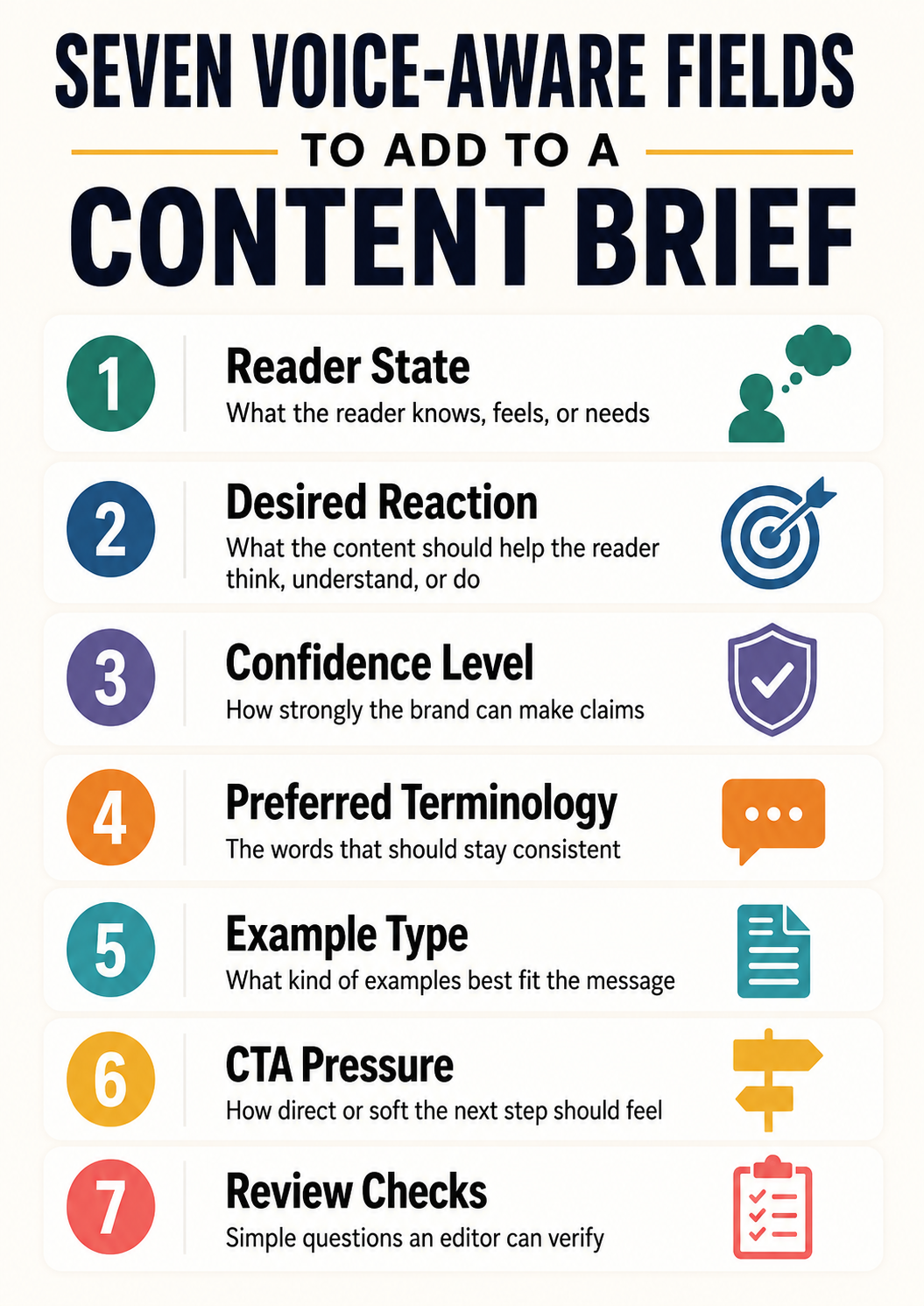
A useful voice-aware brief can be built around seven fields.
1. Reader state
Describe what the reader probably knows, feels or needs at this point. “Comparing several tools and worried about switching effort” is more useful than “B2B audience”.
2. Desired reader reaction
Define what the content should help the reader think, understand or do. This keeps tone connected to purpose.
3. Confidence level
State how strongly the brand can make claims. For example: “Be clear and decisive about the process, but qualify performance claims that depend on the customer’s setup.”
4. Preferred terminology
List the terms that should stay consistent, especially when an audit has found naming drift.
5. Example type
Specify the kind of example that fits the brand and the article. A practical workflow example may be more useful than a generic analogy.
6. CTA pressure
Explain how assertive the next step should feel. An educational article may need a low-pressure CTA, while a product comparison page can be more direct.
7. Review checks
Turn the most important voice findings into questions an editor can answer with yes or no.
These fields do not replace a normal content brief. They add the voice decisions that topic, keyword and outline fields usually leave unresolved.
From a Weak Brief to a Usable One
Consider a fictional brief for an article about reducing customer-support response time.
Weak brief
- Topic: reducing support response time
- Keyword: customer support response time
- Audience: SaaS teams
- Tone: friendly and professional
- CTA: try the product
The brief provides the subject but leaves almost every communication choice open.
A voice-aware version could look like this:
Brief fieldUsable instructionReader stateSupport manager under pressure to improve response times without adding headcountDesired reaction“There are practical process changes I can test before buying more software”Confidence levelGive direct process advice; do not promise universal time savingsTerminologyUse “response time” for first reply and “resolution time” for full issue closureExamplesUse queue triage, routing and saved-reply examplesCTA pressureLow to medium; offer the product as one possible next step, not the only answerReview checksAre response and resolution time kept distinct? Are claims specific but qualified? Does the article help before it sells?Now the writer has boundaries without being given a script. Different writers can still choose different sentences, examples and rhythms, but they are more likely to make compatible decisions.
Test the Brief Before You Scale It
Before using a new brief format across a whole content programme, test it on one real assignment. Give the same brief to two writers or compare a new draft with an older piece created without the voice-aware fields.
Do not ask only whether the drafts “sound on brand”. Check the specific decisions the brief was supposed to control. Did both writers use the same terminology? Did they make claims at a similar confidence level? Did they understand how much pressure the CTA should carry? Did they choose examples that fit the intended reader state?
If the answers differ sharply, the brief may still contain hidden ambiguity. Rewrite the field that caused the disagreement rather than adding more general adjectives.
Once the team can reliably translate findings into repeatable writing decisions, the next challenge is connecting those decisions to the wider content system. This guide covers the step from voice checks and audit findings into content strategy:
https://seolabsdp.blogspot.com/2026/05/from-brand-voice-checklist-to-content.html
A Simple Implementation Checklist
Before approving a voice-aware content brief, check that it:
- describes the reader’s current situation, not only a demographic;
- states the reaction or action the content should support;
- defines how strong claims can be;
- locks any terminology that must remain consistent;
- specifies the type of example that will make the content useful;
- sets the appropriate CTA pressure;
- gives the reviewer a small number of observable checks.
A content brief does not need to contain an entire brand voice system. It only needs to bring the relevant voice decisions into the work before drafting starts. That is what turns audit findings from interesting observations into instructions a writer can actually use.


