
Why Do Tone of Voice Guidelines Fail When Content Production Gets Busy?

Tone of voice guidelines often fail under production pressure because they depend too heavily on people remembering a document. When deadlines tighten, content volume rises and several writers work at once, abstract instructions such as “be confident”, “sound human” or “keep it friendly” are easy to interpret differently or ignore. The problem is usually not that the guidelines are bad. It is that the voice controls have not been built into briefs, examples, templates, ownership and final QA.
A broader explanation of tone of voice in marketing is useful for understanding what the guidelines are trying to protect:
https://seolabsdp.blogspot.com/2026/04/what-is-tone-of-voice-in-marketing-with.html
Why Production Pressure Exposes Weak Guidelines
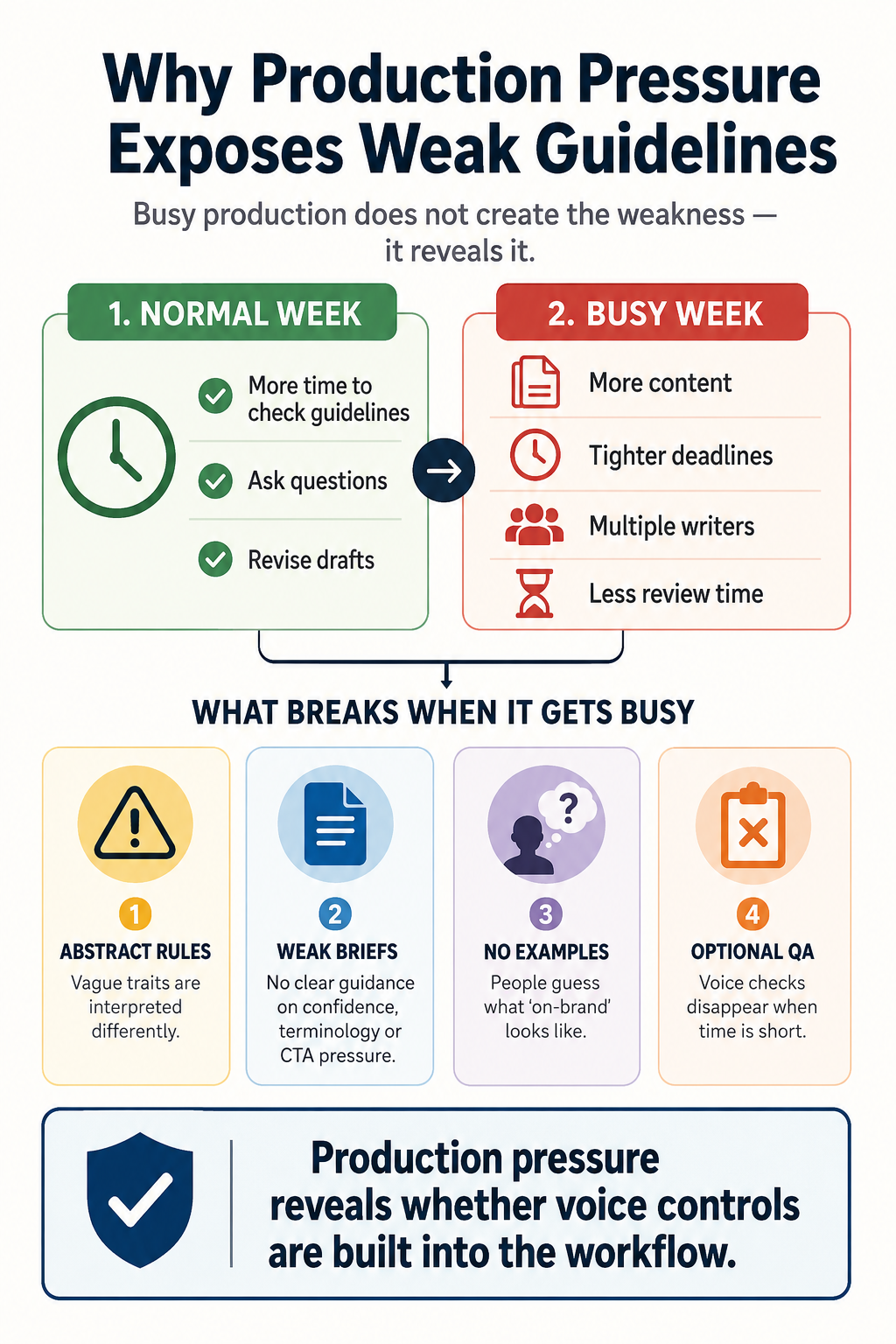
A normal editorial week can make a weak voice system look stronger than it really is. There may be enough time for writers to check the guideline document, ask an editor for clarification and revise a draft after subjective feedback.
A high-volume launch week is different. Five pages may need updating at once. Emails, social posts, product copy and support messages may be moving through different people. Review time gets shorter, and the team begins prioritising what appears essential to shipping.
If tone of voice exists mainly as a document, it is usually one of the first controls to weaken. People remember the headline adjectives but forget the practical boundaries behind them. “Confident” becomes stronger claims. “Friendly” becomes casual language. “Simple” becomes less explanation.
The pressure does not create the weakness. It reveals that the system depended on memory.
Five Voice Controls That Disappear First
The first failure point is usually abstract language. Broad traits are easy to agree with but hard to apply quickly. A writer under pressure needs to know what confidence changes in a claim, how much explanation is expected and which wording is out of bounds.
The second is missing brief-level guidance. If the content brief contains only the topic, keyword and deadline, writers have to reconstruct the voice decisions themselves. Different people will make different choices about confidence, terminology, evidence and CTA pressure.
The third is lack of usable examples. A long guideline document may explain principles without showing what good execution looks like in a landing page, email or support reply. When time is limited, examples are faster to use than abstract interpretation.
The fourth is unclear ownership. If a writer, editor and marketing lead all have different views of what “on brand” means, pressure turns voice review into negotiation. Teams need to know who owns the final decision and which changes require escalation.
The fifth is optional QA. When voice is checked only “if there is time”, it becomes inconsistent by design. A small final review can be more reliable than a large guideline document that nobody revisits before publishing.
Normal Week vs Busy Week
Consider the same team in two different situations.
During a normal week, a writer receives a blog brief, checks the voice guide and sends the draft to an editor. The editor notices that several claims sound too absolute, rewrites the CTA and changes a few terms. The final piece looks consistent, but much of that consistency comes from the editor repairing the draft.
Now imagine a launch week. The team needs a landing page, three emails, two support updates and several social posts. The same editor cannot deeply review every piece. Writers rely on memory, and each person interprets the guidelines slightly differently.
The fix is not to ask everyone to read the guidelines more carefully. The workflow needs embedded controls.
A useful brief could specify the reader state, desired reaction, confidence level, preferred terminology and CTA pressure. A small example bank could show what “measured confidence” looks like in a claim or what “friendly” should not become. One named owner could resolve exceptions, while a short final QA checks the highest-risk voice decisions before publication.
This creates a system that still works when attention is limited.
Build the Controls Into the Workflow
An embedded-control checklist can be short:
- Brief: Does it define the voice decisions that matter for this piece?
- Examples: Is there a usable reference for the content type?
- Terminology: Are important terms fixed before drafting?
- Claims: Is the acceptable confidence level clear?
- Ownership: Does everyone know who resolves a voice disagreement?
- QA: Is there a final check for claims, terminology, tone and CTA pressure?
The purpose is not to create more bureaucracy. It is to move voice decisions to places the team already uses during production.
This is also why content teams usually need more than a tone-of-voice document when they want consistency to survive scale and pressure:
https://seolabsdp.blogspot.com/2026/05/why-content-teams-need-more-than-tone.html
Guidelines Should Survive the Busy Week
Good tone of voice guidelines are still valuable. The problem begins when the document is expected to do every job by itself.
A resilient system turns the guidelines into brief fields, examples, templates, ownership rules and a lightweight QA step. Then the voice does not depend on whether every contributor has time to reopen a document and interpret it correctly.
The best test is simple: if production volume suddenly doubles, which voice controls would still happen automatically? Those are the controls the team can rely on. Everything else is still optional.


