
What Should You Fix First When Brand Messaging Starts to Feel Inconsistent?

When brand messaging starts to feel inconsistent, fix contradictions in meaning before you polish the writing style. The highest-priority problems are usually differences in the core promise, terminology, claim strength and what the customer is told to expect next. These mismatches can change how people understand the offer, while smaller differences in warmth, sentence length or formatting are often less urgent.
A useful first step is to separate messaging alignment from surface-level tone. If different pages describe the same product, service or process in conflicting ways, the problem is deeper than wording. For a broader explanation of how messaging alignment works across content, see:
https://seolabsdp.blogspot.com/2026/05/what-is-brand-messaging-alignment-and.html
Why Some Inconsistencies Matter More Than Others
Not every difference between two pieces of content deserves the same level of attention. A sales email can be more direct than an educational page, and onboarding copy can be shorter than a detailed guide. Those differences may be perfectly reasonable because the reader’s situation has changed.
The more serious problems are the ones that change what the brand appears to mean. If the website promises a fully automated process but onboarding requires several manual steps, the customer has received conflicting expectations. If sales calls something an “audit” while onboarding calls it an “assessment”, the wording may create uncertainty about whether those are the same service.
This is why starting with style can waste time. A team may spend hours making sentences sound more consistent while leaving the underlying contradiction untouched.
The Four Things to Check First
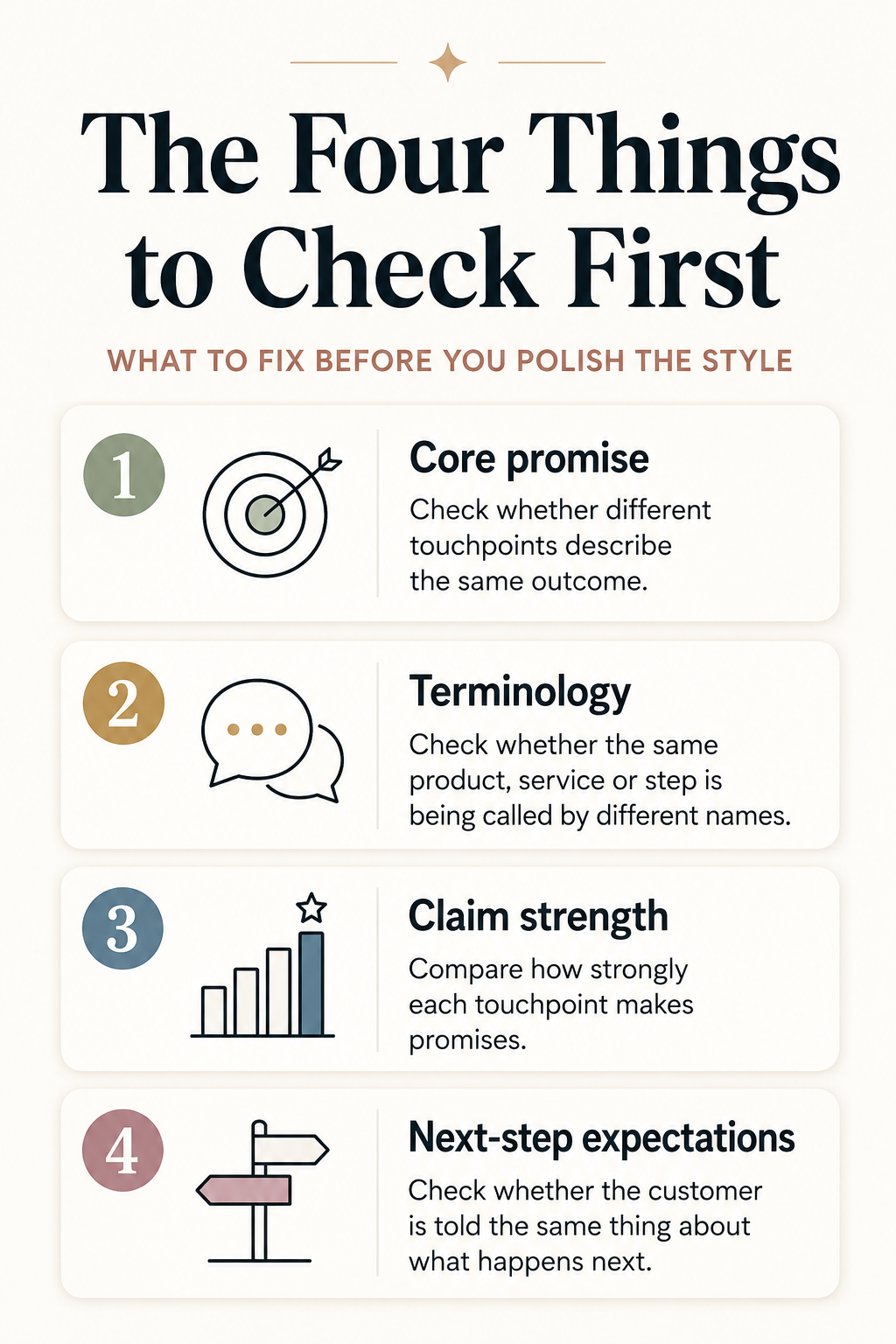
When messaging begins to drift, review four areas before anything else.
1. Core promise
Check whether different touchpoints describe the same outcome. A homepage might promise simplicity while sales content emphasises control and customisation. Both can be true, but the relationship between them needs to be clear.
2. Terminology
Look for different names being used for the same product, service, stage or action. Terminology drift makes the customer work harder to understand whether two phrases refer to the same thing.
3. Claim strength
Compare how confidently each touchpoint makes promises. “Can help reduce manual work” and “eliminates manual work” create very different expectations.
4. Next-step expectations
Check what the customer is told will happen after they act. A landing page may promise an immediate start while the confirmation email says the process begins after manual review. That conflict affects the experience more than whether both pages use the same sentence rhythm.
Use an Impact-First Triage
A simple High / Medium / Low matrix helps prevent teams from fixing cosmetic differences before the important ones.
InconsistencyPriorityWhy it mattersWebsite says “fully automated”, but onboarding requires several manual stepsHighThe core promise and actual process conflictSales calls the service an “audit”, onboarding calls it an “assessment”Medium–HighTerminology creates uncertaintyEmail sounds warmer than the websiteLowThe context can justify a tone shiftCTA wording changes from “Start” to “Continue”LowUsually cosmetic unless the action itself changesThe exact priority will depend on the business and customer journey, but the principle stays useful: fix contradictions that change understanding before differences that mainly affect presentation.
A Three-Touchpoint Repair Example
Imagine a fictional consultancy with the following messages.
Website: “Get a complete brand audit with clear recommendations in five working days.”
Sales email: “Our brand assessment gives you a quick overview of the biggest issues within three days.”
Onboarding: “After payment, we review your materials and confirm the assessment scope before the audit begins.”
Each message is individually understandable, but together they create several problems. The service is called both an audit and an assessment, the promised timing changes, and the customer is not sure whether the five-day period starts immediately or after the scope is confirmed.
The repair order should be:
- Fix the promise contradiction. Decide what the real delivery timeline and process are.
- Unify the terminology. Choose one primary name for the service and define any secondary term only if it has a different meaning.
- Align the next-step expectation. Explain clearly when the work begins and what happens after payment.
- Only then polish the tone and style. Once the meaning is stable, the team can adjust warmth, sentence length and formatting for each channel.
This order matters because polished wording cannot repair a contradictory offer.
Fix Meaning Before You Polish the Voice
Once the high-impact inconsistencies are resolved, the team can work on tone and execution. At that point, differences between pages are easier to judge because the underlying message is stable.
A practical next step is to turn the corrected messaging into repeatable content decisions: which claims are acceptable, which terms are preferred, how much certainty the brand should use and what readers should be told before each action. This implementation process is covered in more detail here:
https://seolabsdp.blogspot.com/2026/04/how-to-apply-tone-of-voice-to-improve.html
Brand consistency does not mean every sentence should sound identical. It means the customer should not receive conflicting promises, labels or expectations as they move through the journey. When inconsistency appears, fix the meaning first. Style becomes much easier to align once everyone is working from the same message.


