
AI-orchestrated product development: why founders are leaving traditional outsourcing behind

AI has completely changed how teams produce software. They generate code faster, assemble interfaces in minutes, and build prototypes without long setup cycles.
But product delivery hasn’t become simpler. In many cases, teams have made execution harder to control — not because of AI itself, but because of how they use it within existing delivery models.
Most teams still rely on workflows designed for a pre-AI world, where work moves step by step with manual coordination.
AI has disrupted the speed balance in this system — and that’s exactly where AI orchestration becomes necessary.
The principal difference between AI development and AI orchestration
Any AI-powered, AI-enabled, or AI-driven development refers to the toolset and tech stack teams use to build a product. AI orchestration is a different question entirely: how do you coordinate, manage, and involve those tools in your workflow without sacrificing project costs, time, resources, or quality?
Most teams treat these two things as the same problem. They're not. You can use every relevant AI tool on the market and still have a delivery process that's slower and more expensive than it needs to be — because the tools aren't coordinated. Someone has to absorb the overhead of connecting them.
Why disconnected AI acceleration is a bottleneck for the software development lifecycle
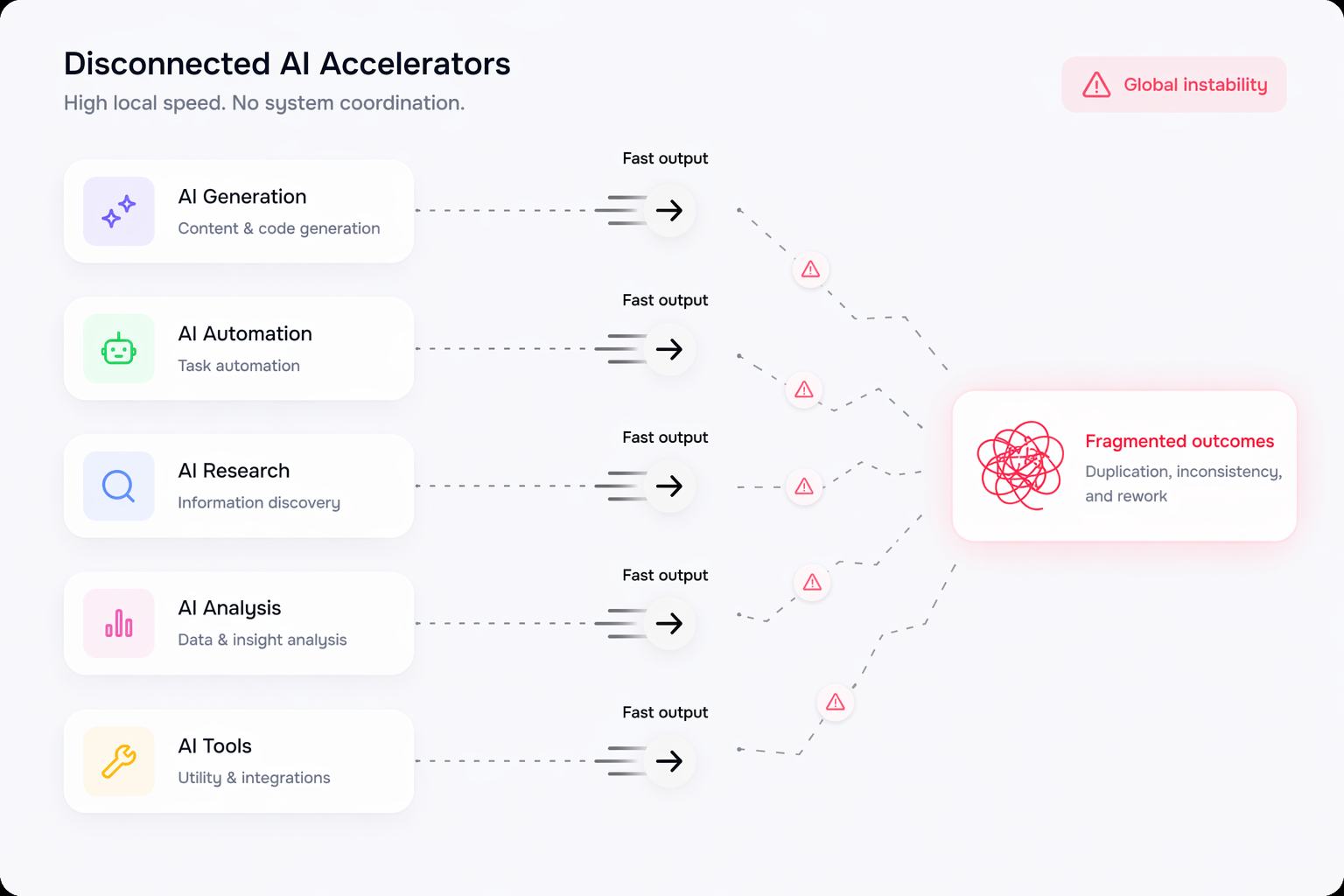
Most teams now run dozens of AI tools across design, code, testing, and documentation. Each tool works well on its own. Problems appear when outputs meet.
The pattern that comes up repeatedly:
• Features move faster than the senior team can validate.
• Integration becomes manual coordination that falls to engineers or founders.
• Decision-ownership spreads across tools and roles with no clear accountability.
• Rework surfaces late in the cycle, after significant effort has already been spent;
At that point, AI doesn't reduce workload. It redistributes it into coordination overhead, and the people absorbing that overhead are usually the most expensive ones on the team.
What teams experience in practice — but rarely say publicly
These observations come up consistently across Reddit threads and engineering forums:
- "AI works in demos, but breaks in production."
- "Costs scale unpredictably due to retries and loops."
- "Outputs look correct, but fail under real conditions."
- "Teams spend more time fixing than building."
- "Clients become de facto project managers."
Each of these is a symptom of the same underlying issue: AI is generating output faster than the process around it can keep up with. Without a structured way to route, validate, and integrate that output, the speed advantage disappears into coordination and rework.
AI orchestration speeds up your SDLC without compromising quality, control, or timeline
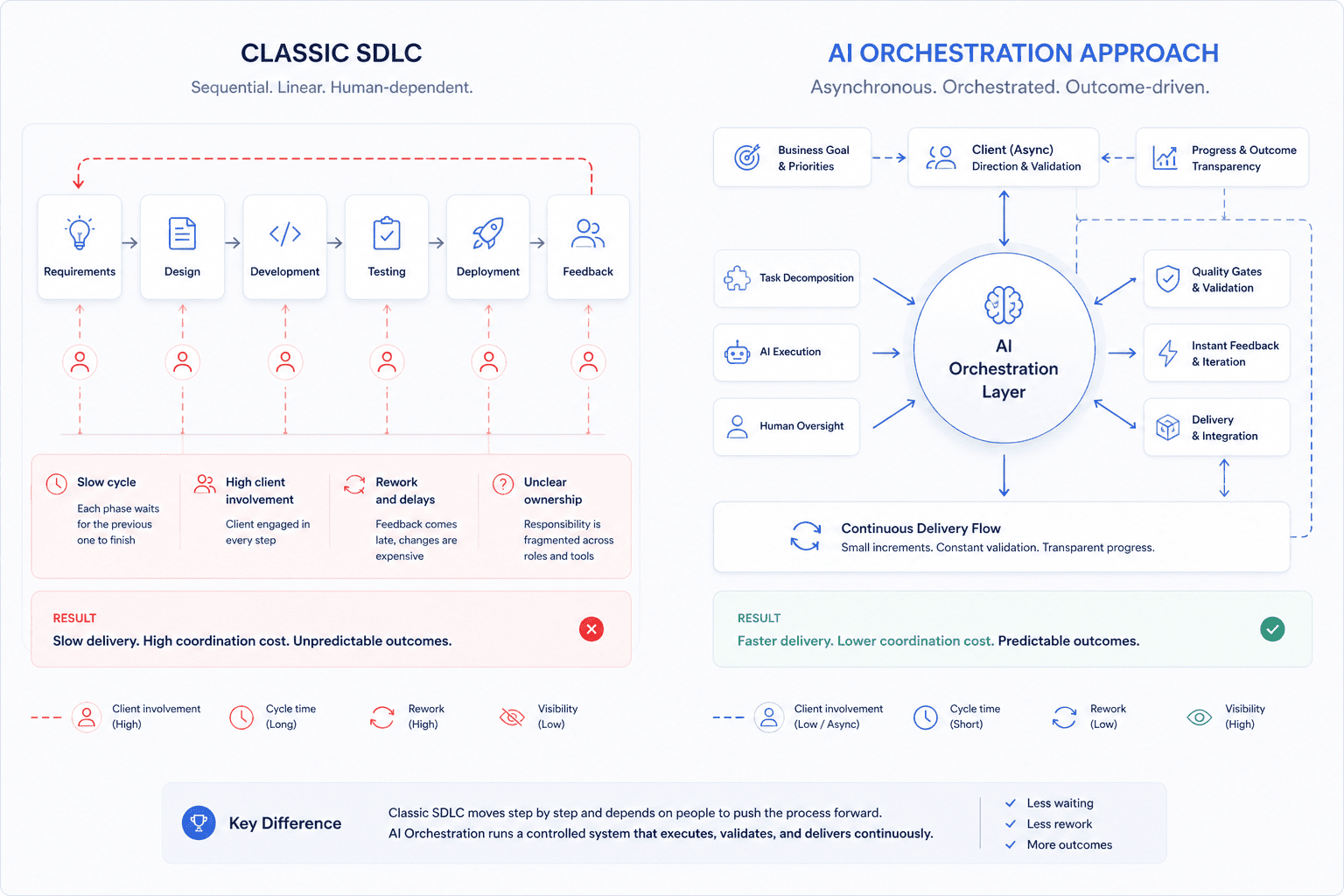
AI-orchestrated software development isn't a fundamentally different partnership model. The discovery phase is still discovery. Design is still design. Development, testing, and deployment remain. What changes is how AI integrates with each phase — and who or what is responsible for validating the output before the next phase begins.
In practice, this means connecting specific tools and validation steps to each SDLC phase:- AI-assisted validation during discovery;
- UX testing tools like Maze during design;
- code generation during development;
- automated regression tests with defined human-review gates;
- structured deployment checks.
Each stage runs faster, and each has a clear owner and a defined exit condition.
Wrapping up
AI orchestration isn't another fancy tool or assistant that accelerates generation or automates discovery & design stages throughout the product development phase. It's a completely different mental model & delivery approach that prevents AI from becoming a source of rework, overspends, and delays — by coordinating its actions, validating outputs, and allowing humans to intervene, redirect, or stop execution before issues scale.
Ready for more insights?
That’s not all we have to say about AI orchestration — for more useful information, dive into the full version on Goodface's website — including a comparison sheet of three delivery models, how this custom framework plugs into delivery, and how product leaders exactly benefit in this 25-30% more efficient partnership model.


