
From Portfolio Site to Sales System: How Agencies Should Rethink Their Website

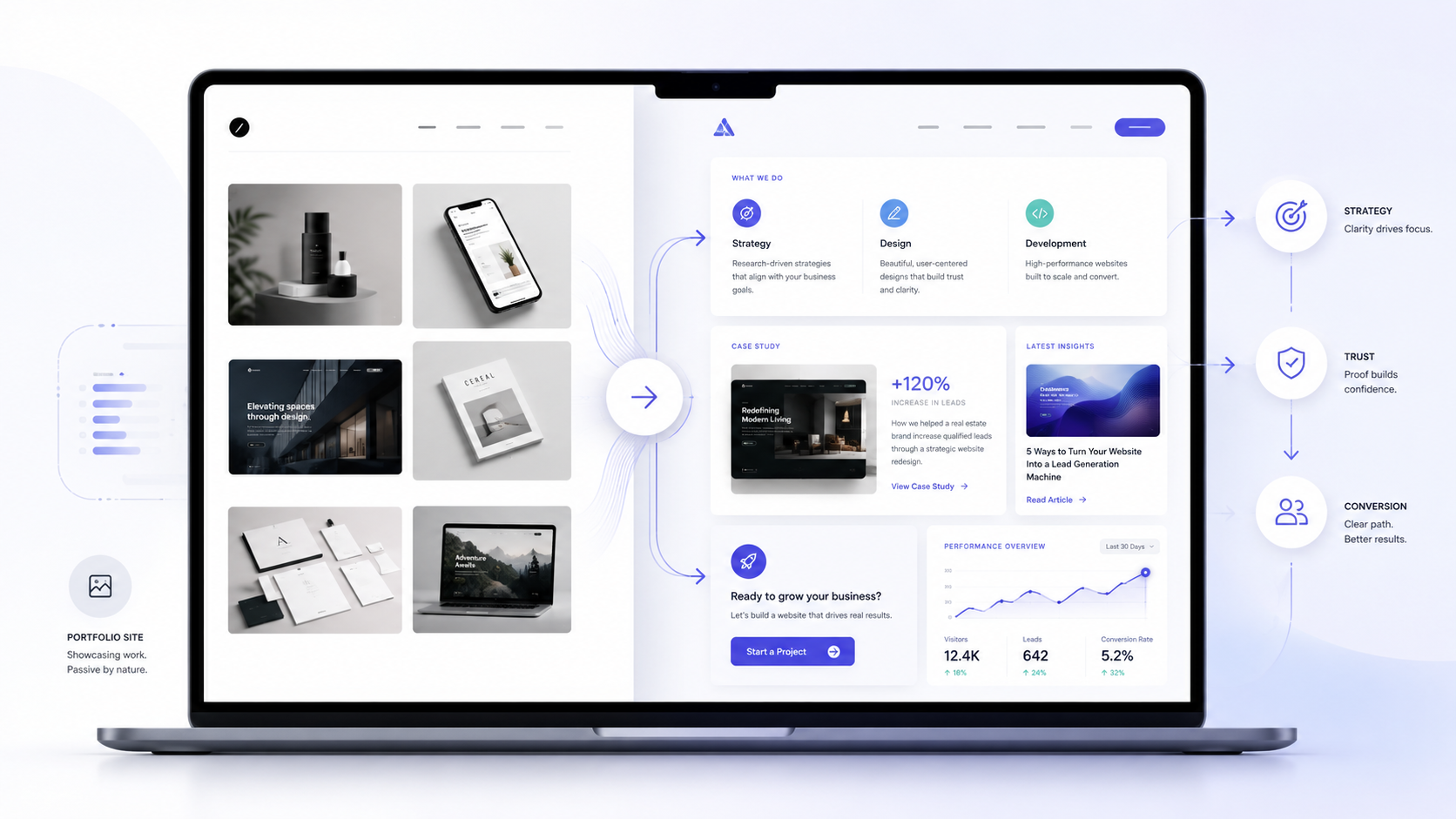
A digital agency website should do more than show finished projects. A portfolio can prove that the agency has experience, but it does not always explain why that experience matters, how the agency solves problems, or why a potential client should start a conversation. A good-looking gallery of work may create interest, but interest alone does not always turn into leads.
This is where many agency websites stay too passive. They present services, display case studies, add a contact form, and expect visitors to connect the dots themselves. But visitors often need more than proof that the agency can design, develop, write, optimize, or manage campaigns. They need a clear path from problem to solution. They need to understand what the agency does, who it helps, how it works, and what makes its approach credible.
A stronger agency website works more like a sales system. That does not mean using aggressive copy or forcing visitors into a call before they are ready. It means building a website where every important part has a role. The homepage creates direction. Service pages explain problems and solutions. Case studies build proof. Blog content attracts and educates. Internal links guide the visitor forward. Calls to action appear when the visitor has enough context to act.
This shift matters because a website is often the first real experience a client has with an agency. If the site feels slow, vague, inconsistent, or disconnected, it weakens the agency’s promise. If it feels clear, stable, specific, and easy to trust, it becomes more than a portfolio. It becomes a working part of the agency’s sales process.
Why a Portfolio Is No Longer Enough
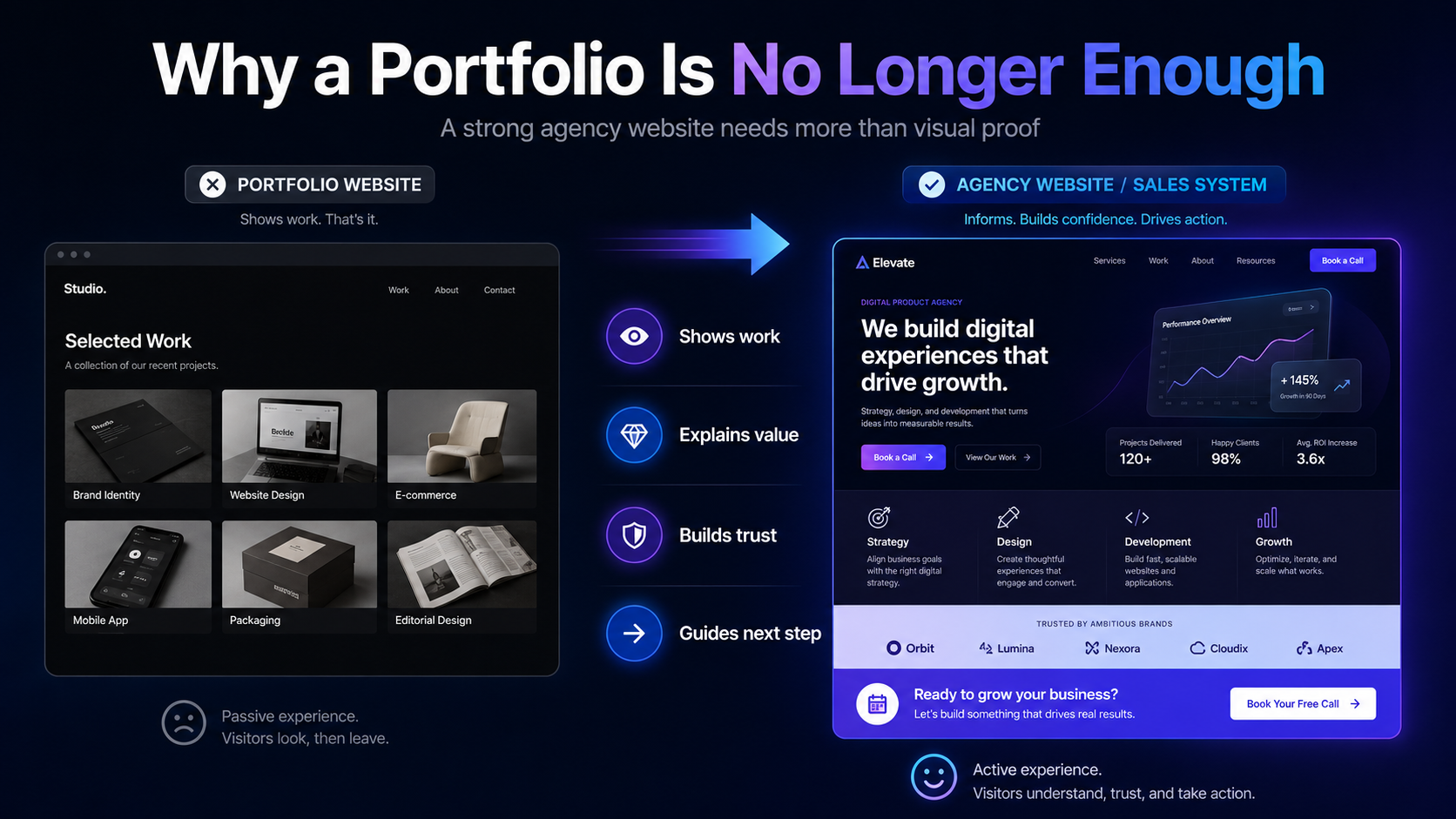
A portfolio shows what an agency has created. But it does not always explain why the work mattered, what problem was solved, or how the agency helped the client move forward.
That is the weakness of many agency websites. They show finished projects, but they do not build a full decision path for the visitor.
A portfolio alone may leave important questions unanswered:
- What kind of clients does the agency help?
- What problems does it solve best?
- How does the agency approach strategy?
- What makes its process different?
- What results or improvements can clients expect?
- What should the visitor do next?
A strong website needs more than visual proof. It needs positioning, service logic, case study context, clear calls to action, and a smooth route between pages.
This does not mean the portfolio is unimportant. It still matters. But it should work as one part of the sales system, not as the whole website strategy. A good case study should support trust. A good service page should explain value. A good homepage should guide the visitor toward the right next step.
What an Agency Website Sales System Actually Includes
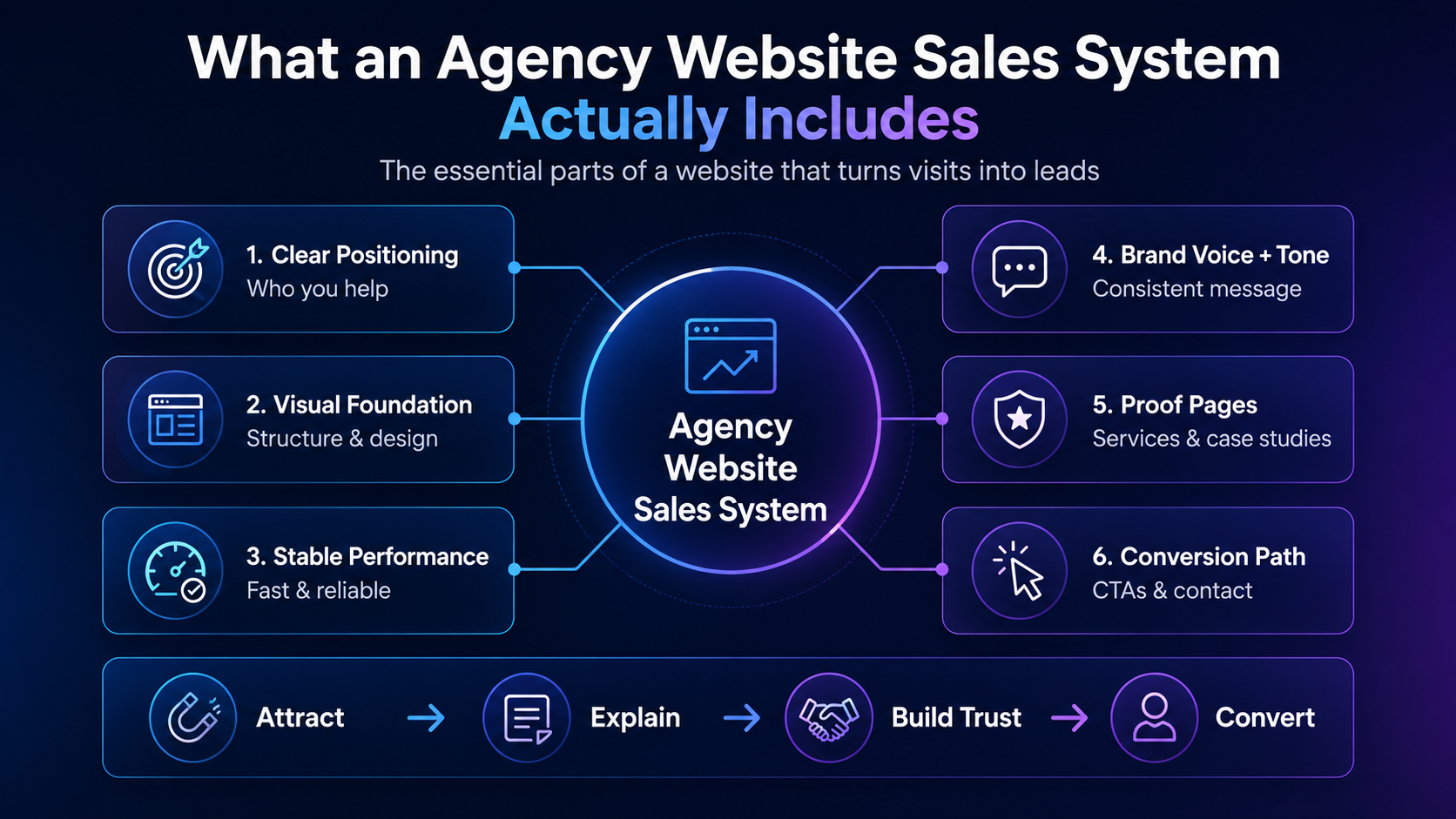
An agency website sales system is not about pressure. It is about helping the visitor move from attention to trust to action without confusion.
A strong sales system usually includes:
- clear positioning;
- a strong visual foundation;
- stable website performance;
- consistent brand voice;
- persuasive tone of voice;
- service pages built around real problems;
- case studies with proof and context;
- internal links between related pages;
- clear calls to action;
- a simple contact path.
Each element has a role. The homepage explains direction. Service pages show how the agency helps. Case studies prove the work. Blog content brings in relevant visitors. Internal links guide them forward.
The main goal is to avoid a passive website. Instead of making visitors guess what matters, the site should show the path clearly. It should answer the right questions at the right moment and make the next step feel natural.
Build the Right Structure Before You Think About Design
Before choosing colors, visuals, or animations, the agency should define the website structure. A sales-focused site needs a clear path, not just attractive sections.
The main structure should usually include:
- homepage for positioning and direction;
- service pages for specific problems and solutions;
- case studies for proof;
- blog content for traffic and education;
- contact page for simple conversion;
- internal links that connect these pages logically.
This structure helps visitors move through the site with less effort. They should not have to guess where to go after reading a service page or blog post.
Design should support this path. If the structure is weak, even a beautiful website can feel confusing. But when the page system is clear, design has a stronger job: making the journey easier to scan, understand, and trust.
Choose a Visual Foundation That Supports the Sales Journey
The website design should support the sales path, not only the portfolio. A good visual foundation helps visitors understand services, compare proof, read content, and move toward contact.
For many agencies, WordPress is a practical starting point because it can support:
- service pages;
- case studies;
- blog content;
- landing pages;
- CTA sections;
- contact forms.
A useful starting point is choosing a WordPress structure that can support services, case studies, blog content, and calls to action. This overview of digital agency WordPress themes can help compare practical options:
https://medium.com/@wwwebadvisor/best-digital-agency-wordpress-themes-mostly-free-a4f64e0bd03f
But the theme is not the sales system by itself. It gives the site structure and visual rhythm, but the agency still needs clear positioning, strong service pages, stable performance, proof, and consistent messaging.
Make Performance Part of the Sales Path
Performance is not only a technical issue. On an agency website, it directly affects the sales path. If the homepage loads well but a service page feels slow, the visitor’s confidence can drop before they reach the CTA.
Performance problems often appear at the worst moments:
- when a visitor opens a service page;
- when they view a case study;
- when they browse on mobile;
- when they click a contact form;
- when scripts, images, or plugins make pages heavier.
A sales-focused website needs performance that feels stable across the whole journey, not only in one test. This article explains why website performance can feel inconsistent in real use:
https://volodymyrzh.medium.com/why-website-performance-is-inconsistent-88d33b1a6eba
The goal is not to chase a perfect score. The goal is to remove friction. Visitors should be able to move from homepage to service page, from proof to contact, without noticing delays or instability.
When performance supports the journey, the website feels more professional. When it breaks the journey, even strong design and good copy become less persuasive.
Define the Brand Voice Before Writing Sales Pages
Sales pages become weaker when every page sounds different. The homepage may sound confident, the service page may sound generic, and the contact page may sound cold. That makes the website feel less like one system.
Before rewriting sales pages, the agency needs a clear voice system. This guide explains how to define brand voice step by step:
https://seolabsdp.blogspot.com/2026/04/how-to-define-brand-voice-step-by-step.html
Brand voice helps define how the agency should sound across:
- homepage sections;
- service pages;
- case studies;
- blog articles;
- CTAs;
- contact forms.
This matters because clients judge the agency’s thinking through its words. If the website sounds clear, focused, and consistent, the offer becomes easier to trust. If the voice changes from page to page, the sales path feels less reliable.
Use Tone of Voice to Make CTAs Feel Natural
A CTA does not work only because the button is visible. It works when the visitor already understands the value, trusts the message, and feels that the next step makes sense.
Tone of voice helps make that moment feel natural. It affects:
- headlines;
- service descriptions;
- CTA text;
- form microcopy;
- case study summaries;
- contact page messages.
Once the brand voice is defined, tone of voice helps apply it in real conversion moments. These tone of voice examples show how wording can make website copy clearer and more persuasive:
https://seolabsdp.blogspot.com/2026/04/tone-of-voice-examples-that-convert.html
The goal is not to make CTAs louder. The goal is to make them fit the journey. A calm, expert agency may need a different CTA than a bold creative studio. A technical agency may need more clarity before the ask.
When tone matches the offer, CTAs feel less forced. They become a logical next step instead of a sudden sales push.
Turn Service Pages Into Decision Pages
A service page should not only describe what the agency offers. It should help the visitor decide whether the service fits their problem.
A strong service page usually answers:
- What problem does this service solve?
- Why does the problem matter?
- How does the agency approach it?
- What is included in the service?
- What proof supports the offer?
- What should the visitor do next?
This is the difference between a service page and a decision page. A service page lists capabilities. A decision page explains value, reduces doubt, and connects the offer to a real business situation.
The best pages are specific. Instead of saying “we create effective marketing strategies,” the agency should explain what kind of strategy, for what type of client, and what problem it helps solve.
When service pages are built around decisions, the website becomes more useful. Visitors do not just learn what the agency does. They understand why it may be the right next step.
Make Case Studies Work as Proof, Not Decoration
Case studies should do more than show finished work. A nice screenshot, client logo, or short project note can make the portfolio look active, but it may not prove enough.
A strong case study should explain:
- what problem the client had;
- why that problem mattered;
- what the agency changed;
- how the process worked;
- what result or improvement followed;
- what the case proves about the agency.
This turns a case study into sales support. The visitor can see not only what the agency created, but how it thinks and solves problems.
The tone should stay specific and credible. Broad claims like “we transformed the brand” or “we delivered amazing results” need context. The case study should show what changed and why that change was valuable.
When case studies connect problem, process, and proof, they stop being decoration. They help visitors trust the agency before the first conversation.
Use Blog Content to Feed the Sales System
Blog content should not sit outside the sales journey. It can attract visitors through search, but it should also help them understand the agency’s expertise, point of view, and services.
A strong agency blog can support the sales system by:
- answering real client questions;
- explaining problems before the sales page;
- linking readers to relevant services;
- supporting case studies with context;
- showing how the agency thinks;
- building trust before direct contact.
This does not mean every article should sound like a pitch. Educational content works better when it helps first. But each post should still connect to the bigger website strategy.
If the blog brings traffic but does not guide readers anywhere, it becomes a disconnected content archive. If it connects topics, services, proof, and next steps, it becomes part of the sales system.
Conclusion: A Portfolio Shows Work, but a Sales System Builds Trust
A portfolio can show that an agency has experience. But experience alone does not always create enough trust to make a visitor take action. A stronger agency website needs to explain the value behind the work, guide the visitor through the offer, and make the next step feel clear.
That is why an agency website should work as a sales system, not only as a gallery. The structure should help visitors understand what the agency does. The design should support the journey. Performance should remove friction. Brand voice should keep the message consistent. Tone of voice should make CTAs and service pages feel natural. Case studies and blog content should build proof instead of sitting apart from the main website.
The goal is not to make the website aggressive or overloaded with sales language. The goal is to make it useful, clear, and trustworthy. When every part of the site has a role, visitors do not have to guess why the agency matters or what they should do next.
A portfolio shows the work. A sales system explains the value, builds confidence, and turns attention into real business opportunities.


