
Launch Green-Tech Products Around Customer Scenarios, Not Feature Announcements

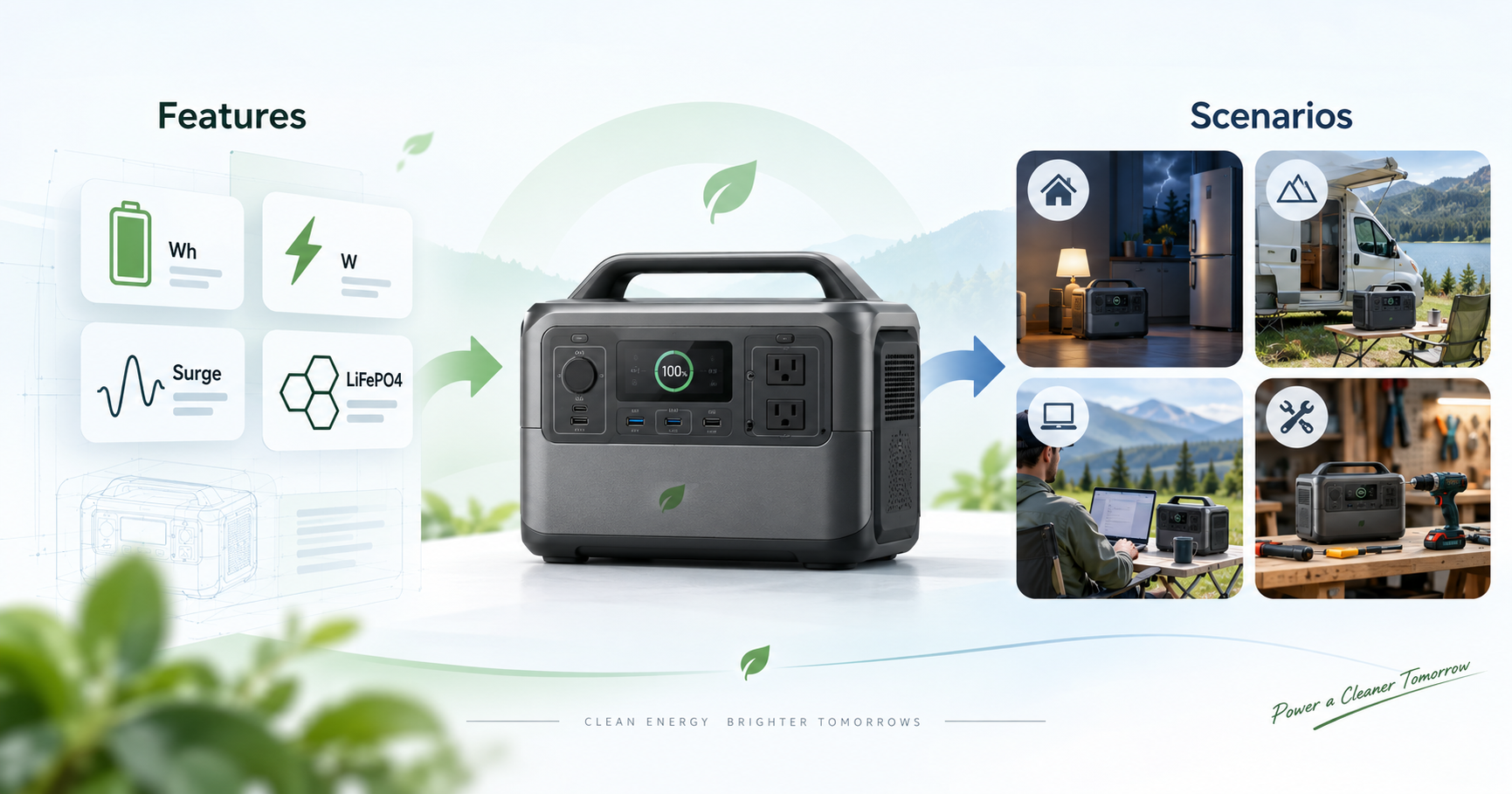
Green-tech product launches often begin with the specification sheet.
2,048 Wh. 2,400 W. 4,800 W surge. LiFePO4. Fast charging. 4,000 cycles.
For the product team, those numbers may represent years of engineering decisions. For the customer, they can still leave the most important questions unanswered.
Will it keep essential devices running through a blackout? Can it handle a workshop tool with a high startup load? Is it enough for a camper overnight? Will it recharge quickly enough to be useful again the next day?
This is where many product launches lose clarity. They announce what the product has, but do not immediately explain what the customer can actually do with it.
A feature-led launch forces the buyer to translate technical specifications into real-world consequences. They must work out whether watt-hours are enough for the required runtime, whether continuous output can support their appliances and whether peak power matters for motors, pumps or compressors.
A scenario-led launch reverses that process.
Instead of starting with:
“Here are the specifications of our new product.”
the campaign starts with:
“Here is the situation this product is designed to handle.”
For a portable energy system, that could mean a night of essential home backup, a mobile workshop, an off-grid weekend, remote work or emergency power. The product remains the same, but the story changes according to the customer’s actual job to be done.
That shift — from feature announcement to customer scenario — can make technical products easier to understand, easier to compare and easier to position.
Feature Announcements Are Easy to Produce — and Easy to Ignore
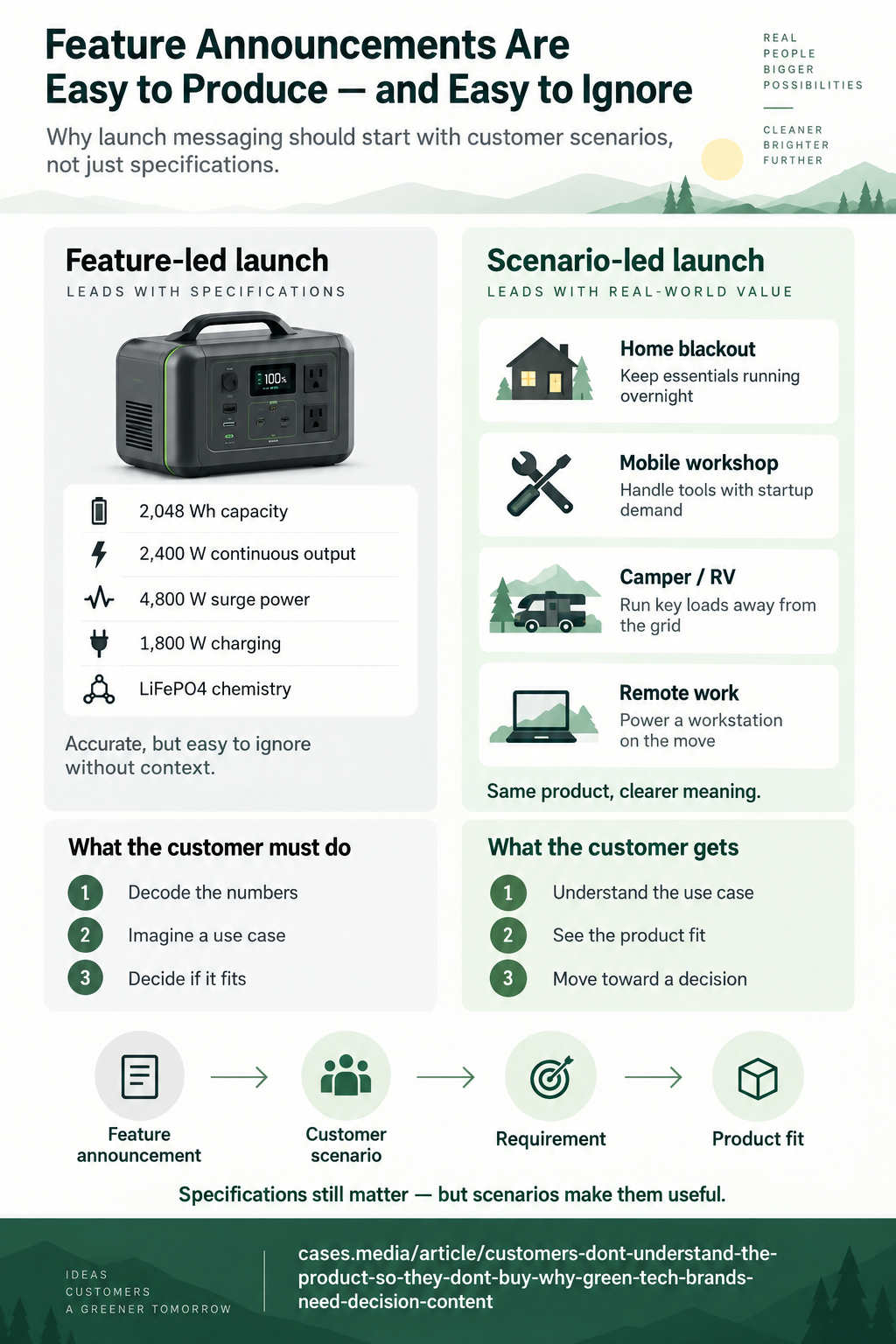
Feature-led launches are popular for a simple reason: they are easy to build.
The product team already has the numbers. The engineering team has validated them. The marketing team can turn them into a launch page, press release, comparison table and social graphics without much interpretation.
That usually produces messaging like:
2,048 Wh capacity
2,400 W continuous output
4,800 W surge power
1,800 W charging
LiFePO4 chemistry
Everything may be accurate. The problem is that accuracy does not automatically create relevance.
A customer does not usually begin with the question:
“Which product has 2,048 Wh?”
They begin with a situation.
They may need backup power during an outage, enough energy for a camper overnight, reliable electricity for a remote workstation or enough output to run tools away from the grid.
That means a feature announcement often starts one step too early.
The customer must first decode the specification, then connect it to a use case, then decide whether the product fits. Every additional interpretation creates friction.
Compare these two launch messages.
Feature-led:
2,048 Wh capacity, 2,400 W output, 4,800 W surge and fast charging.
Scenario-led:
Keep essential home devices running during an overnight outage, with enough output to handle appliances that briefly require more power when they start.
The second version does not eliminate specifications. It gives them a reason to exist.
This is especially important in green-tech categories because the products often combine several technical dimensions at once: capacity, output, charging rate, efficiency, chemistry, lifetime and operating conditions.
When all of those numbers are announced at the same level, the customer has to decide which ones matter.
A stronger launch creates that hierarchy for them.
The specification still belongs on the page. It just should not have to carry the entire product story.
Customer Scenarios Turn Technical Specs Into Meaning
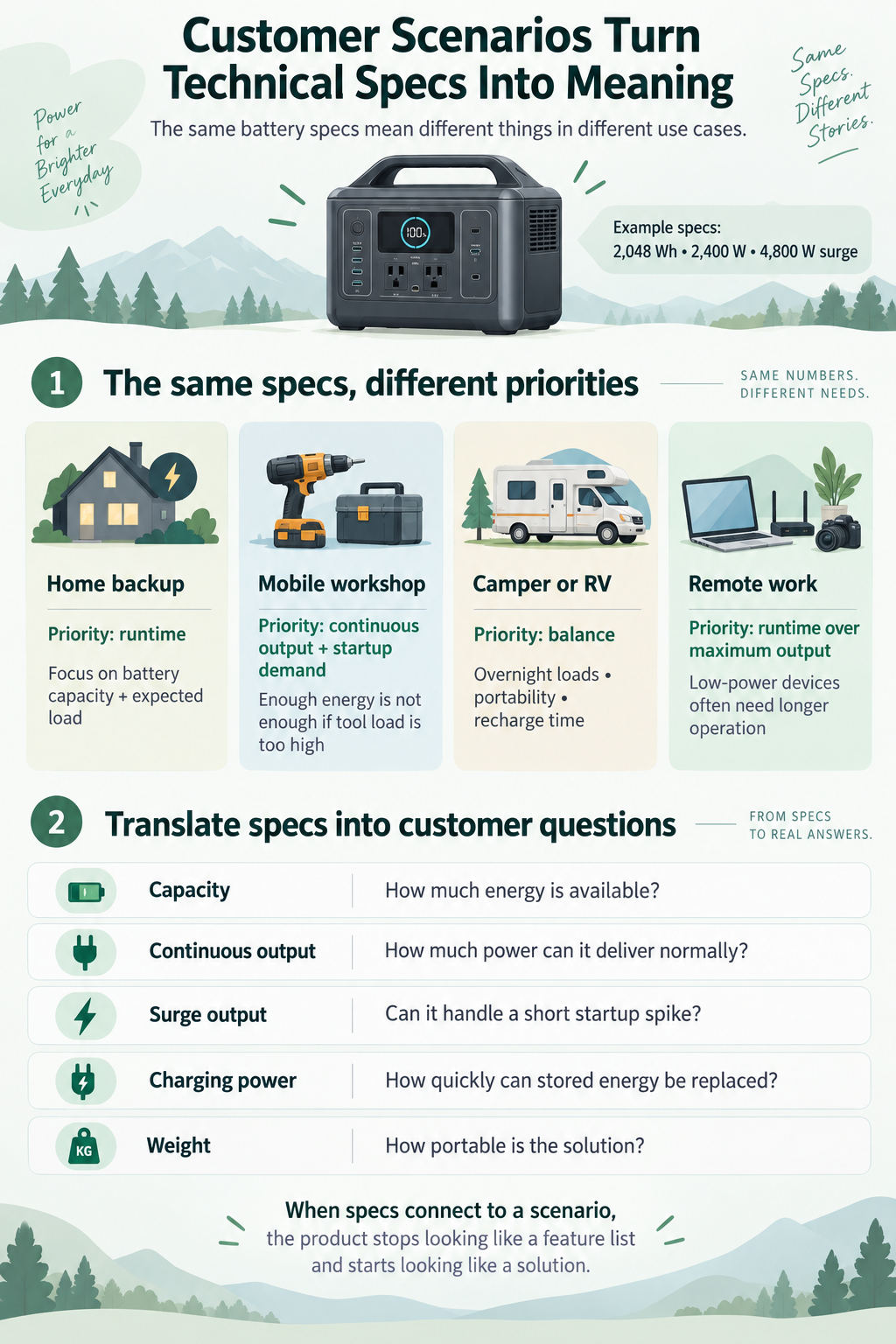
Technical specifications become easier to understand when they are attached to a specific situation. A portable power station may have the same 2,048 Wh capacity, 2,400 W continuous output and 4,800 W surge power for every customer, but those numbers mean different things depending on the use case.
- Home backup: runtime becomes the priority, so battery capacity and expected load matter most.
- Mobile workshop: continuous output and startup demand may matter more; plenty of stored energy is useless if the system cannot support the tool load.
- Camper or RV: the customer balances overnight energy needs, cooking or heating loads, portability and recharge time.
- Remote work: laptops, monitors, routers and cameras may require relatively little power, making runtime more important than maximum output.
This is why specifications should not disappear from product marketing. They should be organised around the customer’s problem.
A capacity number becomes much easier to interpret when the customer can connect it to the devices they actually need to run. A practical approach is to start with the device load and required runtime instead of choosing a battery size first:
https://digitalowl.fika.bar/how-much-battery-capacity-does-a-device-need-01M2JVYX8GC5RDZQS859RWT5XB
The same logic applies across the specification sheet:
- Capacity: How much energy is available?
- Continuous output: How much power can the system deliver normally?
- Surge output: Can it handle a short startup spike?
- Charging power: How quickly can the stored energy be replaced?
- Weight: How portable is the solution?
Once those numbers are connected to a scenario, the product stops looking like a collection of technical features and starts looking like a solution to a specific job.
Build the Launch Around Jobs, Not Product Categories
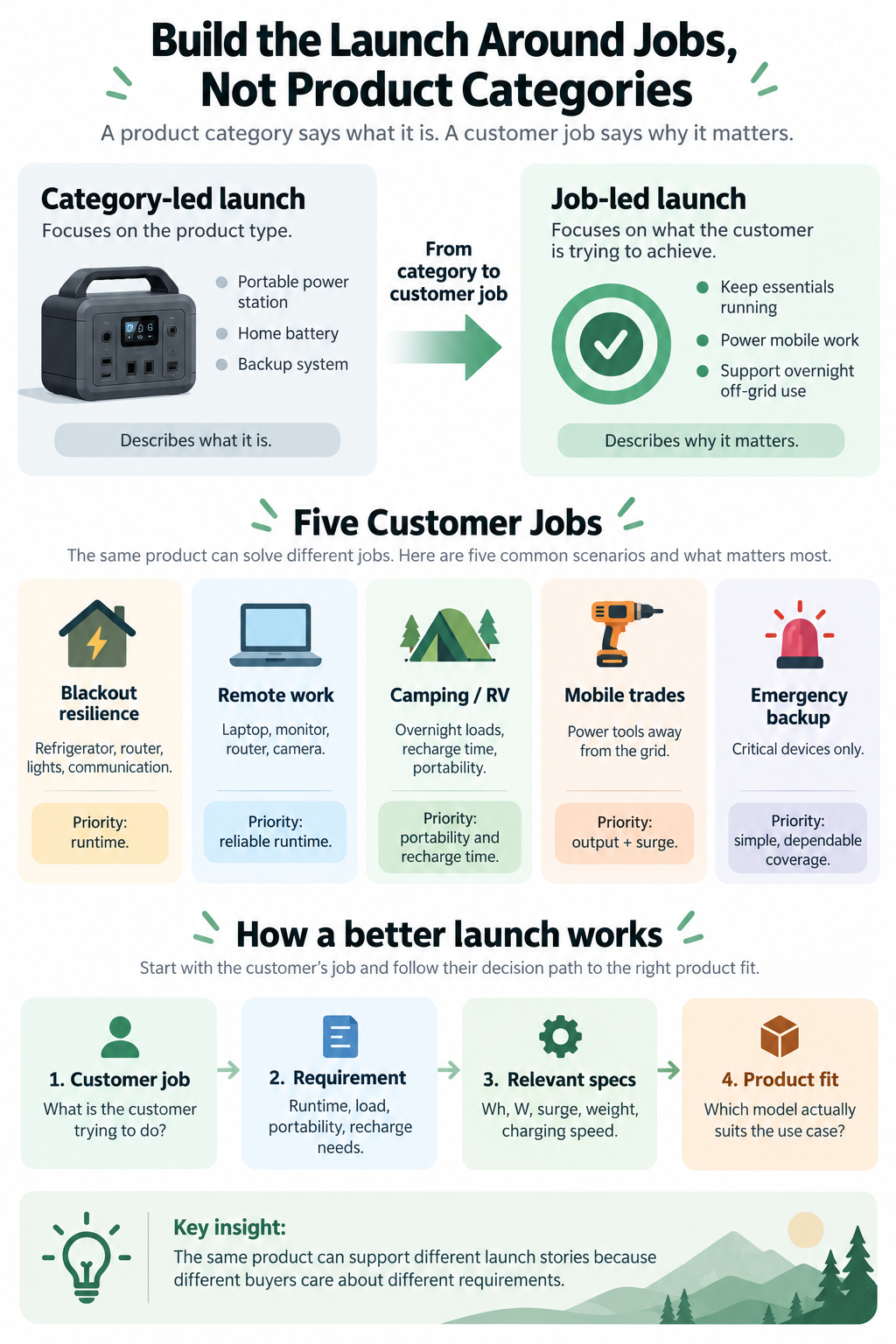
A product category tells the customer what something is. A job tells them why it matters.
“Portable power station” is a category.
“Keep essential devices running during an outage” is a job.
That distinction changes how the launch should be structured. Instead of organising the campaign around product features alone, the brand can organise it around the situations customers are trying to solve.
- Blackout resilience: keep refrigerators, routers, lights and communications running.
- Remote work: power laptops, monitors, cameras and connectivity away from the grid.
- Camping or RV use: support overnight loads while keeping portability and recharge time manageable.
- Mobile trades: run tools where grid power is unavailable.
- Emergency backup: maintain a limited set of critical devices when normal power fails.
The same hardware can serve several of these jobs, but each customer evaluates it differently.
A blackout buyer may care most about runtime. A contractor may care about continuous and surge output. A camper may care about weight, noise and recharge options. A remote worker may need far less peak power but much longer operation.
This is where jobs-to-be-done thinking becomes useful for product marketing. The launch does not need to ask, “Which audience segment are we targeting?” first. It can ask:
“What is the customer trying to accomplish, and what information do they need to decide whether this product fits?”
That makes the launch more flexible because one product can support several decision paths without pretending that every customer values the same specification.
Comparison tools and decision trees are especially useful when several jobs overlap. They can guide the customer from scenario to requirement and then to the most relevant product attributes:
https://seolabsdp.blogspot.com/2026/09/comparison-tools-and-decision-trees.html
A stronger launch therefore moves from:
Product category → feature list
to:
Customer job → requirement → relevant specs → product fit
That is a much better foundation for positioning, campaign creative and product-page structure.
A Good Launch Needs a Decision Path
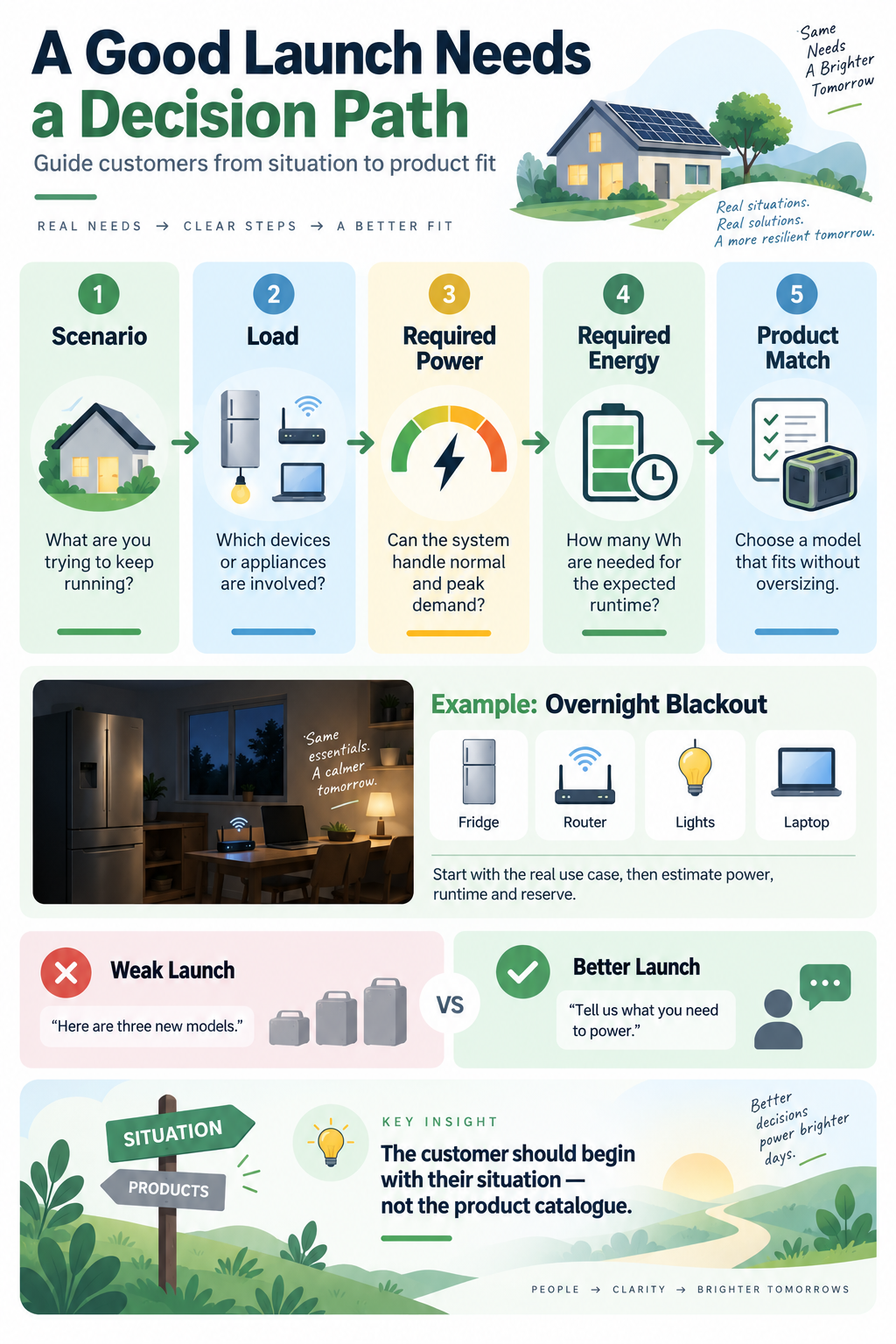
A strong product launch should not stop at describing a scenario. It should help the customer move from that scenario to a product choice.
A simple decision path looks like this:
Scenario → Load → Required Power → Required Energy → Product Match
For example, a customer planning for an overnight blackout might start with a refrigerator, router, lights and laptop. The next step is to estimate how much power those devices use, how long they need to run and whether any of them create short startup peaks.
That produces a much more useful launch experience than a generic “2,048 Wh / 2,400 W” message.
The customer can move through the decision in stages:
- Scenario: What are you trying to keep running?
- Load: Which devices or appliances are involved?
- Power requirement: Can the system handle the normal and peak demand?
- Energy requirement: How many watt-hours are needed for the expected runtime?
- Product match: Which model provides enough capacity and output without unnecessary oversizing?
This is where launch content can become interactive instead of purely promotional.
A sizing workflow can help the customer estimate the battery requirement from real loads, runtime, efficiency losses and a safety margin:
The advantage is that the customer does not have to begin with a product catalogue. They begin with their own situation and arrive at the relevant specification range.
That changes the role of the launch page.
Instead of saying:
“Here are three new models.”
it can say:
“Tell us what you need to power, and we’ll help you understand which model fits.”
That is a much stronger bridge between product marketing and customer decision-making.
Peak Power Can Change the Recommended Product
Two customers can need roughly the same amount of stored energy and still require different products.
The difference may be peak power.
A laptop, router and lights usually create a relatively steady load. A refrigerator, pump, compressor or power tool can briefly demand much more power when it starts.
That changes the buying decision.
- Low-surge setup: capacity and runtime may be the main priorities.
- Motor-driven appliance: startup demand can become the limiting factor.
- Workshop tools: short high-power bursts may matter more than average consumption.
- Mixed backup loads: both stored energy and surge capability need to be checked.
This is why launch messaging based only on battery capacity can be misleading. A 2 kWh system may contain enough energy for the planned runtime but still be a poor fit if its inverter cannot handle a startup spike.
Average and peak power therefore answer different questions:
- Average power: How much power does the load typically use?
- Peak power: How high can demand briefly rise?
- Continuous output: Can the system support the normal load?
- Surge output: Can it tolerate the short spike?
A practical explanation of that difference is available here:
https://digitalowl.fika.bar/average-power-vs-peak-power-01M2K4KCTV720ZHP7EVSTJP6M6
For product launches, the lesson is simple: two customers with similar energy needs may still belong in different product recommendations.
That is another reason to build the launch around real scenarios rather than one headline capacity number.
One Product Can Need Several Launch Stories
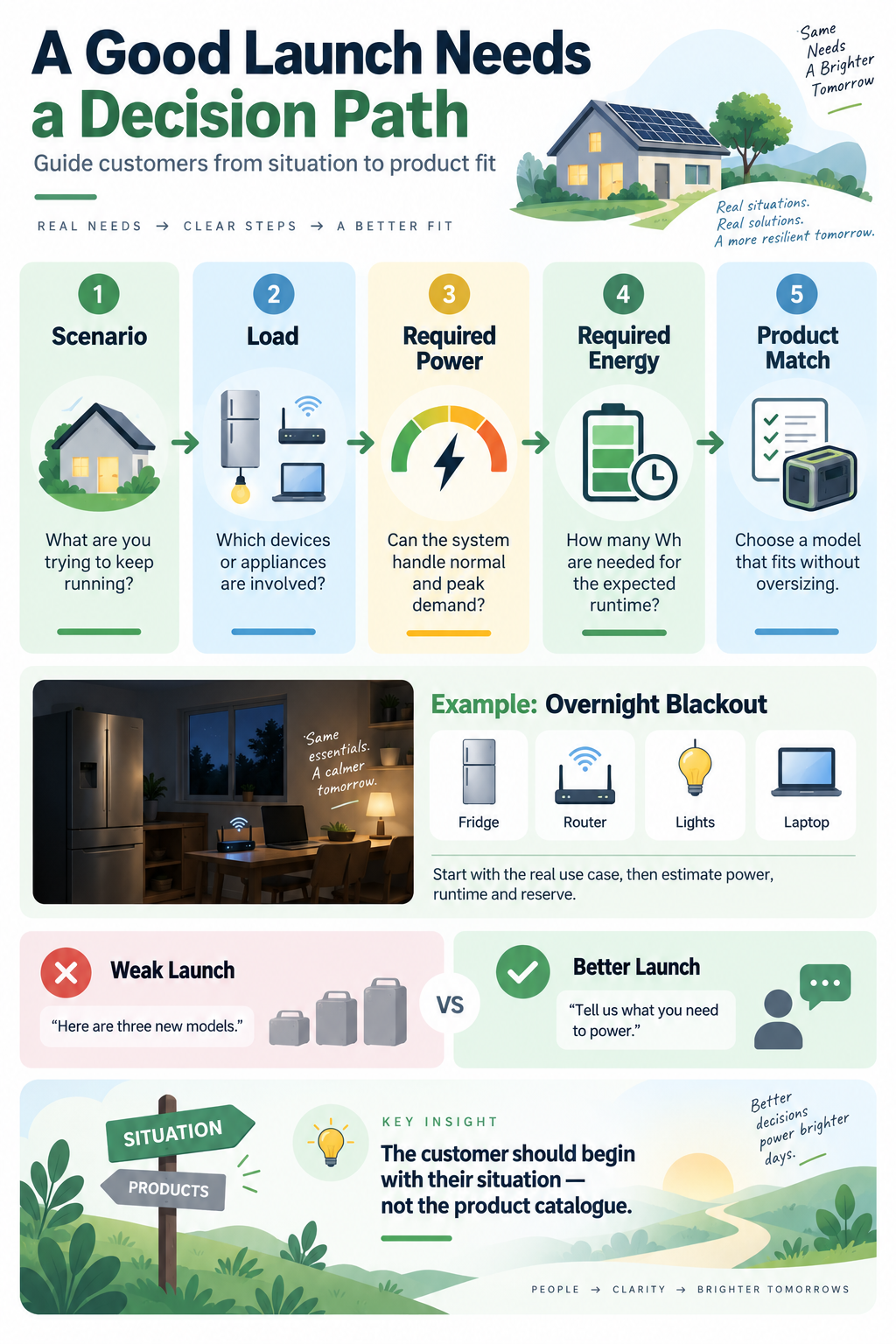
A single green-tech product does not need a single marketing story. The hardware stays the same, but different customers notice different benefits because they are trying to solve different problems.
- Blackout story: keep essential devices running when grid power disappears.
- Remote-work story: maintain laptops, routers, cameras and communication equipment away from fixed power.
- Camper story: cover overnight loads without relying on a generator.
- Workshop story: support tools with higher continuous or startup demand.
- Emergency story: maintain a limited set of critical devices during an unexpected outage.
Each story can emphasise a different part of the same specification sheet:
- Blackout: runtime and essential loads.
- Workshop: continuous output and surge capability.
- Camper: portability and recharge options.
- Remote work: predictable low-power operation over many hours.
This gives creative teams more ways to present the product without inventing new claims. The same technical facts can become:
one product page → several landing pages → several ad concepts → several short videos → several social narratives
The specifications stay consistent. Only the customer context changes.
The product remains one product; the stories multiply because the jobs are different.
Turn the Sizing Logic Into an Interactive Launch Asset
A scenario-led launch becomes much stronger when the customer can test their own situation instead of reading a fixed example.
For a power product, that could mean a simple selector that starts with:
What do you need to power?
The customer chooses devices, enters the expected runtime and moves through a short decision flow:
- Select the load: refrigerator, router, laptop, pump, tools or other equipment.
- Set the runtime: how long should those devices operate?
- Check power demand: does the system need to handle high continuous or startup loads?
- Estimate energy: how many watt-hours are required?
- Add reserve: account for losses and a practical safety margin.
- Match the product: show which model fits the requirement without unnecessary oversizing.
This turns the launch from a presentation into a useful decision tool.
Instead of forcing customers to compare several specification tables, the brand can let them begin with their own problem and gradually reveal which specifications matter.
The same logic can also support multiple launch assets:
calculator → product selector → comparison page → sales tool → campaign landing page
That creates a useful bridge between marketing and product education. The launch still introduces the product, but it also helps customers answer the question that matters most:
“Is this the right size for what I actually need?”
Build Creative Assets Around Scenarios Too
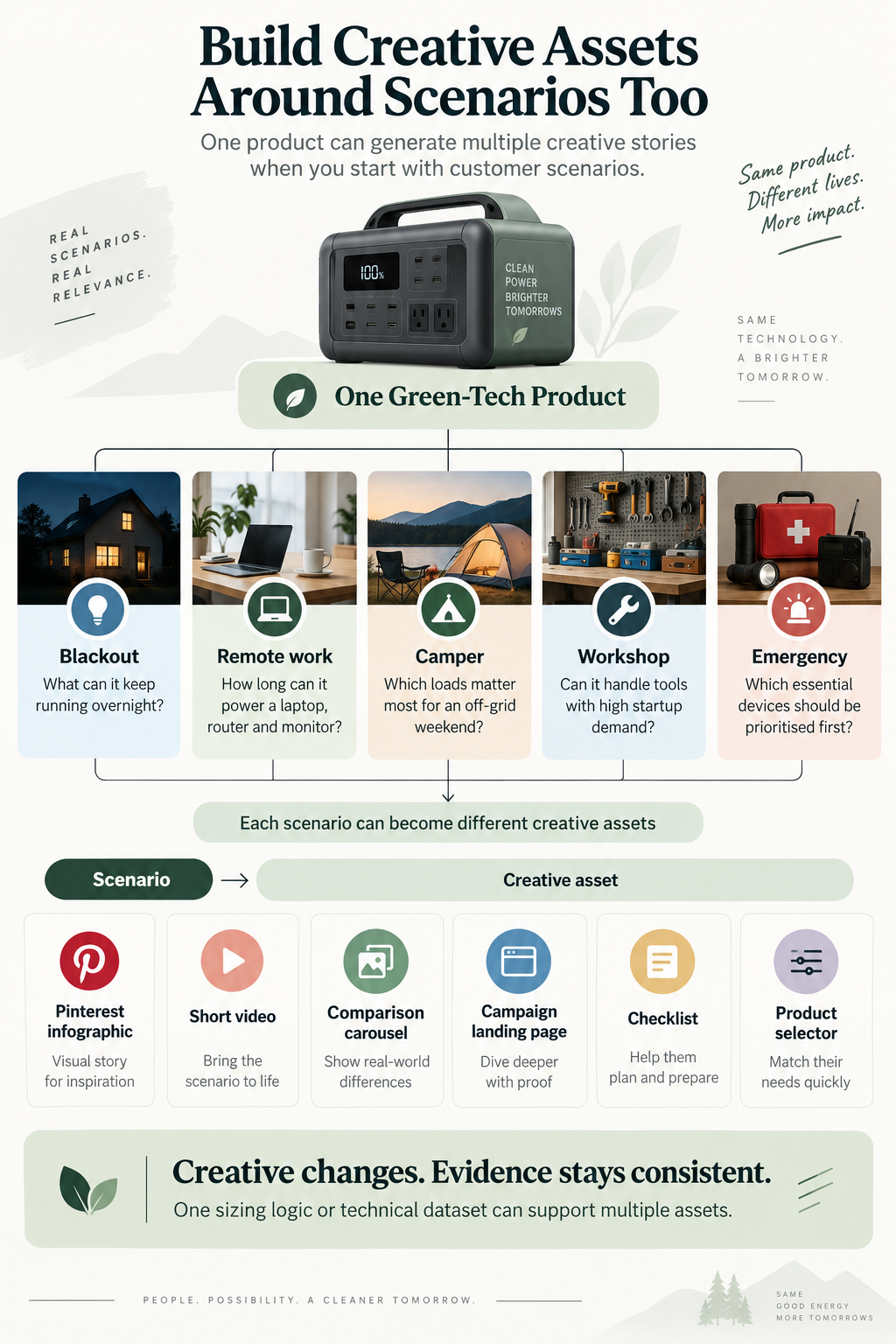
Scenario-led thinking should not stop at the launch page. It can shape the entire creative system around the product.
Instead of producing one generic visual built around specifications, the team can turn each customer scenario into a separate asset with its own message.
- Blackout: “What can this system keep running overnight?”
- Remote work: “How long can it power a laptop, router and monitor?”
- Camper: “Which loads matter most for an off-grid weekend?”
- Workshop: “Can it handle tools with high startup demand?”
- Emergency: “Which essential devices should be prioritised first?”
Those scenarios can then become different formats:
Pinterest infographic → short video → comparison carousel → campaign landing page → checklist → product selector
The advantage is that the creative starts with a customer question instead of a design brief built around product features.
A strong infographic might explain one scenario visually. A short video can demonstrate the same use case in 60–90 seconds. A comparison carousel can show how the recommended product changes when runtime, load or portability becomes more important.
This also makes campaign production more efficient. One technical dataset or sizing framework can support several assets without changing the underlying claims.
The creative changes.
The evidence stays consistent.
That is especially useful in green-tech marketing, where the same product may need to speak to homeowners, mobile professionals, campers, tradespeople and emergency-preparedness buyers without becoming five different products.
Launch Metrics Should Measure Understanding, Not Just Reach
A product launch can generate strong reach and still leave customers confused.
Impressions, clicks and CTR are useful, but they mainly show whether the campaign attracted attention. For a technical product, the more important question is whether the launch helped people understand what fits their situation.
Useful indicators can include:
- Calculator starts: Are customers trying to estimate their own requirement?
- Product-selector completions: Are they reaching a concrete recommendation?
- Comparison interactions: Are they actively evaluating trade-offs between models?
- FAQ usage: Which technical questions still create uncertainty?
- Scenario-page engagement: Which use cases attract the strongest interest?
- Assisted conversions: Does educational content appear in journeys that lead to sales?
- Sales-question patterns: Are basic specification questions decreasing after the launch?
These signals can reveal something that traffic metrics cannot: whether the campaign is reducing decision friction.
For example, a launch page may receive fewer total visits than a broad promotional campaign but produce more completed product selections, deeper comparison activity and fewer repetitive questions for sales teams.
That can be a stronger outcome.
The most useful launch metrics therefore connect three layers:
Attention → Understanding → Decision
Reach tells you whether people arrived.
Decision-support metrics tell you whether the launch helped them move forward.
How to Audit a Green-Tech Launch Before It Goes Live
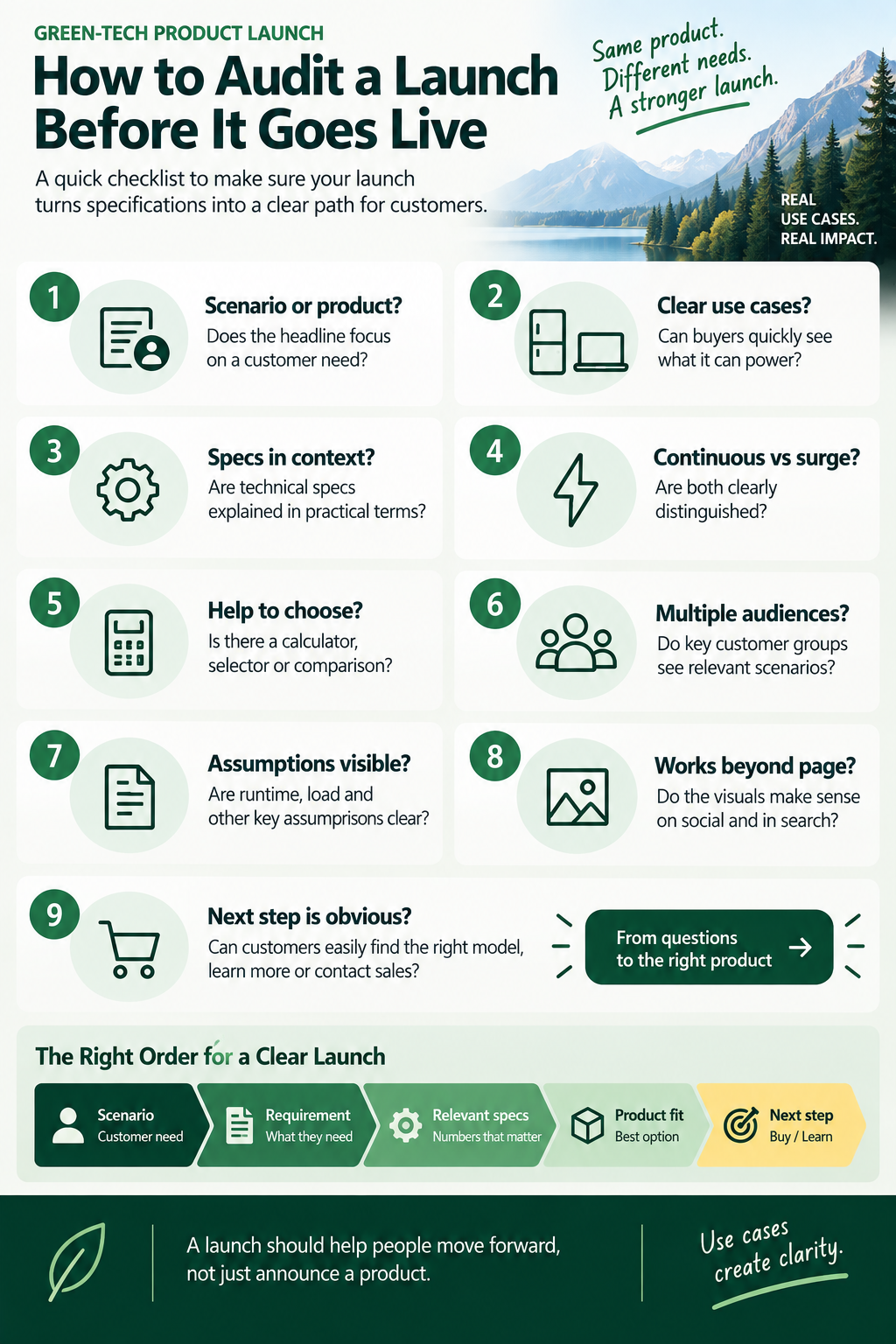
Before launch, review the campaign from the customer’s point of view rather than the product team’s.
Use this checklist:
- Does the headline describe a customer scenario or only the product?
- Can buyers quickly understand what the product can actually power or support?
- Are technical specs translated into practical consequences?
- Are continuous and peak power clearly separated where relevant?
- Is there a sizing, comparison or selection path for customers who need help choosing?
- Do different customer groups see scenarios that reflect their actual jobs to be done?
- Are assumptions behind runtime, performance and savings claims visible?
- Can the main creative assets still make sense when seen outside the launch page?
- Is the next step obvious once the customer understands their requirement?
A launch can pass every technical review and still fail this audit if the customer has to decode the message alone.
The goal is not to remove specifications. It is to place them in the right order:
Scenario → Requirement → Relevant specs → Product fit → Next step
If that sequence is clear, the launch is much more likely to function as decision support instead of just another product announcement.
Launch the Use Case, Not the Specification
A green-tech product launch should not force customers to decode the specification sheet before they understand why the product matters.
The strongest structure is usually:
Customer scenario → Requirement → Relevant specs → Product fit → Decision
That sequence keeps technical information important without making it the starting point.
Blackout buyer: starts with the devices that must keep running, not watt-hours.
Contractor: starts with the tools that must operate, not surge power.
Camper: starts with required off-grid runtime and loads, not battery chemistry.
Specifications become useful once the scenario gives them context.
This does not mean removing technical detail. Green-tech buyers often need information about capacity, power, efficiency, chemistry, lifetime and charging constraints. The better approach is to reveal that detail in the order the customer needs it:
Start with the situation.
Define the requirement.
Show which specifications matter.
Connect those specifications to the right product.
The same logic can shape product positioning, campaign creative, comparison content, sales materials, calculators, videos and customer education.
The product still needs strong specifications.
But the specification is not the story. The customer scenario is.


