

A customer’s quote can be verbatim, and still mislead the business.
Reading time ~ 8 min
What a quote is and why the client needs it
A quote is a verbatim fragment of a respondent’s words that we use to show what they think.
Why does it matter to us? The client who commissioned the research will not listen to the interviews. In fact, they are unlikely to be paying you for the recordings. More often, the quotes in your report are the only “live voice of the customer” the client will ever hear. A quote is what makes a conclusion persuasive, and a decision “grounded in real human needs”.
Hence a simple rule: the more accurately a quote conveys what a person thinks, the more on target the decision built on it will be. In practice, a quote will be read and, most likely, taken literally, without asking what it meant and why it was said. And this may be exactly the line at which a well-conducted interview produces poor conclusions, and poor actions afterwards, with the quote as the cause.
1. Is a transcript a set of quotes? No
A transcript is an artefact of the interview. It can be extremely valuable, or it can become one more file among hundreds.
An interview transcript is a set of thoughts, often disjointed and hard to understand without context. Respondents differ: they understand even the same question in different ways, and they differ in skill and in willingness to talk. The text is full of “um” and “mm-hm” and of your own questions. That is natural: not every answer lies on the surface, and what you come to an interview for is mostly considered views.
In my practice, a study rarely has a single research request or one narrow topic. More often we explore sets of causes, problems and needs, or a journey: the sequence of actions that led a person to a decision, their expectations, their pain points, and a few adjacent topics.
Interviewing and analysis are two different states for a researcher:
• The interview. While you listen actively, you are also rearranging questions in your head: the respondent has already opened a topic you haven’t asked about yet; has given an answer that needs clarifying; has drifted away from the subject and needs to be brought back. It is a bit like painting by numbers where you are given only the number, and have to guess the shade and the section yourself.
• The analysis. Sets of thoughts, claims and short stories, linked together like the threads of yarn in a plaid sweater. At first they all look equally valuable, equally strong contenders for the main colour. Only by unpicking all these threads, knots and loops, while holding the research task in working memory, can you make out the sweater’s colour pattern, that is, find “what the speaker meant to say”.
And this is exactly where the skill of choosing the right quotes comes in: to convey the essence you caught, so that a person reading for five seconds grasps it the way you meant it. If all they get is an extract from the transcript, it may lack emotional tone, context, and the answer to the question “Why?”.
I used to think that quotes convey a person’s thought. I still do. But they convey the thought, not the essence of the answer to the research request. My understanding of a quote as a way to convey the essence has shifted a little: taking a respondent’s relevant words verbatim, and conveying the essence of their thought as it answers the client’s request, are not the same thing.

Conceptual illustration: tiny figures on rocks unravel glowing green threads from a giant checkered sweater into balls of yarn, one large and dark blue.
2. The trust paradox
We trust quotes because they are verbatim. That is why they are almost never checked.
As children we played broken telephone, and we understood that a whisper, or a bit of chewing gum in a player’s mouth, could distort the meaning of a phrase or a word. Now we work with far longer “phrases”, and on top of that, interpretation can distort them:
interview → transcript → highlighted line → unfortunate interpretation or presentation of the quote → slide → retelling at a meeting → a decision “off target”
At every step, people trust the research and do not go back to the sources. A manager does not read transcripts; that is not their job. They see one or two sentences on a slide and take them as the voice of the customer, and as fact. That is why the quality of quoting directly affects the quality of the decision that follows.
If a decision depends on a quote, it is reasonable to expect us to say how we chose it. Is that what happens in practice? Let us look at how it is done in scientific publications, where the rules of transparency are stricter than in most reports. A systematic review of 13 published qualitative studies found that only 3 out of 13 explained the criteria they used to select quotes. On average there were 20.5 quotes per article (from 9 to 40). The authors note that without transparency in selection, the door opens to cherry-picking: choosing quotes that do not necessarily reflect the real findings [Yeo & Han, 2025].
3. A quote ≠ an extract
The material for a quote has to be singled out, even when the respondent spoke aptly and at length. If it seems to you that every sentence is a quote, perhaps you don’t quite know what you are looking for. A quote is chosen aptly, usefully, and in line with the goal.
Why isn’t verbatim text alone enough? Because it does not show what you saw during the conversation: the intonation, the questions that were asked. An example:
A hypothetical situation. A respondent is planning a trip to Spain. She spoke about Madrid and Bilbao for over ten minutes, in detail. About Seville she said just one thing: “Seville? Yes, that’s nice too.”
• The quote alone: “Seville? Yes, that’s nice too” sounds positive.
• The quote plus the researcher’s observation: “One phrase about Seville, after which she changed the subject. No real interest: she mentioned it out of politeness.”
The observation adds what the quote cannot show: proportions, pauses, the topic that was avoided. So a quote without an explanation is only part of the evidence.
Hence the three criteria of a good quote [Lingard, 2019]:
• illustrative: it supports the point explicitly, not “by guesswork”;
• succinct: you know exactly what you have cut out;
• representative: it shows the pattern across the whole data set, not an exception.
Lingard is a researcher in medical education (Western University, Canada). In a piece of advice for authors of qualitative studies, she shows how easy it is to break these criteria, using interviews with medical students as her example. She cites a student’s words: “…we’re learning so much all the time, and some of it is the science stuff and some of it is professional or, like, practical ethical things, and we have to figure all that out.” Later she admits that this was the right quote, but that the first three sentences, which spoke directly about “figuring out identity”, had been trimmed away.
What did the student mean? Not that they were “turning into a different person” during training. They were describing several “selves” accumulating inside them: “the ‘life me’, who I was when I started this, is still here, but now there’s also, like, a ‘scientific me’ as well as a sort of ‘doctor me’. And I’m trying to be all of that.” All of these selves now coexist, and the student is trying to be all of them. “Figure all that out” is about how to bring them together. Without the trimmed sentences, the reader may see a complaint about study overload, and read their own meaning into it. Her conclusion: “readers may read their own meaning into decontextualized transcript extracts. Explicit is better” [Lingard, 2019].
So: a verbatim extract from a transcript is not a mistake, but it is not enough either. It is technically accurate, and nobody disputes that. But accuracy is not the same as being fit to serve as evidence and as an answer to the research request. What’s more, different professions understand the very word “quote” differently:
Profession
What a quote should show
Journalist
aptness, vividness, emotion: short and with nothing extra
CX researcher
the essence and the reason behind the respondent’s view, an answer to the client’s request; with context and a way to verify it
It is easy to slip, without noticing, from research mode into journalist mode: to think “oh, that’s well put”, and drop it into the report.
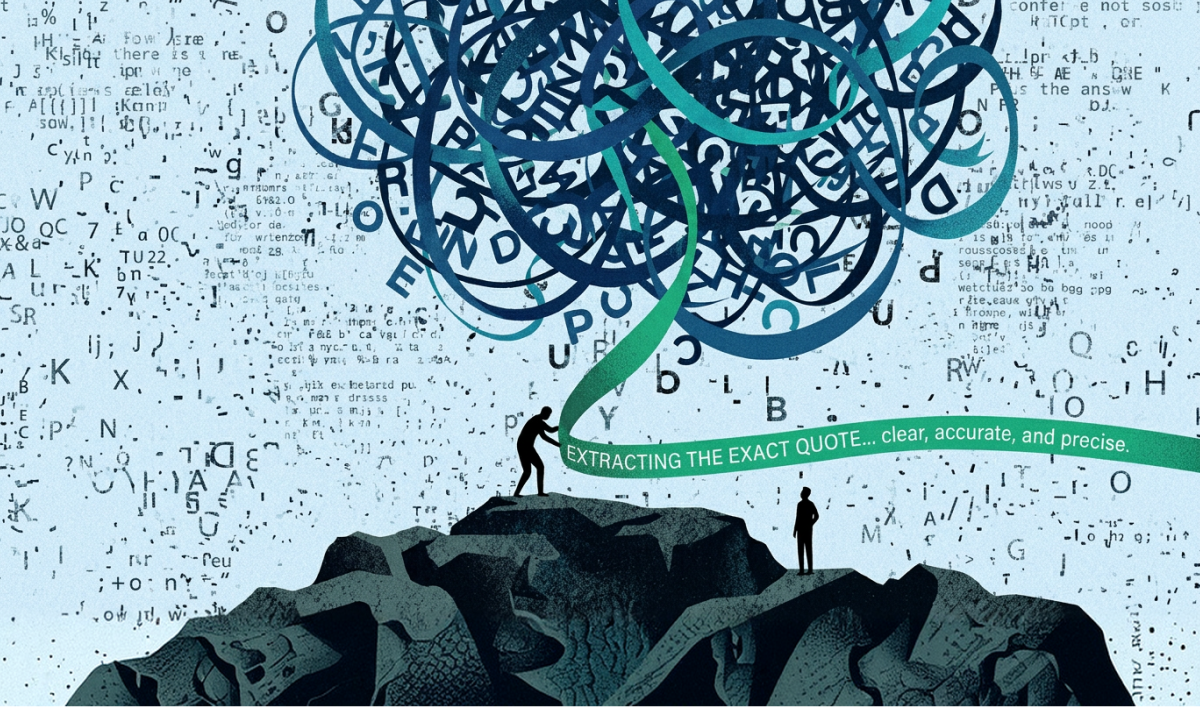
Conceptual illustration: a tiny person on a cliff pulls a straight green ribbon from a giant, chaotic tangle of blue letters. The ribbon reads "EXTRACTING THE EXACT QUOTE... clear, accurate, and precise." A visual metaphor for extracting clarity from messy data.
4. How to quote without losing the meaning
An example (hypothetical). The question: “Why did you stop buying coffee at this place?”
“I used to get it here all the time. Well, the coffee’s fine, the price too. But lately the queue is so long that I just can’t make it. Especially in the morning.”
Construction 1: a clarification in brackets. For when the text contains an unclear word (“this”, “it”) and you need to explain quickly:
“Lately the queue [for coffee] is so long that I just can’t make it.”
Construction 2: an omission, marked. For when you need the words exactly as spoken: an archive, a handover to a colleague, input for AI analysis:
“I used to get it here all the time. […] But lately the queue is so long that I just can’t make it.”
You may cut only what does not change the meaning [Lingard, 2019]. Here “Well, the coffee’s fine, the price too” has been removed. If it matters for the request that the problem is not the taste or the price, these words must stay.
Construction 3: a quote inside the author’s sentence. For when space is short: a conclusion, a slide title.
The respondent stopped buying coffee because it takes more time than she can spare: “I just can’t make it.”
These constructions can be combined, depending on the task: for example, an omission […] together with brackets, or a quote inside a sentence together with a clarification in brackets.
How much context is enough
There is enough context when a person who was not at the interview can answer five questions without opening the transcript:
1. What question is this the answer to?
2. What exactly is being referred to (“this”, “they”, “so”)?
3. Which situation or period is it about?
4. Is it one person’s view or a pattern?
5. Which part is the respondent’s words, and which is our interpretation?
In the coffee example: the question is “Why did you stop buying coffee?”; “the queue” is the queue for coffee; the period is “lately”; whether it is a pattern or one person has to be marked; the respondent’s words are “I just can’t make it”, and the interpretation is “the problem is not the coffee but the time”.
There is a flip side: add the context that changes the meaning or the weight of a quote, not the context that merely decorates it. That is, if the answers to the five questions do not change without a given sentence, that sentence is unnecessary.
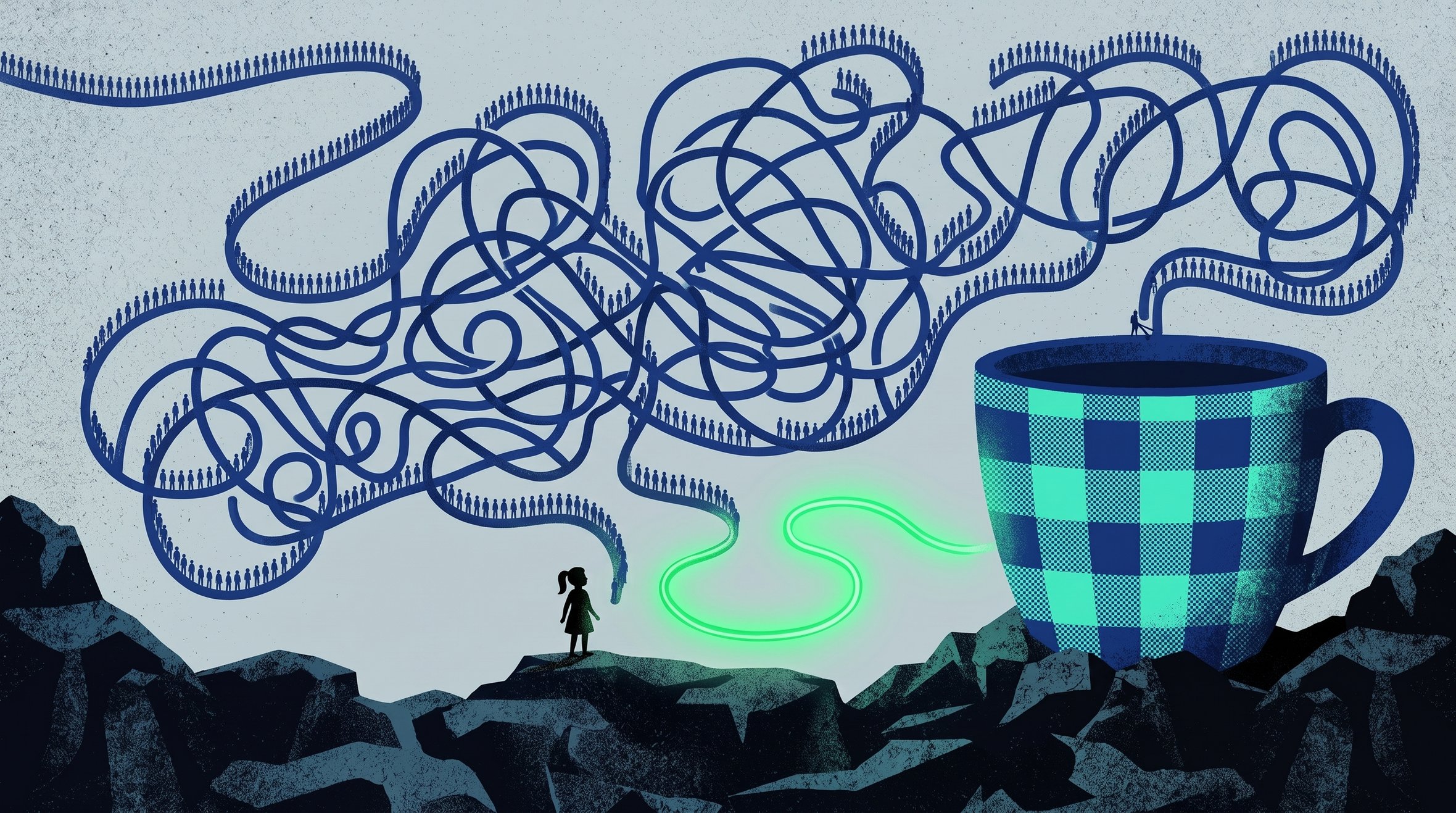
Conceptual illustration: a tiny girl on dark rocks faces a giant plaid coffee cup. A chaotic, infinitely tangled queue of tiny people fills the sky above a glowing green path.
5. What context gives to decisions
For decisions on business tasks, this is critical. The right context:
• protects against a wrong decision: one remark does not become a reason to change a product in a way nobody asked for;
• separates fact from interpretation;
• cuts off cherry-picking: you can see whether it is a pattern or a conveniently chosen phrase;
• shows the reasons, not only the complaint.
A chain worth keeping in front of you:
context → task → quote → clarification → interpretation → meaning for the decision
Context does not mean showing 40 pages of transcript in the report. It means making the path from words to decision transparent, and leaving a way back to the original source.
Conclusion
Every quote in a report is someone’s choice. Out of dozens of pages of transcript, the researcher decides what to keep, and it is this choice that is later taken for the voice of the customer.
The first filter is the goal of the research. Even the most striking insight, if it does not answer that goal, will not help anyone make a decision; it will only distract.
The second is who and what you are writing the quote for, and who will work with it next: a report, a slide, notes to your future self, AI analysis, an archive, or a business decision. This determines which construction to choose, how much context to add, and whether a conclusion is needed alongside it.
There is one more layer. The client often does not expect context: to them it is “too much text, let’s get to the point”. What they want is a short “magic” phrase that holds the answers to every question. I am not calling for long reads in a report. But what matters is not only what the respondent said, but what they meant, and which part of it matters for the goals of the research. Convey the thought so that the quote cannot be read in two ways.
A quote is the best tool we have for conveying a respondent’s voice honestly and vividly. But it rarely speaks for itself, simply because we humans do not form our thoughts as beautiful slogans. It speaks exactly as much as the context you leave beside it.
