
How Can You Tell Whether Brand Voice Rules Work in Real Content?

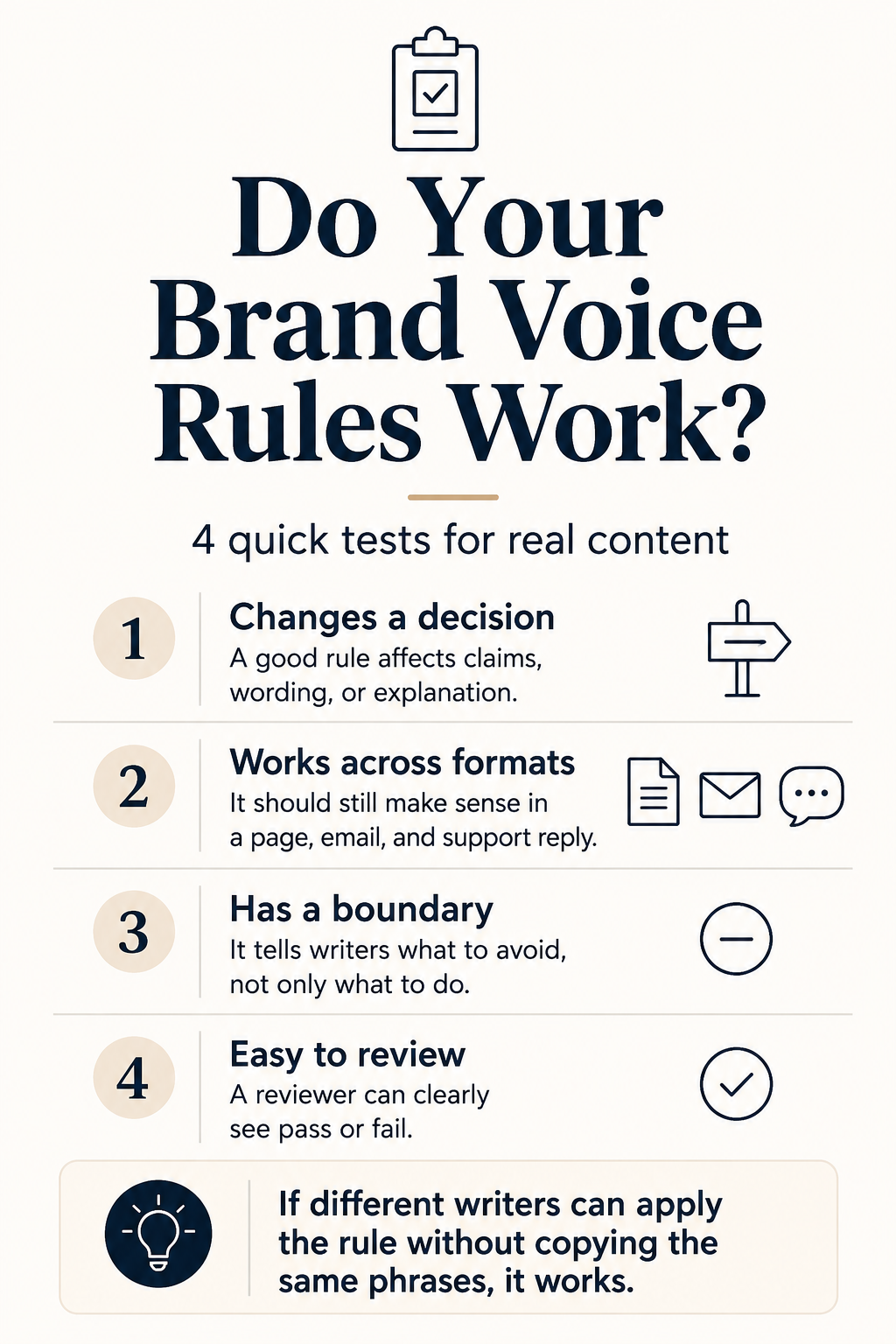
Brand voice rules work when they help different writers make similar communication decisions without forcing them to copy the same phrases. A useful rule should change what someone writes: how confident a claim is, which words feel appropriate, how much explanation is needed, or how directly the reader is asked to act. If a rule sounds good in a brand document but does not influence a real draft, it is probably too vague to be useful.
That distinction becomes easier to see when tone of voice is treated as a repeatable way of communicating rather than a list of adjectives. For broader context on what tone of voice actually means in marketing, see:
https://seolabsdp.blogspot.com/2026/04/what-is-tone-of-voice-in-marketing-with.html
A Good Voice Rule Changes a Writing Decision
Many brand guidelines contain statements such as “be confident”, “sound friendly” or “keep the tone professional”. These ideas may describe the intended direction, but they do not tell a writer what to do when a sentence is in front of them.
Take the instruction:
Be confident and friendly.
One writer may interpret that as energetic sales language. Another may add conversational phrases. A third may simply remove formal wording. All three can honestly say they followed the rule, even if the resulting content sounds unrelated.
A usable rule needs a visible consequence. Instead of one broad instruction, the team could turn it into three decisions:
- Confidence: make specific claims, but avoid absolute promises that the evidence cannot support.
- Friendliness: explain what the reader can do next without sounding patronising or overly casual.
- Clarity: prefer familiar words and explain necessary technical terms before using them as shorthand.
These rules are easier to test because a reviewer can point to the sentence and ask whether the decision was followed.
Use Four Tests Before Calling a Rule Practical
A voice rule should pass more than a “does this sound right?” check. Four simple tests are usually enough to reveal whether the rule can survive real content production.
1. Can two writers apply it independently?
If the rule only works when the person who created it explains what they meant, it is not yet operational.
2. Does it affect more than one content format?
A useful voice principle should still make sense in a landing page, email or support message, even though the writing style changes.
3. Does it include a boundary?
“Be confident” becomes safer when the rule also explains what confidence should not become, such as exaggeration, false certainty or pressure.
4. Can a reviewer identify a clear pass or fail?
If every draft can be defended as technically compliant, the rule is too subjective to support consistent editing.
The goal is not to eliminate judgement. It is to reduce the amount of guesswork required every time someone writes.
Test the Same Rules Across Three Content Formats
Imagine a software company has adopted the three rules above: specific confidence, helpful friendliness and plain-language clarity. The team can test whether those rules work by applying them to different formats.
FormatWeak versionVoice-aware versionLanding page“The ultimate platform that transforms your workflow instantly.”“Plan projects, assign work and track progress without adding another complicated process.”Email“Don’t miss out — upgrade today!”“If your current plan is limiting the way your team works, the next tier adds reporting and automation.”Support“Your request has been logged. Please await further communication.”“We’ve received your report and are checking the issue. We’ll update you in the same thread when we know what caused it.”The voice-aware versions are not written in the same style. The landing page is concise, the email is commercial, and the support message is reassuring and procedural. What stays consistent is the decision logic: realistic confidence, useful explanation and respect for the reader.
That is the real test of a brand voice rule. It should create recognisable behaviour across different situations without turning every piece of content into the same template.
For more examples of how tone of voice appears in real marketing content, continue with:
https://seolabsdp.blogspot.com/2026/04/how-tone-of-voice-works-in-real.html
Watch for Rules That Only Work in Ideal Conditions
Some guidelines look practical when a senior editor is reviewing every sentence but collapse when content production speeds up. Writers start interpreting adjectives differently, shortcuts replace examples, and reviewers fall back on personal preference.
This usually means the rule is dependent on experience rather than clearly documented decisions. A stronger system gives writers enough information to act before the review stage.
For each important rule, add:
- one positive instruction;
- one boundary explaining what to avoid;
- one short example;
- one contrasting example when confusion is likely;
- one review question that can be applied to a real draft.
For example, “sound expert” is difficult to use. “Explain the reason behind recommendations, use specific terminology where it helps, and do not use complexity to signal authority” gives the writer much more to work with.
Final Takeaway
Brand voice rules are useful only when they survive contact with real content. They should help writers make repeatable decisions across different formats, while still allowing natural variation in sentence structure, rhythm and detail.
The easiest test is practical: take one rule, give it to more than one writer, apply it to several content types and compare the decisions they make. If the rule produces recognisable choices without requiring everyone to copy the same wording, it is doing its job. If it still depends on explanation, intuition or personal taste, the rule needs another round of refinement.


