


Most property searches now begin online. Buyers, sellers, landlords, and investors use search engines to compare local estate agents, explore neighbourhoods, research property prices, and find answers before contacting a professional.
Having a real estate website, however, does not guarantee that potential clients will find it. Your pages must compete with property portals, established agencies, local publications, and other businesses targeting the same locations.
Real estate link building is the process of earning relevant backlinks from property websites, local media, business organisations, industry publications, and other trusted online sources. These links can help search engines discover your pages, strengthen your website’s authority, generate referral traffic, and improve the visibility of your services and location-specific content.
This guide explains how estate agents, property companies, developers, and real estate marketers can build valuable backlinks through local partnerships, original research, guest contributions, digital PR, competitor analysis, and linkable content.
Why Is Link Building a Must-Have for Your Real Estate Venture?

Link building can support real estate SEO by helping search engines discover important pages and understand how other websites reference your business, expertise, and content. It can also introduce your brand to people who are already reading local, property-related, or financial resources.
Improve Search Visibility
Relevant backlinks can strengthen the authority of service pages, location pages, property guides, and market reports. Links alone do not guarantee higher rankings, but they can support visibility when combined with useful content, sound technical SEO, and clear relevance to the search query.
Generate Relevant Referral Traffic
A well-placed link can bring potential buyers, sellers, landlords, or investors directly to your website. For example, a link from a local newspaper, neighbourhood guide, mortgage broker, or property publication may send visitors who are already interested in your market or services.
Build Authority and Trust
Editorial mentions from credible local and industry sources can reinforce your reputation as a knowledgeable real estate professional. This is especially valuable when the linking page cites your original research, local market data, practical guide, or expert commentary.
The objective is not to collect as many links as possible. A smaller number of relevant, trustworthy links can be more valuable than numerous placements on unrelated or low-quality websites.
Top Strategies of Real Estate Link Building
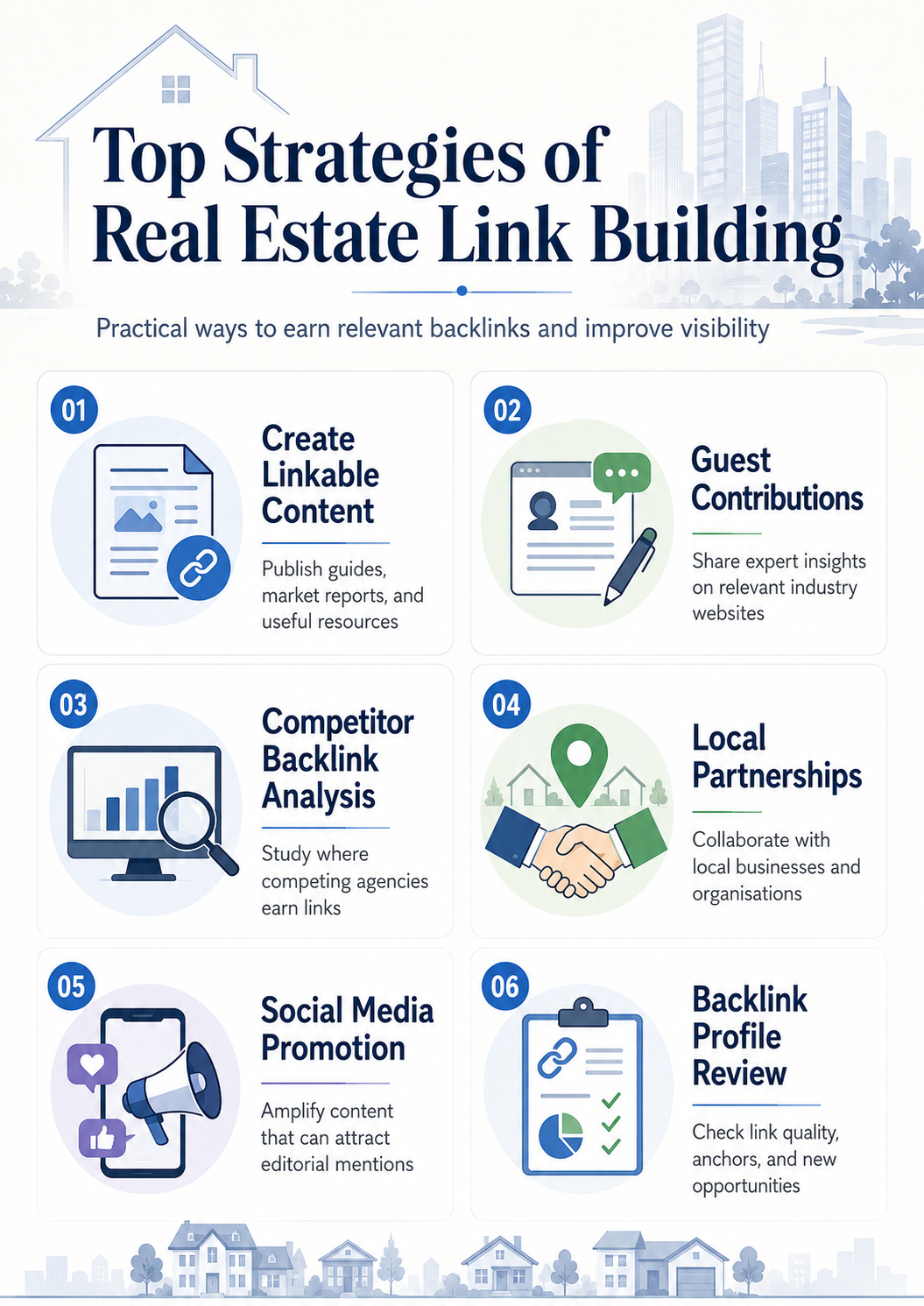
Link building in real estate serves as the digital neighborhood's 'curb appeal.'
Employing effective strategies can transform your website into the online equivalent of a prime piece of real estate.
Eager to elevate your online presence in real estate? Let's dive in!
1. Content Strategies
1. Create Linkable Real Estate Content
Publishing content is not enough to attract backlinks. Property photographs, listing descriptions, and virtual tours may support sales, but other websites rarely cite them unless they provide unique information or broader value.
Linkable content gives journalists, local organisations, property professionals, and bloggers a clear reason to reference your website. The strongest assets usually contain original data, useful tools, detailed local information, or practical resources that are difficult to find elsewhere.
a. Publish Original Property Market Research
Real estate businesses often have access to local information that can be turned into valuable research. Analyse your own listings, enquiries, transactions, or publicly available datasets to identify trends that local publications and industry websites may want to cite.
Potential research topics include:
average property prices by neighbourhood;
areas with the fastest price growth;
average time required to sell a property;
changes in buyer or tenant demand;
the most requested property features;
rental yields by postcode or district;
differences between asking and final sale prices.
Present the findings with clear charts, tables, definitions, and an explanation of the methodology. A journalist is more likely to reference the research when the data is transparent, current, and easy to verify.
b. Create Detailed Local Area Guides
A useful neighbourhood guide should provide more than a short description and a list of current properties. It should help buyers, tenants, investors, or people relocating to understand what living in the area is actually like.
A comprehensive guide may cover:
typical property types and price ranges;
transport connections and commuting options;
schools, healthcare, shops, and local services;
parks, leisure facilities, and community spaces;
planned developments and infrastructure projects;
rental demand and investment considerations;
practical advantages and limitations of the location.
Local publications, employers, relocation services, universities, and community websites may link to a guide when it offers reliable information for their audiences. Review these pages regularly so that prices, transport details, and local facilities remain accurate.
c. Build Useful Property Tools and Templates
Interactive tools and downloadable resources can attract backlinks because they help users complete a specific task.
Examples include:
mortgage affordability calculators;
rental yield calculators;
moving cost estimators;
property viewing checklists;
home-selling preparation checklists;
landlord compliance checklists;
renovation budget templates;
questions to ask an estate agent;
first-time buyer timelines.
Each resource should have its own indexable page with clear instructions, supporting explanations, and examples. Avoid publishing a calculator or downloadable file without enough context for users and search engines to understand its purpose.
d. Produce Visual Assets That Explain Real Estate Data
Infographics, maps, charts, and visual comparisons can make complex property information easier to understand and share. However, the visual should be based on useful information rather than created only for decoration.
Strong visual assets may include:
property price maps;
rent-versus-buy comparisons;
neighbourhood affordability charts;
home-buying process diagrams;
property market trend timelines;
comparisons of property types;
visual explanations of common fees and costs.
Publish the visual on a supporting page that includes the underlying data, methodology, explanatory text, and a clearly labelled image that other publishers can reference.
e. Update and Promote the Asset
Even a strong resource may not attract links without promotion. After publication, identify journalists, local organisations, bloggers, and businesses whose audiences would benefit from it.
Your outreach should explain:
what the resource contains;
what makes the information new or useful;
why it is relevant to the recipient’s audience;
where the data came from;
how the recipient may use or reference it.
Continue updating successful assets as new data becomes available. An annually refreshed market report or local guide can earn links over a longer period than a one-off article that quickly becomes outdated.
2. Guest Posting Strategies
Contribute Expert Content to Relevant Publications
Guest contributions can help real estate professionals reach new audiences, demonstrate expertise, and earn relevant editorial mentions. However, publishing articles on unrelated websites solely to obtain backlinks is unlikely to create lasting value.
Focus on publications whose readers genuinely overlap with your target audience. These may include property websites, local business publications, financial blogs, relocation resources, architecture platforms, landlord associations, and regional news websites.
a. Choose Publications Based on Relevance
Do not evaluate a website using only a third-party authority metric. Before proposing an article, review:
the subjects it regularly covers;
the location and interests of its audience;
the quality of existing articles;
whether real readers engage with the content;
its estimated organic visibility;
how frequently it publishes sponsored or guest articles;
whether links are placed naturally within useful editorial content.
A smaller local publication may be more valuable to an estate agency than a larger international website with no connection to its market.
b. Offer a Specific Article Idea
Avoid broad pitches such as “I would like to write about real estate”. Propose a clearly defined subject that fits the publication and gives its readers useful information.
Strong ideas may include:
what first-time buyers misunderstand about a local market;
how infrastructure projects may affect nearby property demand;
what landlords should check before purchasing in a particular area;
how buyers can compare similar neighbourhoods;
what recent transaction data reveals about local demand;
how energy efficiency affects property decisions;
common mistakes sellers make before listing a home.
Review the publication’s recent content before pitching. Your proposal should add a missing perspective rather than repeat an article it has already published.
c. Demonstrate First-Hand Expertise
A useful contribution should contain information that a general writer could not easily reproduce. Include practical observations, anonymised examples, original data, local experience, or commentary from qualified professionals.
For example, instead of writing another general article about preparing a home for sale, explain which preparation mistakes repeatedly delay transactions in your market and why.
This strengthens the article for readers and gives the publisher a genuine editorial reason to mention your business or link to a supporting resource.
d. Link Only Where It Helps the Reader
A backlink should lead to a page that expands on a point in the article. Suitable destinations may include:
an original market report;
a detailed neighbourhood guide;
a calculator or template;
a relevant research page;
a comprehensive educational resource.
Avoid forcing links to a homepage, sales page, or unrelated property listing. The anchor text should describe the destination naturally rather than repeat the same commercial keyword across multiple publications.
When a contribution or link is paid for, the arrangement should be transparent and the link should use the appropriate sponsored or nofollow attribute.
e. Build Ongoing Editorial Relationships
Treat publication outreach as relationship building rather than a one-off transaction. Deliver accurate work, follow editorial requirements, respond promptly, and avoid sending the same article to multiple publishers.
A strong relationship may later lead to:
expert commentary requests;
recurring columns;
inclusion in market round-ups;
interviews;
citations in news coverage;
opportunities to contribute original data.
These editorial mentions are often more valuable than repeatedly placing generic guest articles on low-quality websites.
3. Use Digital PR to Earn Real Estate Backlinks
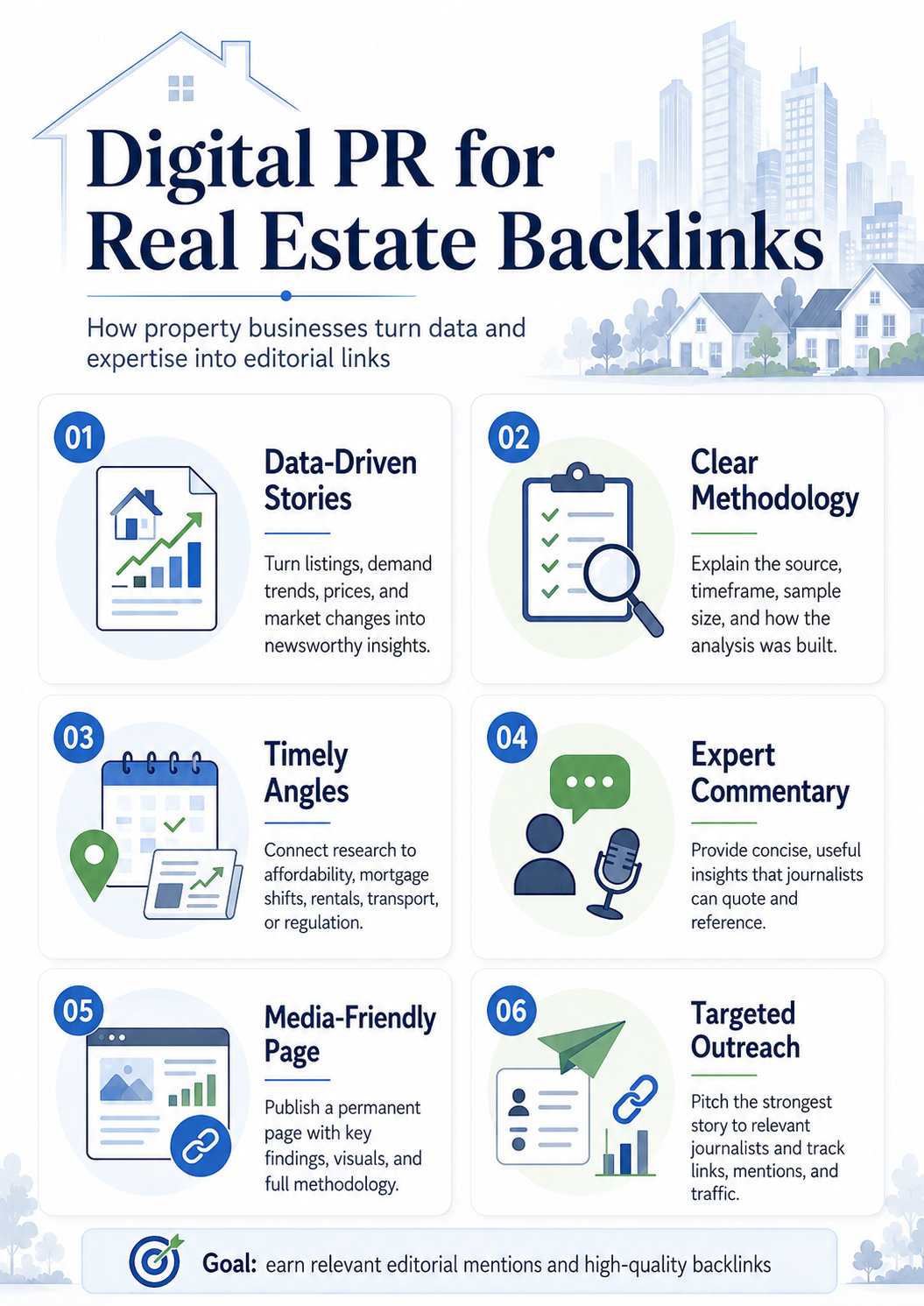
Digital PR helps real estate businesses turn market knowledge, internal data, expert commentary, and original research into stories that journalists and publishers may want to cover.
Unlike routine guest posting, digital PR does not begin with a request to publish an article. It begins with information that has genuine news value. When a publication uses your findings or commentary, it may mention your company and link to the original source.
a. Turn Property Data Into Newsworthy Stories
Estate agents, property managers, developers, and property platforms may already hold data that can support an original story.
Useful data may include:
- changes in buyer or tenant enquiries;
- average time required to sell or let a property;
- the most frequently requested property features;
- neighbourhoods attracting growing interest;
- changes in asking prices or rental prices;
- differences between property types;
- seasonal changes in market activity;
- locations attracting first-time buyers, families, or investors.
Do not publish a spreadsheet of figures without interpretation. Identify the most significant finding, explain why it matters, and place it within the wider property market.
For example, “Average rental prices increased” is too broad. A stronger angle would identify where the largest change occurred, which property types were affected, and what may have contributed to the trend.
b. Create a Clear and Verifiable Methodology
Journalists need to understand how your conclusions were reached. Every data-led campaign should explain:
- the source of the data;
- the period covered;
- the number of listings, transactions, or locations analysed;
- how areas or properties were compared;
- whether any categories were excluded;
- when the data was last updated;
- the limitations of the analysis.
Publish the full methodology on the page containing the research. This makes the findings easier to verify and gives publishers a reliable source to reference.
Avoid presenting a small or unrepresentative dataset as proof of a nationwide trend.
c. Connect the Research to a Timely Story
Data becomes more useful to publishers when it relates to something their audiences are already discussing.
Possible angles include:
- housing affordability;
- mortgage rate changes;
- rental supply;
- remote working and relocation;
- transport and infrastructure projects;
- energy efficiency;
- new property regulations;
- university terms and student housing;
- seasonal buying or selling patterns;
- regeneration and new development.
A local estate agency, for example, could analyse how a planned transport connection is influencing buyer enquiries in nearby neighbourhoods. A property management company could examine changes in landlord priorities following new regulation.
The connection should be relevant and evidence-based rather than forced onto an unrelated news event.
d. Offer Expert Commentary to Journalists
Original research is not the only way to earn editorial mentions. Real estate professionals can also provide clear, useful commentary on current property stories.
Good commentary should:
- answer the journalist’s question directly;
- explain what the development means in practical terms;
- avoid excessive self-promotion;
- use plain language;
- include a specific local or professional insight;
- remain within the expert’s genuine area of experience.
A useful comment might explain how a change in mortgage costs affects the behaviour of first-time buyers in a particular market. A weak comment simply repeats that market conditions are changing.
Prepare short biographies for relevant experts within the business. Include their role, experience, location, and specialist subjects so journalists can quickly determine whether they are suitable sources.
e. Develop Strong Seasonal Campaigns
Real estate offers many recurring opportunities for data-led campaigns.
Examples include:
- the most affordable areas for first-time buyers;
- neighbourhoods with the shortest commuting times;
- locations offering the highest rental yields;
- the property features buyers value most;
- the best-connected areas for remote and hybrid workers;
- where homes sell fastest;
- areas with the largest increase in rental demand;
- how energy efficiency relates to property prices;
- the most searched-for neighbourhoods during different seasons.
Seasonal relevance can improve the timing of outreach, but the idea must still offer original information. Avoid reproducing rankings that already exist unless your dataset, methodology, or geographic focus provides a genuinely different perspective.
f. Prepare a Media-Friendly Research Page
The campaign should lead to a permanent page on your website rather than only a press release hosted elsewhere.
The research page should include:
- a clear headline describing the main finding;
- a concise summary of the results;
- key statistics near the top;
- charts, maps, or tables;
- regional or category-level findings;
- expert interpretation;
- the full methodology;
- the publication date and latest update;
- downloadable images or data where appropriate;
- contact details for press enquiries.
This page becomes the primary source that journalists can cite and link to. It can also continue attracting backlinks after the initial outreach campaign ends.
g. Personalise Media Outreach
Do not send the same generic message to hundreds of publications. Build a focused list of journalists and editors who regularly cover property, housing, personal finance, business, or the relevant local area.
A concise pitch should explain:
- the strongest finding;
- why it is relevant now;
- why it suits that journalist’s audience;
- where the complete data and methodology can be found;
- whether expert commentary or regional figures are available.
Lead with the story rather than the request for a backlink. Editorial links are more likely when the research is genuinely useful and the source page makes it easy for the journalist to verify the information.
h. Measure More Than the Number of Links
A successful digital PR campaign should not be assessed only by the total number of backlinks.
Track:
- relevant referring domains;
- editorial mentions;
- links from local and industry publications;
- referral traffic;
- branded searches;
- organic visibility of the research page;
- journalist relationships created;
- enquiries or conversions influenced by the coverage;
- links and mentions that remain live over time.
A campaign with several highly relevant editorial mentions may be more valuable than one that produces dozens of links from websites with little connection to property or the target location.
4. Analyze Your Competitors’ Strategies
Scouting the field is often as vital as executing your strategies.
Gleaning wisdom from the strategies of fellow real estate professionals can provide invaluable perspectives, potentially shifting the balance to your advantage.
Eager to secure a competitive edge? Let's plot our course!
a. Analyzing the Backlink Landscape
Consider backlinks as pathways that lead to a destination.
Envision having a map to all the pathways leading to your rivals' domains!
This is precisely the advantage provided by Backlink Portfolio Analysis.
Utilize Link Analysis Tools: Tools such as Ahrefs or SEMrush can unveil the origins of your competitors' backlinks.
Focus on Quality: Scrutinize the quality and relevance of the sites that link back to your competition.
Monitor Backlink Acquisition: Keep an eye on the pace at which competitors secure new backlinks.
Assess Link Variety: Ensure to check whether they are receiving backlinks from a diverse array of sources.
b. Uniformity in Local Listings
Having a uniform local presence is akin to having well-placed signposts that guide clients directly to you. In the digital realm, this role is played by local listings.
Maintaining accurate information across these platforms is key.
Check Directory Consistency: Verify that your competitors' information remains consistent across all local directories.
Observe Review Engagement: Pay attention to how competitors interact with reviews.
Ensure Citation Uniformity: Check for consistency in how their business details are presented across the internet.
5. Local Link Building
Envision infusing your online identity with the vibrant hues of the local scene, making you a recognizable entity in the digital community.
Through the cultivation of local links, you're seamlessly integrating into the tapestry of the community.
a. Forge Partnerships with Local Entities
Consider local entities as your community compatriots.
Cultivating ties with them is more than socializing; it's about creating a supportive network of local champions and directing premium links to your online presence.
Mutual Ventures: Initiate collaborations with local businesses for shared promotions or community events.
Community Sponsorship: Contribute to local causes or events to enhance your profile within the community.
Collaborative Content Creation: Produce articles or videos together that explore local developments or trends.
b. Utilize Local Directories for Visibility
Imagine local directories as eye-catching billboards, leading prospects directly to you.
Maintaining your presence in these directories effectively plants your flag across the digital landscape's various corners.
Secure Your Presence: Verify that your business is featured in leading local directories.
Detail Consistency: Ensure your business details are uniform and regularly updated across platforms.
Proactive Interaction: Engage with feedback or queries to uphold an active and dependable presence.
6. Social Media Link Building
Social media channels are crucial battlegrounds for link building in the contemporary digital landscape.
Creating links on these platforms enables you to engage with a broad audience, nurture connections, and amplify your digital footprint.
Let's develop real estate backlinks via social media platforms.
a. Creating Engaging Content
The power of shareable content on social media cannot be overstated.
It's akin to designing a property so mesmerizing that it compels everyone to stop, capture, and share it within their networks.
Striking Visuals: Employ standout property photos or vibrant infographics that demand attention.
Insightful Advice: Distribute concise, valuable tips on everything from interior design to investment strategies.
Dynamic Interactions: Conduct real estate-themed polls, quizzes, or Q&A sessions to engage your audience.
Community Spotlights: Feature local events or iconic spots to connect with regional pride.
b. Partnerships with Influencers
Teaming up with influencers is a savvy digital strategy.
Their recommendations can serve as widespread invitations to their followers, similar to an open house.
Choose Compatible Influencers: Look for personalities that align with the real estate, home décor, or lifestyle sectors.
Exclusive Property Showcases: Offer influencers a first look at properties, generating content their followers will adore.
Social Media Takeovers: Allow them to curate your social channels for a day, introducing new angles.
Collaborative Promotions: Execute joint contests or giveaways to merge audiences effectively.
c. Utilizing Instagram Stories
Have you ever teased a property viewing on Instagram Stories?
It's a fleeting yet impactful highlight that captures immediate interest.
And with Highlights, your standout moments receive the forefront they merit.
Reveal the Process: Share sneak peeks of open houses, renovations, or daily routines in the real estate world.
Highlight New Offerings: Preview upcoming listings on Stories to build excitement.
Interactive Engagement: Utilize polls and questions to gauge preferences on home aesthetics or desired property features.
Organized Highlights: Arrange your most engaging Stories into categorized Highlights, such as ‘Client Praise’ or ‘Recently Sold’.
7. Evaluate Your Backlink Profile
Your backlink profile serves as a crucial indicator of your online credibility.
Delving into it can reveal your digital strengths and pinpoint opportunities for enhancement, setting the stage for a more robust online presence.
Are you prepared to scrutinize your digital persona?
a. Identify Questionable Links
Rooting out dubious links is crucial since these questionable ties can damage your site's standing and search engine optimization (SEO) performance.
Examine Link Origins: Employ tools such as Ahrefs or SEMrush to identify links from low-quality or unrelated websites.
Alert for Over-Optimized Anchor Texts: Stay vigilant of anchor texts that are unnaturally repetitive.
Watch for Sudden Backlink Increases: An abrupt rise in backlinks could indicate potential issues.
Use Google Search Console for Penalty Detection: Check for any penalties that might be related to undesirable backlinks.
b. Analyze Anchor Text Significance
Anchor texts act as directional markers on your digital journey, guiding both search engines and visitors towards what lies ahead.
If these markers are too similar or lead astray, it can lead to confusion.
Thus, scrutinizing anchor texts is vital to ensure your site's backlinks are varied and pertinent.
Ensure Anchor Text Variety: With tools like Ahrefs, verify that your backlinks include a balanced mix of branded, generic, and keyword-focused anchor texts.
Guard Against Anchor Overuse: An excessive focus on a single keyword as an anchor could appear forced.
Confirm Content Relevance: The content surrounding an anchor text should be related to your site.
Avoid Misleading Anchors: Anchor texts that don't reflect the linked content can be misleading.
c. Track Link Velocity
Consider link velocity as the growth rate of your digital property portfolio.
Just as the sudden appearance of a luxury estate might draw scrutiny, so too can an unexpected spike in backlinks.
Observing this velocity helps ensure your expansion is perceived as legitimate and credible.
Monitor Backlink Accumulation: With SEMrush, track how quickly you're gaining or losing backlinks.
Identify Sudden Growth Spurts: Rapid increases could hint at unsavory link-building practices or targeted SEO attacks.
Assess Link Quality Consistently: As your backlink volume grows, maintain a standard of quality.
Spot Trends in Link Sources: Recognize patterns in your backlinks' origins to refine your strategy as needed.
What Makes Quality Backlinks?
In our expansive digital community, backlinks serve as endorsements from your online neighbors.
Consider the difference in impact between a recommendation from a highly respected local figure versus an unknown passerby directing someone to your property.
This analogy illustrates why, in the digital realm, the quality of backlinks significantly outweighs their quantity.
Relevance:
Niche Compatibility: A backlink from a website related to real estate or home lifestyle holds more value than one from an unrelated field.
Target Audience: High-quality backlinks typically originate from websites whose audience would find genuine interest in your offerings.
Authority:
Domain Reputation: Websites recognized as authorities in their field or with high domain authority are more influential in their backlinking effect.
Source Trustworthiness: Links from reputable sources, such as well-known news platforms or educational institutions, enhance your site's credibility.
Link Placement:
Integration into Content: Links placed within the core content of a webpage are more impactful than those in sidebars or footers.
User Accessibility: Links that are easily visible and clickable by users are deemed to be of higher quality.
Anchor Text:
Clickable Guidance: This is the text that users click on in a link, serving as a directional cue.
Content Match: The anchor text should accurately reflect the content of the linked page.
Diversity: A natural variety in anchor texts contributes to a link's authenticity.
Descriptiveness: Anchor texts provide a sneak peek into the content of the linked page.
Grasping these elements of quality backlinks for real estate websites is crucial for developing a strong and reputable online presence, positioning your site as a key destination in the extensive online real estate landscape.
Conclusion
Embarking on a journey in the real estate sector is akin to setting off on an exhilarating quest for treasure. In this digital era, link building acts as our map, leading us to the ultimate reward: lucrative sales.
This exploration into link-building strategies reveals that it's not just about forming links but about forging meaningful connections.
Each backlink is a conduit to prospective clients, new ventures, and growing success.
As you navigate the complex world of online real estate, let these strategies guide your path.
Armed with the right connections and a strategic focus, the next major million-dollar deal could be just a click away in the digital expanse.
Platforms for Finding Real Estate Publication Opportunities
The following platforms can help you discover publishers, compare placement opportunities, and arrange sponsored content across real estate, business, local news, and related websites:
PRnewsIO https://prnews.io/sites?i=18039
Collaborator.pro https://collaborator.pro/?ref=bVEnob
PRposting https://prposting.com/ref/YG5EO7N6
Before choosing a publication, review its topical relevance, geographic audience, editorial quality, estimated organic visibility, and outbound link patterns. A placement should support your broader marketing strategy rather than exist solely to manipulate search rankings.
Affiliate disclosure: Some links in this section are affiliate links. If you make a purchase through one of them, I may receive a commission at no additional cost to you.


