
AI Hyperautomation Platform: TuplOS Launch, GTM Strategy and Multi-Vertical Expansion

product-market fit reached | ~$30M estimated revenue | offices in 3 countries
TUPL had spent years building an AI hyperautomation platform without ever selling it as one. Customers bought telecom solutions and never saw the engine behind them. We built a go-to-market (GTM) strategy to launch that engine as TuplOS, a product of its own, and to open the door to industries beyond telecom.
About TUPL
TUPL is an AI hyperautomation company founded in 2014. Its offices are in Bellevue (US), Málaga (Spain) and Tokyo (Japan). The company uses AI, machine learning and agentic frameworks to automate complex operations work. It first built this technology for Tier-1 telecom operators, still relying on it.
The problem: a strong engine that nobody could buy
TUPL had strong technology that big telecom operators already trusted. But there was a hidden problem: every product the company offered was a telecom-specific solution, and all of them ran on the same core engine. The engine itself, TuplOS, had no name, no product page and no market identity.
So buyers only ever met the finished solution. They had no way to know the same platform could power operations in other industries. TUPL was ignoring a whole layer of its own business.
Why the timing made it harder
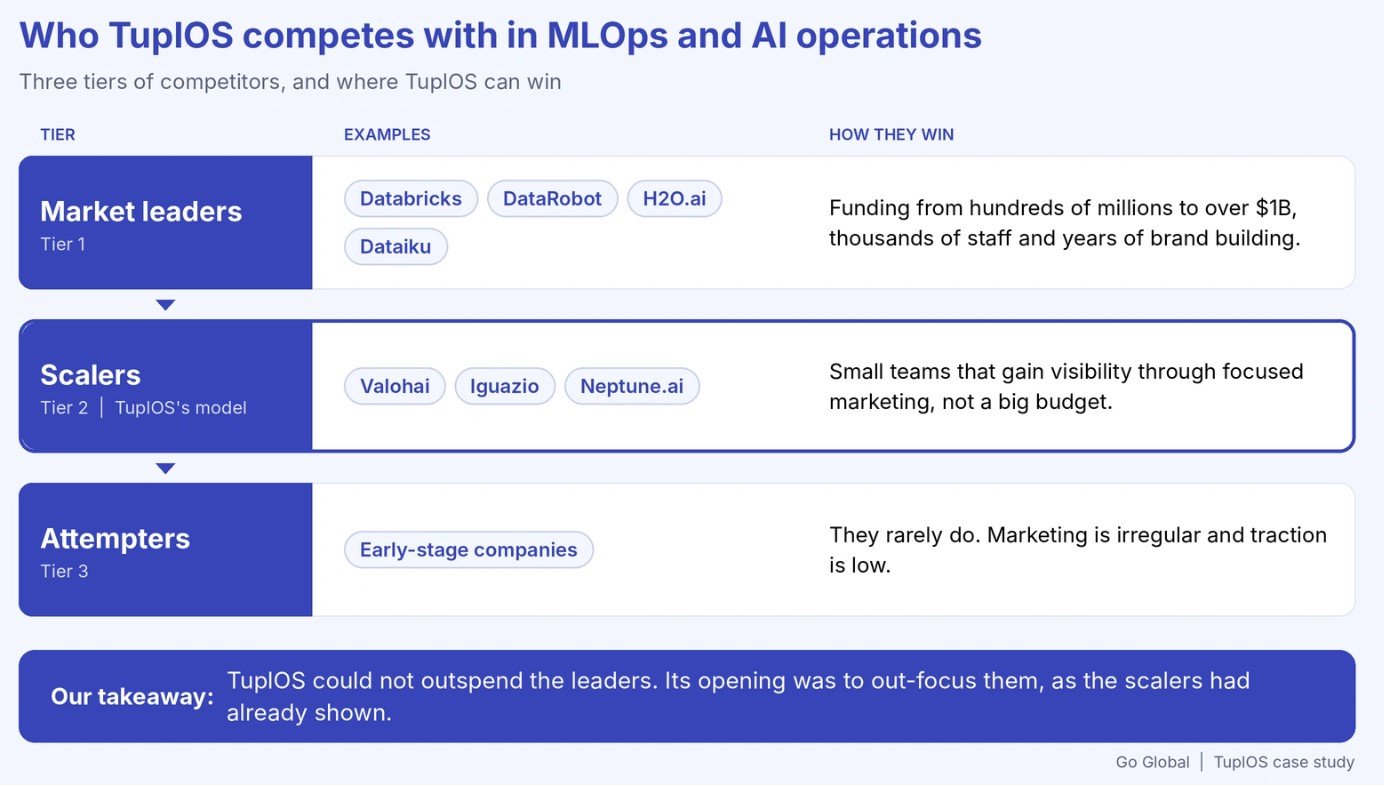
TuplOS would enter the MLOps and AI operations market, which was already full of strong players. We saw three levels of competition:
Before writing any marketing copy, we needed honest answers to these questions:
- What is TuplOS best at, compared with platforms that have far more money behind them?
- How many customers can TUPL serve well, especially if large enterprise buyers appear?
- Who should hear about the platform first: data scientists, developers, business analysts, business leaders or enterprise executives?
- Which industries should come after telecom?
How we built the GTM strategy for the TuplOS launch
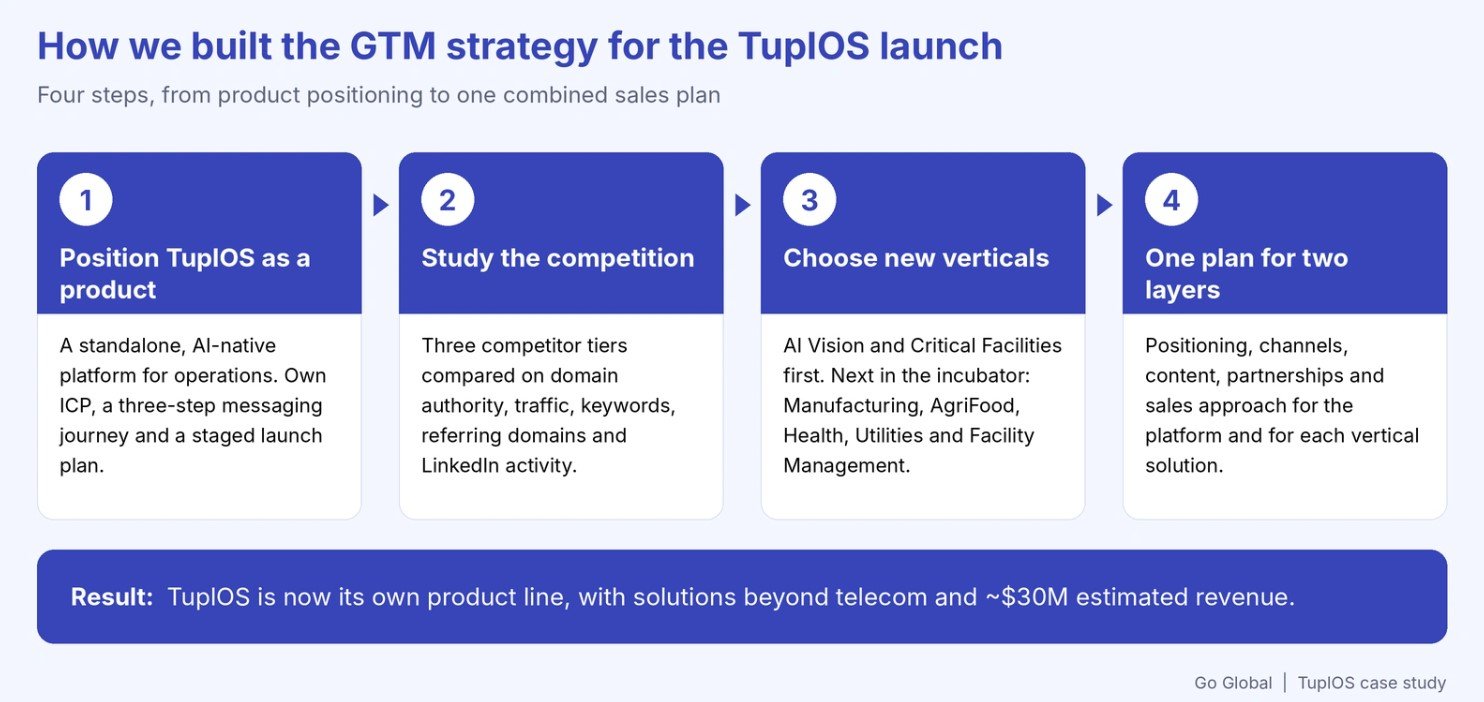
Step 1: Position TuplOS as a product, not a feature
We presented TuplOS as a horizontal, AI-native hyperautomation platform for operations. It is infrastructure that any company with heavy operational work can build on, whatever the industry.
The messaging follows a simple three-step journey: Connect & Transform, then Predict & Optimize, then Automate & Orchestrate. We also defined an ideal customer profile (ICP) for the platform that is separate from the ICP of the telecom solutions. Instead of one big launch day, we planned the go-to-market in stages.
Step 2: Study the competition with real numbersWe did not guess who TUPL was up against. We compared TuplOS with all three groups using domain authority, organic traffic, keyword rankings, referring domains, content frequency and social media activity. One clear pattern showed up on LinkedIn: market leaders post 15 to 20 times a week, while attempters post rarely or not at all.
The data showed that TuplOS should not try to outspend the leaders. Its best chance was to stay narrow and focused, the same way the scalers had won.
Step 3: Choose the next verticals beyond telecomOnce the platform story was clear, we looked for the industries where the technology could fit next. Two were ready to start right away: AI Vision (industrial visual inspection and operations AI) and Critical Facilities (automation for data centers and critical infrastructure). We also set up an incubator pipeline for later: Manufacturing, AgriFood, Health, Utilities and Facility Management.
Step 4: One marketing and sales plan for two layersTUPL now had to sell a platform and several industry solutions at once. We wrote one combined plan covering positioning, channels, content, partnerships and the sales approach. Each layer gets its own message, so the platform and the vertical solutions do not compete for the same story.
Results
- TuplOS now exists as a separate product line, with its own page, positioning and messaging.
- TUPL moved from telecom only to active solutions in AI Vision and Critical Facilities, plus an incubator program across 6 more verticals.
- The team grew 24% year over year, and estimated revenue is about $30M.
- The company runs offices in 3 countries (US, Spain, Japan) and takes part in global telecom events, including DTW25.
What this means for your business
If your company has a strong engine hidden behind a single product, you may have a second product line too. A clear platform story, a competitor map built on data and a staged launch can open new markets without needing a huge budget.
At Go Global, our mission is to help businesses reach their expansion goals. Book a free Strategy Session (Q&A) and we will go through where your business stands, what your priorities are and where growth is possible.

